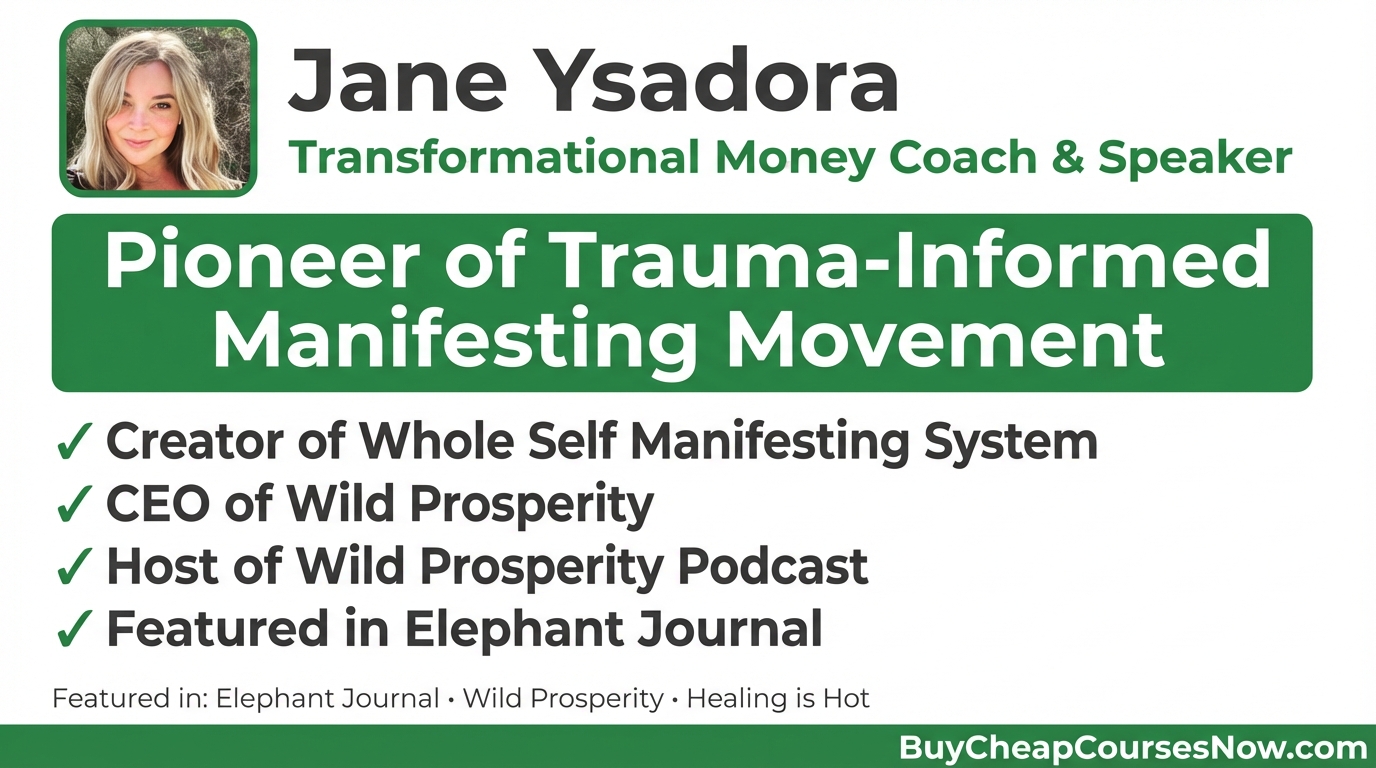
Abundance Academy 2025 Review (2026): Every Framework, Honest Limitations — Jane Ysadora
Abundance Academy 2025 is a $1,997 course by Jane Ysadora that teaches 8 frameworks for identifying and changing the nervous-system patterns underneath your financial behavior. It is worth it if you know what to do in your business but cannot make yourself break through the same income ceiling consistently. Skip it if your problem is tactical — if you need clients, marketing, or a revenue model — because this course will not give you any of that.
I have read every lesson of Abundance Academy 2025. I extracted every framework, mapped every module, and identified exactly what it covers and what it leaves out. The full framework-level breakdown is available on Course To Action. Here is the most complete, unsponsored summary you will find.
The short version: if you suspect your income ceiling is emotional rather than strategic — if you have done the business courses, implemented the tactics, and still hit the same invisible wall — this program is the most scientifically grounded and practically designed course in the nervous-system-and-money space. It is genuinely therapeutic. It is also genuinely demanding. And it will not teach you a single thing about marketing, pricing, or getting clients.
That distinction matters enormously. Keep reading.
The Course at a Glance
| Field | Details |
|---|---|
| Course | Abundance Academy 2025 |
| Creator | Jane Ysadora |
| Price | $1,997 |
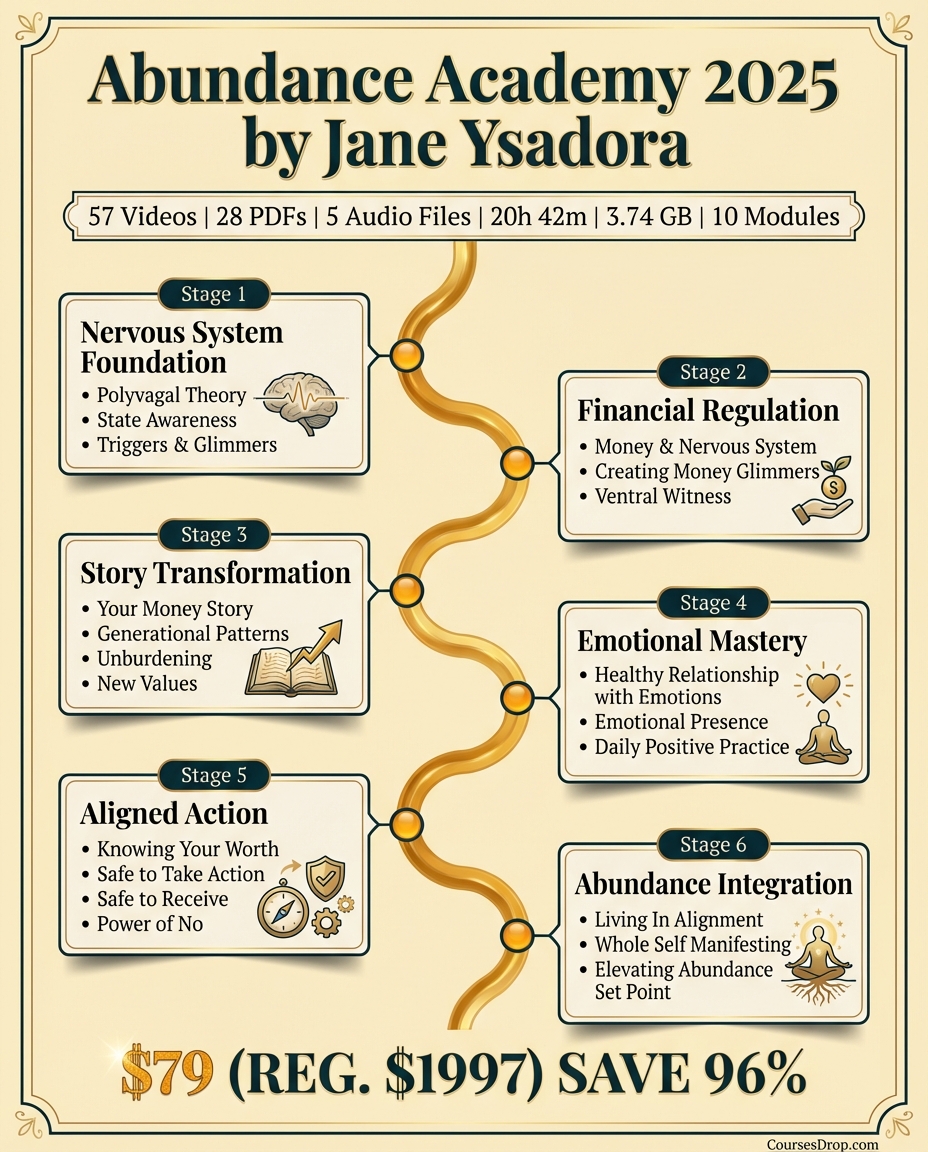
| Content | 10 modules / 49 lessons / 12.3 hours of video |
| Best For | Entrepreneurs and coaches who have hit a psychological income ceiling |
| Core Topic | Nervous system regulation applied to money, manifesting, and self-worth |
| Skip If | You need business strategy, marketing tactics, or revenue-generating frameworks |
| Rating | ★★★★☆ — Exceptional psychological depth; zero business strategy |
The Core Insight
Your financial ceiling is not set by your business strategy, your market positioning, or how hard you work.
It is set by whether your nervous system perceives money as safe.
The core insight is that this is the organizing principle behind all 49 lessons. Jane Ysadora builds her entire program on polyvagal theory — the neuroscience of Stephen Porges — and applies it with surgical precision to financial behavior. When your body is in a survival state (sympathetic fight/flight or dorsal shutdown), your prefrontal cortex goes offline. You cannot make clear money decisions. You cannot receive opportunities. You cannot sustain higher income. The hustle does not help because the problem is not a strategy problem. The problem is a nervous system problem.
The path to abundance, according to this course, is not better affirmations or tighter offers. It is teaching your nervous system, through daily somatic practice, that having money is safe, receiving is safe, and taking action is safe. Once your nervous system upgrades its "neuroception" of money from threat to safety, abundance behaviors stop feeling like a grind and start feeling automatic.
That is a genuinely paradigm-shifting idea. The course delivers on it.
The Frameworks: The 20% That Delivers 80% of the Value
Not cliff notes. Full deconstructions. Here are the eight core frameworks Jane Ysadora teaches — and how each one builds on the last.
1. The Polyvagal Ladder (Three States + Blended States)
The Polyvagal Ladder is Jane Ysadora's visual framework for mapping the three autonomic nervous system states — ventral vagal (safe, connected, creative), sympathetic (fight/flight, mobilized), and dorsal vagal (shutdown, collapsed) — onto observable financial behaviors. The steps of the model move sequentially: you cannot skip from dorsal collapse to ventral calm without passing through sympathetic first.
This is the theoretical spine of the entire program. The crucial financial application is the mapping: sympathetic creates overspending and strategy-hopping, dorsal creates under-earning and financial avoidance, and only ventral enables the clear money decisions and consistent income growth you are after. Jane also teaches four blended states — freeze, fawn, stillness, and play — two protective, two productive. Module 1 covers this in under eight minutes. It is the single lesson that makes every subsequent module click into place.
2. The Financial Working Model
Drawn from John Bowlby's attachment theory, this framework maps the unconscious money blueprint you inherited — direct messages, observed behavior, and multi-generational patterns — and uses the insight that negativity bias distorts your money story ten-to-one toward scarcity, requiring you to deliberately reconstruct the positive half of your financial history.
3. The Emotional Presence Meditation
The course's signature daily practice: breathe into whatever emotion is present with loving awareness — without engaging the story — developing the critical skill of being with a feeling rather than in it, which is the core distinction between emotional processing and emotional cycling.
4. The With It / In It / Taken Out Scale
A 3-level self-assessment for emotional regulation state before any financial work, built around the foundational safety rule: when "In It" or "Taken Out," regulate first — do not do parts work — because healing requires a present internal witness, and skipping this step is what makes money work feel retraumatizing.
5. The Financial Set Point Model
Jane Ysadora's framework for the unconscious income baseline your nervous system treats as safe — when income rises above it, self-sabotage follows automatically — and a somatic method for consciously raising it using a "stretch and a yes" body cue rather than an aspirational number.
6. The Four Money Attachment Styles
Applies Diane Poole Heller's attachment research to financial behavior across four types — Secure, Anxious, Avoidant, and Disorganized — with the counterintuitive central insight that money is already a secure attacher, so healing is about flooding the relationship with positive experiences rather than excavating wounds.
7. The Alignment Emotions vs Block Emotions System
Each person has approximately two core alignment emotions and two core block emotions; the practice builds if-then plans to generate alignment states instead of defaulting to coping behaviors (scrolling, avoidance, impulse spending), reducing block emotions in duration and intensity through intentional replacement, not suppression.
8. The 5-Day Whole Self Manifesting Process
The capstone framework integrates all prior nervous system work into a daily manifesting sequence — notably including Day 3, the most original step, which requires processing the desire itself, because unprocessed wanting keeps you vibrating at "I want and do not have" rather than already having.
The full breakdown of all 8 frameworks is on Course To Action — the Polyvagal Ladder, Financial Working Model, Emotional Presence Meditation, With It / In It / Taken Out Scale, Financial Set Point Model, Four Money Attachment Styles, Alignment vs Block Emotions, and 5-Day Whole Self Manifesting Process. Use the AI tool "Apply to My Business" to connect any framework directly to your situation. Start free — no credit card required.
What This Course Teaches Exceptionally Well
The neuroscience is real and applied. Jane cites Stephen Porges on polyvagal theory, John Bowlby and Diane Poole Heller on attachment, and Dr. Frank Anderson on IFS. These are not name-drops — the frameworks are built on the science and applied with specificity to financial behavior. This gives the course a credibility floor that most mindset programs cannot match. The safety protocols are built in, not bolted on. The With It / In It / Taken Out scale is introduced before any deep emotional work, and Jane returns to it throughout. The explicit instruction "do not do parts work when dysregulated" prevents the re-traumatization that undermines so many self-help approaches. The course is genuinely designed for people with trauma histories, not just marketed as trauma-informed. The bonus content punches above its weight. A 105-minute masterclass applying attachment theory directly to money relationships is buried in the course bonus materials. The insight that money is already a secure attacher — and that healing is about flooding the relationship with positive experiences rather than excavating wounds — is paradigm-shifting enough to justify a significant portion of the course price on its own.What makes this different is the combination of real neuroscience with a structured daily practice. Most money mindset courses stay at the level of beliefs and affirmations. Abundance Academy goes to the body — to the actual nervous system regulation that precedes belief change.
Get Every Framework from Abundance Academy 2025
The course costs $$1,997. The complete breakdown is $49/year.
Start free — 10 full summaries, no credit card
What This Course Does Not Cover
We tell you what the course DOESN'T cover. No other review does this.
There is zero business strategy in this program. No marketing. No offer creation. No client acquisition. No pricing strategy. No sales framework. If you do not yet have a mechanism for earning money, this course will not give you one. Jane is explicit about this, but it bears repeating loudly: Abundance Academy teaches you to heal your relationship with money. It does not teach you to make it. The manifesting and spiritual language is not clearly delineated from the neuroscience. Energy, vibration, synchronicity, and abundance attraction are presented alongside polyvagal theory without a clear signal about which claims are evidence-based and which are spiritual beliefs. For practitioners who need strictly evidence-based tools, this blending may be a significant friction point. The program assumes you are already earning. Several frameworks — including the Financial Set Point Model — are designed for people who have income and are hitting a ceiling, not for people who are pre-revenue and need to build a business first. Results require sustained practice, not passive watching. The course is built around daily workbook exercises, the Emotional Presence Meditation, and a 30-day practice tracker. Someone who watches the videos without doing the work will find this an expensive collection of interesting ideas. The embodiment is the product.The main limitation is this: Abundance Academy 2025 is not a complete solution for most entrepreneurs. It is a surgical tool for a specific problem — the income ceiling rooted in nervous system dysregulation — and it requires significant personal investment to work.
Who This Course Is Actually For
You are the right person for Abundance Academy if you can say yes to most of these:
- You are a coach, therapist, healer, or service-based entrepreneur with an established business and an income ceiling you cannot seem to break through strategy alone.
- You recognize a pattern: you get close to a new income level, then self-sabotage — a bad launch, a lost client, an unexpected expense — and land back at your familiar number.
- You had a childhood with financial instability, conditional love, or emotional unavailability, and you suspect these experiences are showing up in your current money behavior.
- You have tried positive affirmations, vision boards, and the standard Law of Attraction toolkit and gotten inconsistent results.
- You are open to somatic and body-based approaches. You are willing to sit with difficult emotions rather than immediately distract from them.
- You have the emotional bandwidth to examine childhood wounds alongside your financial patterns. This course is structured with safety protocols, but it goes deep.
Who Should Skip This Course
Be honest with yourself about these:
- You need business strategy. If your revenue problem is "I don't know how to get clients," this course will not help you. Get a business strategy course first.
- You want purely clinical, evidence-based tools. The manifesting and spiritual framework is woven throughout and cannot be separated from the neuroscience components.
- You are pre-revenue. The frameworks assume you already have a financial set point to work from.
- You want quick tactical fixes. Abundance Academy is designed as a multi-month embodiment practice. The transformation is real, but it is slow by design.
- You have significant unresolved trauma. The course is trauma-informed and has safety protocols, but it is not a substitute for working with a licensed therapist. Jane herself recommends working with a therapist alongside the program for people with complex trauma histories.
The Verdict
Abundance Academy 2025 is exceptional at what it does: building a nervous-system-first relationship with money through rigorous application of polyvagal theory, attachment science, and somatic emotional processing. The frameworks are real, the teaching is dense and efficient, and the bonus content alone — particularly the 105-minute attachment theory masterclass — is worth a substantial portion of the asking price for the right person.
The right person is someone who already has a business, already has income, and keeps hitting the same ceiling despite solid strategy. For that person, this is one of the most comprehensive and scientifically grounded programs available anywhere in the money mindset space.
The wrong person is someone who needs to learn how to make money before they can heal their relationship with it.
Buy it if: You are an established service provider or coach who recognizes an emotional or nervous-system pattern at the root of an income plateau, and you are willing to commit to daily practice for several months. Skip it if: You need business strategy, you want purely evidence-based tools, or you are building revenue from scratch. Before you spend $1,997: Read the complete Abundance Academy breakdown on Course To Action — every framework, every lesson summary, every limitation documented — and know exactly what you are getting before you commit.Course To Action gives you the structured summary of this course plus audio on every summary, an AI tool ("Apply to My Business") to connect the frameworks directly to your situation, and access to 110+ premium courses in the same library. Abundance Academy is $1,997. A Course To Action membership is $49 for 30 days — one payment, no subscription, no auto-renewal. Start free with 10 summaries and AI credits, no credit card required.
Read the full breakdown at Course To Action — start free, no credit card required.Frequently Asked Questions
Does Abundance Academy include business strategy or marketing advice?No. The course has zero business content. There is no marketing, no offer creation, no client acquisition, and no pricing strategy. It is entirely focused on the psychological and somatic relationship with money. If you are looking for business strategy alongside money mindset work, you will need a separate program for the strategy component.
Is Abundance Academy suitable for beginners with no background in psychology or neuroscience?Yes. Jane teaches polyvagal theory, attachment styles, IFS, and emotional processing from scratch, assuming no prior knowledge. The concepts are made accessible through workbook exercises and guided practices. That said, the emotional depth of the work — examining childhood wounds, processing fear, confronting financial patterns — can be challenging regardless of experience level. Beginner refers to knowledge prerequisites, not emotional readiness.
How much time does the course require per week?The video content is 12.3 hours total across 49 lessons, with most lessons running five to ten minutes. The real time commitment is the daily practice: the Emotional Presence Meditation, state check-ins, workbook exercises, and the Abundance Tracker. Jane designs the program as a multi-month embodiment practice. Plan for fifteen to thirty minutes of daily practice in addition to lesson time.
Is the manifesting content spiritual or evidence-based?Both, and they are not always clearly separated. Jane grounds the program in real neuroscience — polyvagal theory (Stephen Porges), attachment theory (John Bowlby, Diane Poole Heller), and IFS (Dr. Frank Anderson). She also includes manifesting, energy, and spiritual concepts throughout. If you need a clean line between evidence-based content and spiritual belief, you will not find it here. The course presents both as part of a cohesive system.
What makes this different from a standard Law of Attraction course?The nervous system science. Standard manifestation courses focus on thoughts, feelings, and belief reprogramming through affirmations and visualization. Abundance Academy focuses on somatic regulation — teaching the body that money is safe through daily practice — with psychological frameworks rooted in academic research. The distinction Jane draws is that affirmations fail because they address the conscious mind while the nervous system (which controls behavior) remains in survival mode. This is not a Law of Attraction course with science branding. The science is foundational, not decorative.
How can I read the full breakdown of Abundance Academy 2025 before deciding?The complete framework-level breakdown — every module, every named framework, every limitation — is available at Course To Action. Start free: no credit card required, and you get 10 summaries plus AI credits at no cost. If you want full access to the Abundance Academy breakdown plus audio on every summary, the AI tool "Apply to My Business," and 110+ other courses, membership is $49 for 30 days — one payment, no auto-renewal. That is $1,997 for the course, or $49 to read the complete structured breakdown first and decide from there.
Course To Action publishes independent framework-level breakdowns of online courses — the 20% that delivers 80% of the value, so you can make an informed decision before you spend a dollar.
Read the Complete Abundance Academy 2025 Summary
The course costs $$1,997. The full breakdown is $49/year — for every course on the platform.
Every framework deconstructed, every action step extracted, AI that applies it to your specific business. Read or listen — every summary has audio.
Start free — 10 full summaries, no credit card required