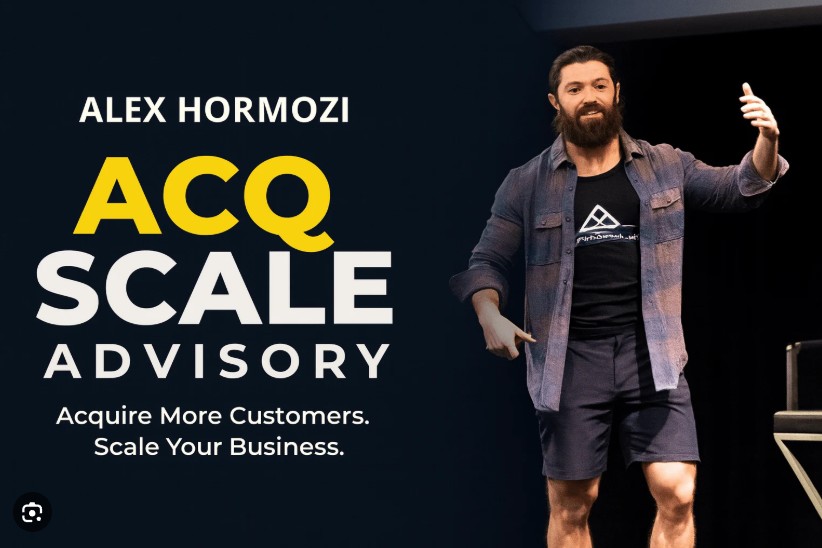
Alex Hormozi ACQ Scale Advisory Review (2026): Is It Worth the Price?
ACQ Scale Advisory is a high-ticket course by Alex Hormozi — the founder of Acquisition.com and author of $100M Offers — that covers 36 lessons across 2 modules on monetization architecture, upsell sequencing, and offer design. The program is priced at a premium (exact price varies through Acquisition.com enrollment), and it is built around one claim: if you structure your offer stack correctly, customers fund the cost of their own acquisition within 30 days. It is worth it if your business is already generating revenue between $100K and $10M and your acquisition economics feel fragile. Skip it if you are pre-revenue, need lead generation, or have product quality problems.
According to the full breakdown on Course To Action, most entrepreneurs believe their growth problem is a lead generation problem. Hormozi's diagnosis is different: you probably have a money model problem. And if you don't fix that first, more leads will only accelerate your cash flow crisis, not solve it. That single reframe — built out across 36 lessons and two modules — is what makes this program worth examining carefully before you decide whether to invest.
Here is what is actually inside.
The Course at a Glance
| Field | Detail |
|---|---|
| Course | ACQ Scale Advisory (Upsell Program) |
| Creator | Alex Hormozi |
| Price | High-ticket (exact price varies) |
| Content | 2 modules / 36 lessons |
| Category | Sales & Monetization |
| Best For | $100K–$10M businesses with a working product who need to make acquisition self-funding |
| Core Topic | Building "money models" — sequenced offer stacks where customers fund their own acquisition within 30 days |
| Skip If | Complete beginners, businesses with product quality problems, anyone primarily looking for lead generation |
| Verdict | ★★★★☆ — Rare, operationally specific monetization curriculum from someone who has built and sold multiple eight-figure businesses |
The Core Insight: You Don't Have an Ad Problem
Here is the problem Hormozi builds the entire curriculum around: most business owners cap their ad spend the moment their Facebook cost-per-lead rises or their CAC climbs above what feels comfortable. They call it an ad budget problem. They go looking for cheaper traffic, better audiences, smarter targeting.
Hormozi's argument is that the actual problem is upstream. It is a money model problem.
The math is this: if your gross profit from a customer in their first 30 days is greater than what it cost you to acquire them, the customer has funded their own acquisition. At that point, ad spend is no longer a risk — it is a machine. You can scale with confidence because each new customer pays for the next one. If your gross profit in 30 days is less than your cost to acquire, you are in a structurally broken position that no amount of lead generation optimization can fix. More volume just means more cash burned faster.
He lived this personally. Gym Launch was nearly destroyed when Facebook CPL increased 5x. The business had no buffer — the money model was too thin. A supplement upsell that generated $100 profit per person within days of acquisition changed the unit economics entirely. That story is not a motivational anecdote in this program. It is the engineering case study around which the entire framework is built.
The core concept Hormozi calls Client-Financed Acquisition (CFA). And it runs through every module.
The Frameworks: Where the Value Lives
1. Client-Financed Acquisition (CFA) — Three Levels
The key takeaway is that CFA is not a binary you either achieve or don't — it is a progression map with three distinct levels, each unlocking a different growth capability.
CFA is the organizing principle of the program. Hormozi presents it in three ascending levels of sophistication:
Level 1 — Break-Even Acquisition: Your front-end offer covers its own acquisition cost. You are no longer losing money to get a customer, but you are not yet profitable on acquisition. You can scale, but carefully. Level 2 — Profitable Acquisition: Gross profit in the first 30 days exceeds CAC. Each new customer funds the next. This is where compounding begins — you can reinvest acquisition profit into more acquisition without touching operating capital. Level 3 — Self-Funding Scale: The money model generates enough margin on new customers that growth becomes self-financing at scale. Ad spend growth is not limited by cash reserves because the model produces cash faster than it consumes it.The three-level structure matters because it gives you a concrete diagnostic: which level are you at, what is the specific gap, and what is the minimum viable intervention to move up one level. This is not theory. It is a progression map.
This is one of 6 frameworks in the ACQ Scale Advisory. The complete breakdown — every framework, every limitation — is available on Course To Action. Start free.
2. The Four-Prong Money Model
Hormozi's full money model is a four-part offer stack, and every component has a distinct function:
Attraction: The entry-point offer. Its job is to acquire customers at break-even or better — not to maximize margin, but to make the first transaction financially neutral or better so that the rest of the stack is pure profit. Upsell: Presented immediately after the customer has committed to the Attraction offer. This is where the bulk of first-30-day gross profit is generated. Hormozi is precise about what makes an upsell work: it must be a natural extension of what the customer just decided they wanted, presented before buyer's remorse has time to form. Downsell: The safety net in the upsell sequence. When a customer says no to the full upsell, the downsell captures a version of that value at a lower price point rather than losing the transaction entirely. Properly constructed, the downsell also de-risks the customer's objection — price, commitment level, perceived complexity — and recovers margin that would otherwise disappear. Continuity: The recurring revenue component that extends the customer relationship beyond the initial purchase and creates LTV. Without continuity, you are perpetually acquiring customers just to replace the ones who leave. With it, each acquisition builds a base of compounding recurring revenue that makes each subsequent acquisition progressively more valuable.The four prongs are not interchangeable. Each has a specific role in the sequence, and skipping or misordering them degrades the model's economics.
3. The Three Acquisition Metrics
The most important framework is the Three Acquisition Metrics — CAC, 30-day gross profit, and payback period — because most business owners only track one of the three.
Hormozi reduces acquisition economics to three numbers and insists that any business owner who does not know all three is flying blind:
- Customer Acquisition Cost (CAC): Total spend to acquire one paying customer — ad spend, sales commissions, software, labor — divided by new customers acquired.
- Gross Profit (30-day): Revenue minus direct cost of delivery for that customer in their first 30 days. This is not net profit. It is the number that determines whether CFA is achievable.
- Payback Period: How many days until gross profit exceeds CAC. The target is 30 days or fewer. At 30 days, you have self-funding acquisition. Beyond 90 days, you have a structural cash flow problem that scale will worsen.
4. Five Upsell Timing Windows
One of the most operationally specific frameworks in the program. Hormozi identifies five distinct moments in the customer journey when an upsell is naturally primed — meaning the customer's emotional state and decision context make a yes more likely:
- Immediately post-purchase — commitment is fresh, buyer's identity has already shifted to "customer," additional offers feel like extensions of that decision rather than new asks.
- First success moment — after the customer has experienced their first tangible result, they have evidence the product works and motivation to accelerate.
- At a natural ceiling — when the customer hits the limit of what their current purchase can deliver, they are already aware of the gap. The upsell fills it.
- Renewal or continuity check-in — when the customer is actively evaluating whether to continue, the conversation is already about value. An upgrade offer fits the frame.
- Referral conversation — customers who are referring others are in a peak satisfaction state. This is an underused upsell window.
5. Menu Upsell — The Four-Step Process
What makes this different is the Unsell step — which is the counterintuitive move of opening by giving the customer permission to say no before presenting any offer.
For service-based businesses and high-ticket contexts, Hormozi teaches a specific upsell presentation sequence:
Step 1 — Unsell: Open by giving the customer permission to say no. "You don't need this. Here's what you already have and what it will get you." This eliminates pressure and, counterintuitively, increases receptivity because it signals that you are not desperate to sell them something. Step 2 — Prescribe: Based on what you know about the customer's situation, present what they would need to achieve a specific additional outcome. Frame it as a diagnosis, not a pitch. "Here is what would need to happen for you to get to X." Step 3 — A or B: Present two options rather than a single yes/no decision. Both options move the customer forward; the only question is which version fits their situation. This shifts the decision from "should I buy" to "which of these fits me." Step 4 — Card on File: Close on a card on file rather than a full payment if the transaction allows it. This reduces friction at the moment of decision and creates a smoother path to completion.Hormozi illustrates the failure mode of this sequence with a specific story: a car salesman who opened his insurance pitch by saying the price was $5,000, sensed resistance, and dropped immediately to $400. The customer bought — and left feeling they had been lied to about the original price. The trust destruction from mishandled downselling is a recurring theme in how Hormozi teaches offer sequencing.
6. Big Head Long Tail Pricing
A pricing architecture framework that structures an offer stack to serve multiple customer segments without diluting the premium positioning of the core offer. The "big head" is the primary high-ticket offer serving the most motivated, highest-budget customers. The "long tail" is a structured series of lower-price-point offers that serve adjacent segments — each one engineered to eventually migrate customers toward the big head as their situation changes, rather than permanently housing them in a lower tier.
The framework solves a common pricing failure: businesses that either alienate budget-constrained prospects with no entry point, or train their best customers to expect discounts by making everything negotiable.
What It Teaches Exceptionally Well
The diagnostic precision is rare. Most business courses give you frameworks to implement. This program gives you a framework to diagnose first — and the diagnosis usually reveals that the problem the business owner thought they had (leads, traffic, ad costs) is a symptom of the problem they actually have (money model structure). That sequence — diagnose before prescribing — is what separates the curriculum from generic sales training. The "Win Your Money Back" case study is one of the most practical examples in the program. Hormozi details an offer that generated 1,800 branded social posts from 100 clients in six weeks. The mechanism is elegant: clients who generate a referral effectively win their money back, creating a self-reinforcing acquisition loop that simultaneously reduces CAC and generates social proof at scale. It is a real deployment example, not a hypothetical. The program is unusually honest about the preconditions for its own effectiveness. Hormozi explicitly states the program is not for businesses with product quality problems. If customers are churning because the core product underdelivers, no amount of upsell architecture will fix the economics. You have to have a working product first. That honesty about scope is itself a signal of credibility.Get Every Framework from ACQ Scale Advisory
The course costs $High-ticket (exact price varies). The complete breakdown is $49/year.
Start free — 10 full summaries, no credit card
What It Doesn't Cover
This is the section no other review will give you. We tell you what the course does NOT cover.
No lead generation content. The program explicitly begins after you have customers — or at least a working acquisition channel. If you need to build traffic, generate leads, or create an audience from scratch, this curriculum does not address that problem. It is monetization and offer architecture after acquisition, not acquisition mechanics themselves. No product creation. The program assumes you have a product or service that works. There is no guidance on building, validating, or iterating the core offer. If your business is pre-product, this program has nothing to offer until you get there. No workbooks or structured exercises. The curriculum is taught through video lessons without accompanying worksheets, calculators, or structured implementation materials. Learners who need scaffolded exercises to translate frameworks into action will need to build their own implementation documents. Video hours are not disclosed. The lesson count (36 lessons across 2 modules) gives you a structural map, but total watch time is not publicly specified. Plan accordingly. Skews toward service businesses. The examples, case studies, and offer architecture are most naturally applicable to service-based businesses — coaching, consulting, agencies, professional services. Product businesses and SaaS companies will find some frameworks transferable, but will need to do more translation work to adapt the upsell timing windows and menu upsell sequence to their specific customer journey.The main limitation is the absence of implementation scaffolding: there are no workbooks, no calculators, no fill-in templates. You get the thinking; the translation into your specific business is entirely on you.
Who This Course Is Actually For
You are the right student for ACQ Scale Advisory if:
You are running a business doing between $100K and $10M in annual revenue with a product or service that demonstrably works — customers are getting results, you are not losing clients to quality issues — but your acquisition economics are thin or unpredictable. You can get customers, but scaling ad spend feels risky because you are not confident the numbers hold up at higher volume.
You have read $100M Offers and $100M Leads and want the monetization-side implementation layer that those books point toward but do not fully build out.
You are a service business owner — coach, consultant, agency, practitioner — who has a core offer but no structured upsell sequence. You are leaving money on the table at the moment of highest customer commitment and you know it.
You have experienced the painful version of scaling ad spend before the money model was ready — CAC climbing, cash getting thin, growth feeling fragile rather than compounding.
This is best suited for operators who can work independently with frameworks and translate principles into their specific business context without guided implementation support.
Who Should Skip This Course
If you are a complete beginner without an existing business or customer base, the program has no foundation to build on. The frameworks assume operational context. Come back after you have product-market fit and initial customers.
If your business has product quality problems — high churn, frequent refund requests, customers who are not getting results — this curriculum is premature. Hormozi says this explicitly. Fix the product first.
If you are looking for lead generation, paid traffic strategy, or audience building, this program does not cover those topics. The curriculum begins after acquisition, not before it.
If your business model is early-stage SaaS or product-heavy e-commerce and you want a direct playbook, expect to spend significant time adapting the frameworks. The program was built with service businesses as the primary context.
Frequently Asked Questions
Is this the same as the free content Hormozi publishes on YouTube?No. The frameworks in ACQ Scale Advisory — particularly the three-level CFA model, the Five Upsell Timing Windows, and the Menu Upsell four-step sequence — are developed at a level of operational specificity that does not appear in his public content. The YouTube and podcast content establishes the vocabulary. This program builds the implementation architecture.
Do I need to have read $100M Offers or $100M Leads first?You will get more out of the program if you have. Hormozi does not re-teach the foundational offer concepts from those books. If you have not read them, the program is still coherent, but some terminology and conceptual grounding will need to be filled in independently.
Is this program relevant for SaaS companies?Partially. The three acquisition metrics (CAC, 30-day gross profit, payback period) are directly applicable to any SaaS company — these are standard unit economics frameworks. The upsell timing windows and Menu Upsell sequence will require more adaptation for a self-serve or low-touch SaaS model. The program is most directly applicable to high-touch, service-influenced SaaS businesses.
What is the actual price?The program is high-ticket and price varies. The "$18K upsell" in the program name refers to the offer tier within Hormozi's advisory structure rather than a fixed public price point. Verify directly through Acquisition.com for current pricing and enrollment options.
Does Course To Action have the full breakdown?Yes. The Course To Action breakdown covers every framework across all 36 lessons — the three CFA levels, the four-prong money model, all five upsell timing windows, the Menu Upsell sequence in full, the Big Head Long Tail pricing architecture, and an honest assessment of who the program serves and where it falls short. Not cliff notes. Full deconstructions.
Where can I read a summary of ACQ Scale Advisory?The independent framework-level breakdown is available at Course To Action. It covers every named framework, the honest limitations, and what the course does NOT teach — the information you need before committing to a high-ticket program.
The Verdict
In summary, ACQ Scale Advisory is a monetization curriculum built by someone who has lived the failure mode it solves — a business nearly destroyed by rising acquisition costs that was rescued by offer architecture, not better ads. That operational credibility is embedded in every framework Hormozi teaches here, and it distinguishes this program from the abstract sales training that dominates its category.
The three acquisition metrics framework alone — CAC, 30-day gross profit, payback period — gives most service business owners a diagnostic they have never had. Understanding that number, tracking it in real time, and building an offer stack designed to compress it below 30 days is the entire program in one sentence. The 36 lessons are how to actually do it.
The gaps are real: no lead gen, no workbooks, no product creation. Service business skew means SaaS and product businesses will translate rather than directly apply. And the price point — high-ticket, exact amount varies — demands that you be at the right stage of business to extract value.
Buy it if: You are running a $100K–$10M service business with a working product, your acquisition economics feel fragile or thin, and you want a complete offer sequencing system built by someone who has solved this problem at scale. Skip it if: You are pre-revenue, need lead generation, or have product quality problems that no upsell architecture can paper over. Before you commit, read the full breakdown on Course To Action. We have the actual course — not the podcast clips, not the YouTube highlights. Every framework Hormozi teaches across all 36 lessons, every case study deconstructed, the full Menu Upsell sequence, the CFA model at all three levels — all of it is in the complete Course To Action breakdown. Course To Action is the pre-read: the thing you do before you invest in a high-ticket program, or the thing you do instead.For the full breakdown of all 6 frameworks in ACQ Scale Advisory — including the three-level CFA model, the Four-Prong Money Model, and the Five Upsell Timing Windows — the independent course deconstruction is available at Course To Action.
Not a review. Not a rating. A complete framework-level analysis so you know exactly what you're buying — or whether you need to buy it at all — before you spend on a high-ticket program.
Full breakdown at Course To Action — start free.Course To Action publishes independent framework-level breakdowns of online courses — the 20% that delivers 80% of the value, so you can make an informed decision before you spend a dollar.
Sources:
Read the Complete ACQ Scale Advisory Summary
The course costs $High-ticket (exact price varies). The full breakdown is $49/year — for every course on the platform.
Every framework deconstructed, every action step extracted, AI that applies it to your specific business. Read or listen — every summary has audio.
Start free — 10 full summaries, no credit card required