Beginners Guide to Wedding Videography Review (2026): Every Framework, Honest Limitations
The Beginner's Guide to Wedding Videography is a $997 course by Runaway Vows — Jake Weisler and Nate Teahan — covering 53 lessons across four modules and 10.7 hours of instruction on camera operation, audio systems, editing in Premiere Pro, and building a profitable wedding film business. It is worth buying if you are starting from zero or stuck under $3,000 per wedding and need one integrated system. Skip it if you edit outside Premiere Pro, operate outside the US market, or are already booking professionally at $5,000+ per event.
There is no shortage of YouTube videos promising to teach you wedding videography in under an hour. Most of them show you how to press record. What they do not show you is how to position three cameras when the officiant blocks your shot, how to price a package so clients stop ghosting you, or how to build a business that books $2,000–$4,000 weddings consistently.
That gap is exactly what Jake Weisler and Nate Teahan of Runaway Vows are trying to close — and according to the full breakdown on Course To Action, they largely succeed.
This review is written for people who are either starting from zero or stuck under $3,000 per wedding and want a structured path forward. If you are already commanding $5,000+ per event and shooting with a seasoned second shooter, this course was not built for you.
Who Are Runaway Vows?
Jake Weisler and Nate Teahan picked up cameras in 2014 and built Runaway Vows into one of the most recognized wedding film companies in the country — named among the Top 18 Wedding Videographers in the U.S. They specialize in luxury destination weddings and have filmed couples around the world.
Beyond their client work, they have invested heavily in education, running collaborative workshops and building out a curriculum aimed at helping newer filmmakers build sustainable businesses. The Beginner's Guide is the most complete expression of that educational mission to date.
Their credibility matters here. This is not a course built by a marketing agency or someone who filmed 12 weddings and decided to monetize their experience. These are full-time professionals who have spent years refining workflows under real wedding-day pressure.
What Is Inside the Course?
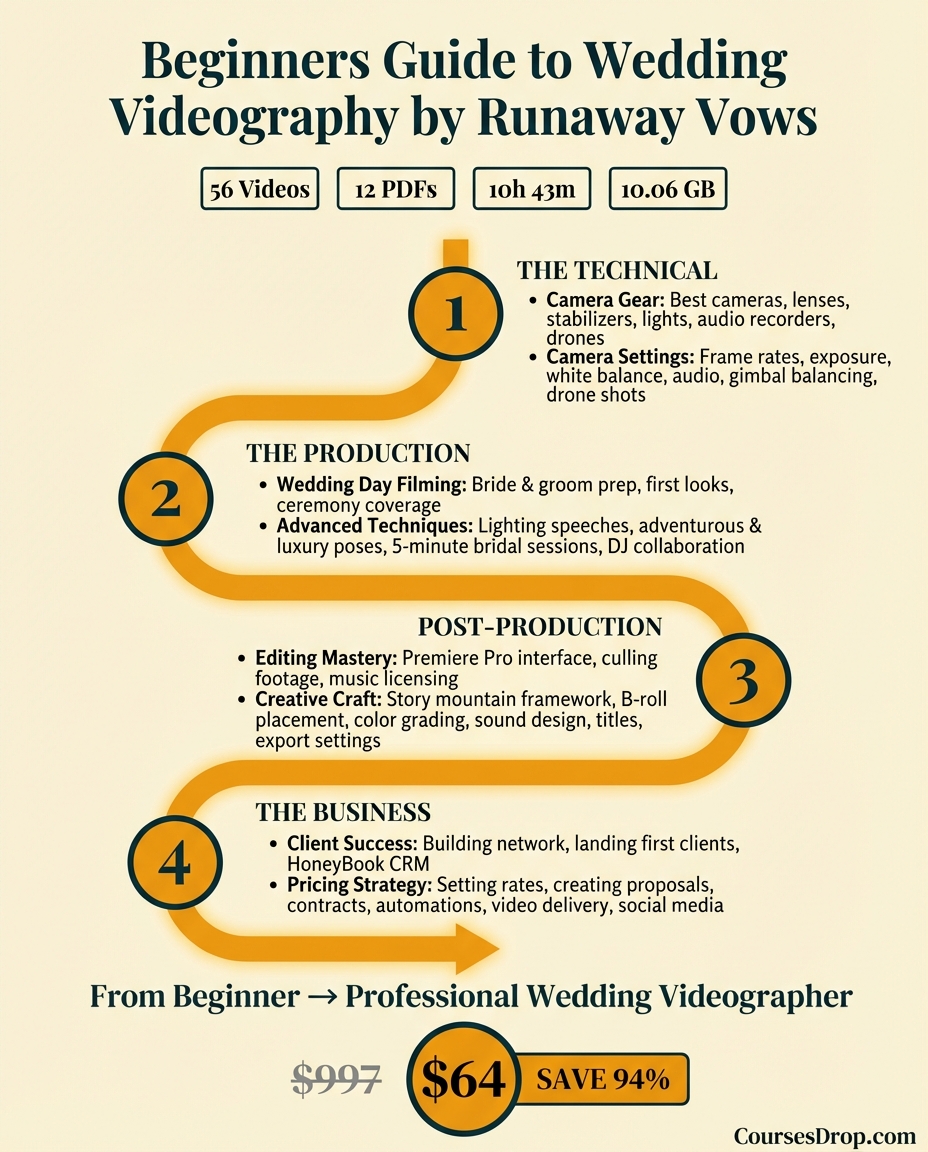
The course is organized into four modules covering the complete arc from pre-production thinking to running a booked calendar.
Module 1: Camera and Gear Fundamentals
This module addresses the question every beginner fixates on — what gear do I need? — but quickly pivots to the more important question: how do you evaluate gear systematically?
The Nine-Category Camera Evaluation is Runaway Vows' framework for scoring cameras across nine criteria — sensor quality, low-light performance, autofocus reliability, battery life, card slot redundancy, menu ergonomics, lens ecosystem, stabilization, and price-to-value ratio — so you can make confident decisions as your budget and needs evolve. It is practical and future-proof in a way that a simple "buy this camera" recommendation never is.
The module also covers the course's core belief, stated plainly: a $600 camera in the hands of a skilled filmmaker will outperform a $50,000 rig operated by a beginner. This is not false modesty — it reorients the entire learning mindset away from gear acquisition and toward skill acquisition.
Key technical specifics covered here include shooting 24fps for A-roll (ceremony and speeches), 60fps for B-roll (details and movement), and keeping skin tones between 40–70 IRE. These are not arbitrary numbers; the course explains the reasoning behind each.
Module 2: On-the-Day Filming
This is the operational core of the course and where most of the practical value lives for true beginners.
Hero Shot First Methodology is Runaway Vows' discipline for ensuring coverage of the three non-negotiable moments — the groom's reaction to the bride's entrance, the ring and vow exchange, and the first kiss — before attempting any creative or experimental angles. The principle: get the sure thing first, then pursue the interesting thing. For someone filming their first or second paid wedding, this single rule could prevent the most common and costly beginner mistake — arriving at the edit with nothing usable from the ceremony.The key takeaway is this: Hero Shot First is not about limiting creativity. It is a forcing function that gives you creative freedom only after your coverage guarantee is locked.
Scalable Camera Placement is Runaway Vows' system for positioning one through four cameras to maximize coverage without requiring a full crew. Each tier is additive — one camera is the anchor, two adds a reaction layer, three builds redundancy, four enables a roaming creative unit — and no tier requires dismantling what came before it. You learn how to work smarter with the resources you actually have.Audio receives serious attention here, which is not common in beginner-level courses. The course recommends the Tascam DR-10L over the DJI Mic for weddings — a specific, defensible recommendation with reasons behind it. Mic placement is covered in precise detail: six inches below the chin, paired with a Bubblebee windscreen for outdoor ceremonies. The course's core thesis on audio — that it represents half of the final viewing experience — is demonstrated rather than just asserted.
The Five Pillars of Storytelling for Wedding Films is Runaway Vows' narrative framework for structuring footage that resonates emotionally, not just chronologically. The five pillars — establishing context, building tension, delivering release, grounding in character, and creating resonance — give editors a diagnostic tool when a rough cut is not working.
For couple portraits, the course includes 10 Adventurous and 10 Luxury Poses — a usable library that removes the awkward guesswork of directing non-model clients on a high-pressure day.
This is one of 6 frameworks in the Beginner's Guide to Wedding Videography. The complete breakdown — including the Scalable Camera Placement system, Three Laws of Pricing, and the shot lists that map to each framework — is on Course To Action. Free account, 10 summaries, no credit card. Or unlock all 110+ courses for $49/30 days.
Module 3: Post-Production in Premiere Pro
This module covers the full editing pipeline from import to export: assembly, color grading, audio sweetening, and final delivery. The instruction is built around Adobe Premiere Pro exclusively. If you use DaVinci Resolve or Final Cut Pro, this module will not translate to your workflow.
Color grading instruction focuses on achieving consistent, professional skin tones — the element that most separates amateur-looking wedding films from professional ones. The course uses the Practical vs. Motivated Sounds framework to guide audio mixing decisions, helping editors understand when to use ambient sound authentically versus when to use it editorially.
The depth here is appropriate for beginners. This is not a master class in color science — it is a practical path to delivering polished, client-ready films without spending months learning theory.
Module 4: Business and Pricing
This module is where many creative-focused courses fall short. The Beginner's Guide does not.
The Three Laws of Pricing is Runaway Vows' model for determining where prices should sit, expressed as: Experience × Audience × Demand. Your price is a function of your portfolio strength, the market segment you serve, and current demand in your geography. This is not a number to copy — it is a framework for adjusting as your experience grows and your market shifts.
The Base Package + Add-Ons Pricing Model is a specific, actionable structure with prices ending in 7. It mirrors proven pricing psychology used across industries and gives students a ready-to-deploy structure. Add-ons — drone footage, same-day edit, extended coverage hours — are designed to be additive, not disruptive to the base offer.
The business module also covers planner networking — one of the highest-leverage activities in the wedding industry. What makes this different is the core insight: a relationship with a single high-volume wedding planner can fill a calendar faster than any amount of social media activity.
What the Course Does Well
It treats workflows as the product, not gear. The entire course is designed around repeatable systems. Students leave with frameworks they can apply on their first paid wedding and refine over years. Audio is treated with respect. Most beginner courses spend 90% of their time on camera settings and 10% on audio. The Beginner's Guide inverts that imbalance meaningfully. The pricing module is honest and specific. Getting concrete guidance on pricing — including a specific model with implementation details — is unusual in creative education. The frameworks are named and memorable. Named frameworks (Hero Shot First, Nine-Category Evaluation, Five Pillars) are easier to recall under pressure than generic advice. On a wedding day, you do not have time to consult notes.What the Course Does Not Cover
The main limitation is important to understand before any $997 purchase decision.
This is a Premiere Pro-only course. If you are already invested in DaVinci Resolve or Final Cut Pro, the post-production module will not transfer. The pricing guidance is US-market focused. Photographers and videographers in the UK, Australia, or other markets operate in different pricing ecosystems. The Three Laws framework will still apply conceptually, but the specific numbers will need recalibration. Same-day edits are not covered. This is a specialized deliverable that some markets increasingly expect. If same-day edits are a priority for your target market, you will need supplemental instruction. Advanced cinematography is not the focus. The course delivers competence and consistency, not cinematic artistry. Students who want to develop a distinctive visual signature will need to seek that education elsewhere after completing this foundation.Get Every Framework from This Course
The course costs $$997. The complete breakdown is $49/year.
Start free — 10 full summaries, no credit card
Who Should Buy This Course
This is best suited for a specific profile and it delivers well for that profile:
- You are starting from zero with no professional filming experience
- You are a hobbyist who has filmed friend weddings for free and wants to go paid
- You are already booking weddings but stuck under $3,000 per event
- You shoot solo or with minimal support
- You use or are willing to learn Adobe Premiere Pro
- You are in the US market
The $997 Question
Wedding videography courses range from $97 to $3,000+. At $997, the Beginner's Guide sits in the middle of that range and justifies its price through depth and specificity.
The more useful comparison is against the alternative: learning by trial and error across 20–30 weddings, charging too little because you lack a pricing framework, and delivering inconsistent results because you have no systematic approach to camera placement or audio.
If the frameworks in this course help you book one additional $2,000 wedding in your first year — a conservative outcome — the ROI is immediate. If they help you raise your average from $1,500 to $2,500, the return compounds year over year.
That said, the course requires a meaningful time investment. 10.7 hours of video is a starting point, not the finish line. Actual skill development happens on real wedding days.
FAQ
Is Beginner's Guide to Wedding Videography worth $997?For beginners and under-$3,000-per-event videographers using Premiere Pro in the US market, yes. The audio instruction, Hero Shot First framework, and pricing model together address the most common and most costly failure modes in early-career wedding videography. If the course helps you add one $2,000 booking, the ROI is immediate. If it helps you raise your average package price, the return compounds.
What does Beginner's Guide to Wedding Videography actually teach?The course teaches six named frameworks across four modules: the Nine-Category Camera Evaluation (gear selection), Hero Shot First Methodology (ceremony coverage), Scalable Camera Placement (1–4 camera system), Five Pillars of Storytelling (narrative editing), Three Laws of Pricing (Experience × Audience × Demand), and Base Package + Add-Ons Pricing (with prices ending in 7). It also covers Premiere Pro editing, audio systems, and planner relationship networking.
What does Beginner's Guide to Wedding Videography NOT cover?The course does not cover DaVinci Resolve or Final Cut Pro editing, same-day edits, advanced cinematography or distinctive visual signature development, or business models outside the US wedding market. It is explicitly a beginner system — it delivers systematic competence, not advanced craft.
Who is Beginner's Guide to Wedding Videography best for?This course is best for aspiring wedding videographers starting from zero, hobbyists who have filmed friend weddings and want to go paid, and working videographers stuck under $3,000 per event who lack a structured system for camera placement, audio, editing, and pricing. US market, Premiere Pro users.
How does Beginner's Guide to Wedding Videography compare to learning on YouTube?YouTube covers individual techniques. This course delivers integrated frameworks — systems where each module's lessons connect to the others. The camera placement logic makes sense because of how the editing workflow is structured. The pricing model makes sense because of the client relationship strategy. This is not a collection of tips. It is an architecture.
Where can I read a full summary of Beginner's Guide to Wedding Videography?The independent framework-level breakdown is available at Course To Action. Start with a free account (10 summaries + AI credits, no credit card required) or unlock 110+ premium courses — with audio and our 'Apply to My Business' AI tool — for a single payment of $49/30 days (no auto-renewal). The course costs $997. Read what it teaches AND what it doesn't before you spend that.
Final Verdict
In summary, the Beginner's Guide to Wedding Videography by Runaway Vows is the most complete beginner curriculum available for this niche. It does not overpromise cinematic mastery — it delivers systematic competence, which is what actually generates income in the early stages of a wedding videography career.
The frameworks are practical. The audio instruction is serious. The business module is specific enough to act on. And the creators have the track record to back up what they teach.
For beginners and under-$3K videographers using Premiere Pro in the US market, this is the course to buy.
Before you spend $997, read the full breakdown on Course To Action. Free account — 10 summaries, AI credits, no credit card. Or get all 110+ premium courses, audio summaries, and the 'Apply to My Business' AI tool for $49/30 days. One payment, no auto-renewal.
Read the summary or listen to the audio version — your call.
Course To Action publishes independent framework-level breakdowns of online courses — the 20% that delivers 80% of the value, so you can make an informed decision before you spend a dollar.Read the Complete Summary
The course costs $$997. The full breakdown is $49/year — for every course on the platform.
Every framework deconstructed, every action step extracted, AI that applies it to your specific business. Read or listen — every summary has audio.
Start free — 10 full summaries, no credit card required