Cash Flow Planning and Control for Small Business Owners Review (2026): Every Framework, Honest Limitations
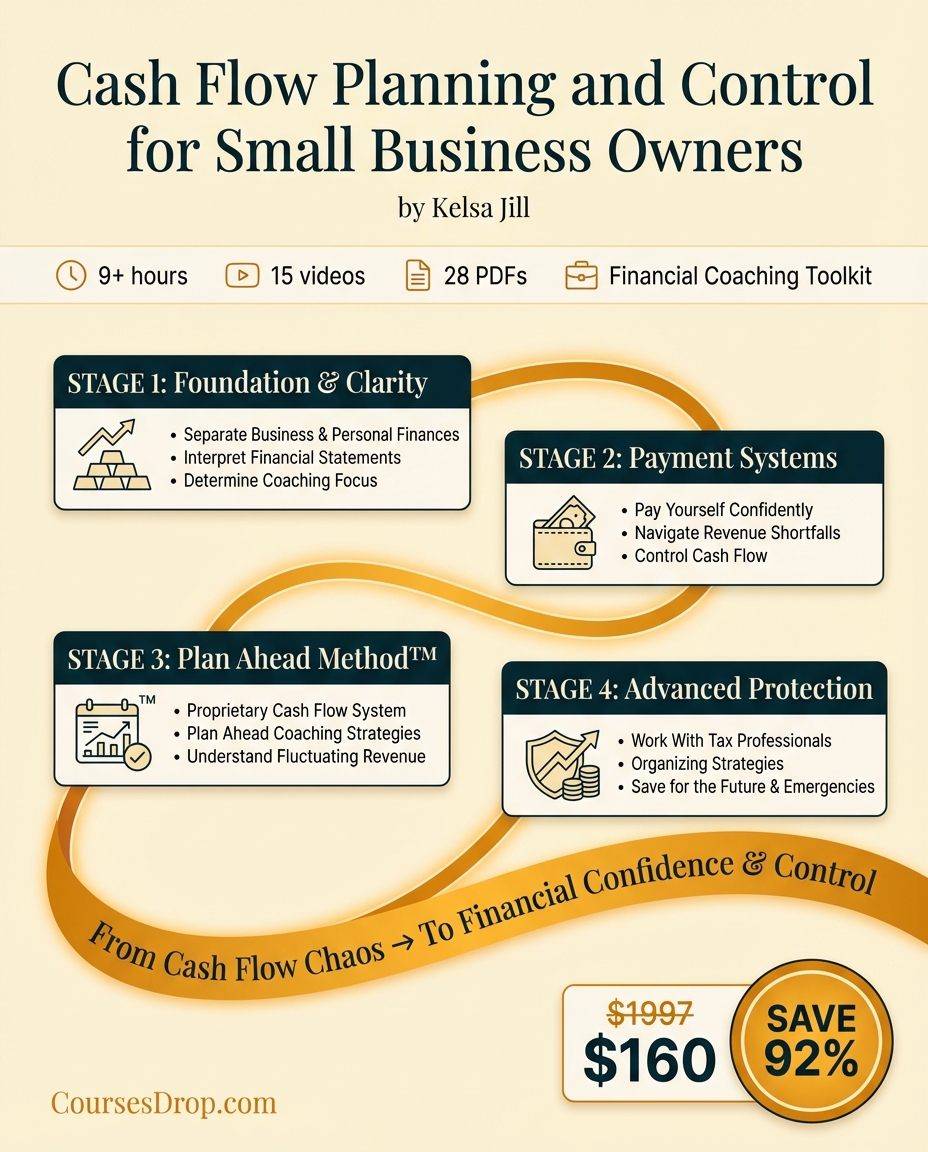
Cash Flow Planning and Control for Small Business Owners is a $1,997 course by Kelsa Dickey that teaches 7 core frameworks for building a complete cash flow system — from separating accounts and calculating a minimum revenue target to structuring owner compensation and coaching business owner clients through financial change. This review is built to answer directly whether it is worth the investment. I've gone through all 15 lessons, mapped every framework, and identified exactly what the course delivers — and where it stops. Not a summary. A full deconstruction.
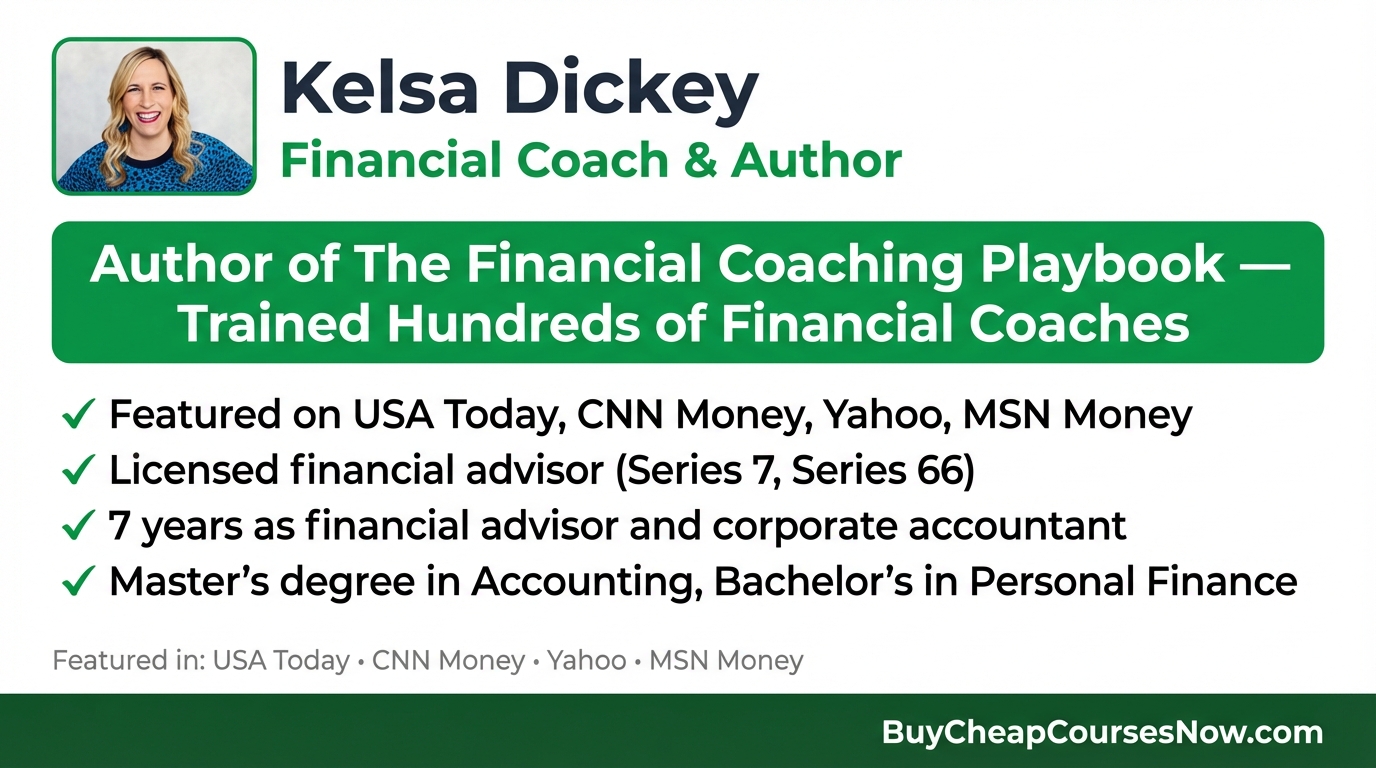
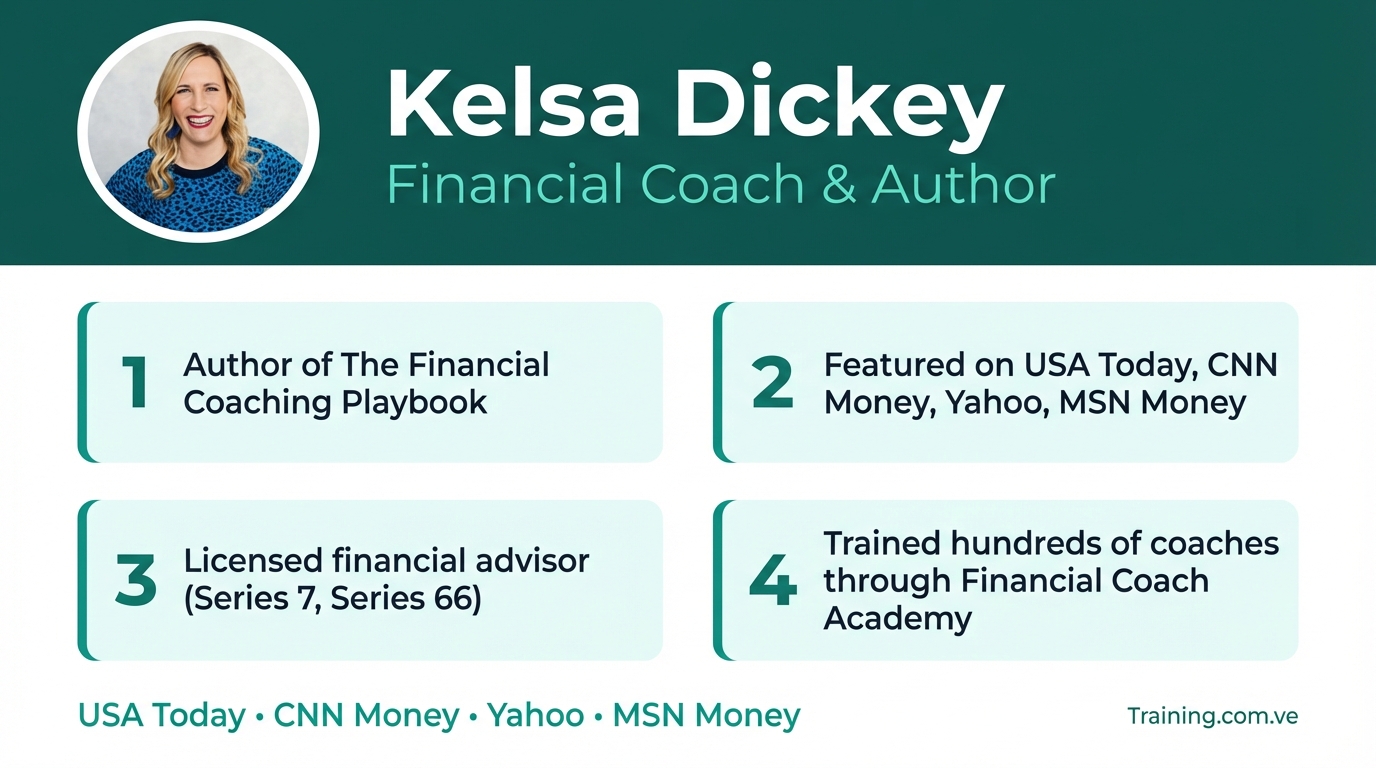
Kelsa Dickey is not a generalist personal finance educator who wandered into business coaching. She founded Fiscal Fitness Phoenix in 2010 after seven years as a financial advisor and corporate accountant, and she built her financial coaching practice from scratch at a time when financial coaching as a profession barely existed. She is also the CEO of the Financial Coach Academy, where she has trained hundreds of coaches to build their own practices. The Plan Ahead Method™ she created is now used by thousands of business owners. Her work has been cited in USA Today, CNN Money, Yahoo, and MSN Money. That background matters when you're evaluating a $1,997 course — this is someone who has personally coached service-based business owners through cash flow crises and built a training infrastructure for coaches to do the same.
According to the full breakdown on Course To Action, this course is one of the most complete cash flow coaching toolkits available for service-based business owners and the coaches who serve them.
Here is what is actually inside.
The Course at a Glance
| Field | Detail |
|---|---|
| Course | Cash Flow Planning and Control for Small Business Owners |
| Creator | Kelsa Dickey |
| Price | $1,997 |
| Content | 15 lessons |
| Best For | Financial coaches adding business finance to their practice; service-based owners under $1M needing a cash flow system |
| Core Topic | Separating finances, calculating minimum revenue targets, managing fluctuating income, planning for taxes, and building savings using the Plan Ahead Method™ |
| Difficulty | Intermediate — assumes some familiarity with personal or business finances |
| Skip If | You sell physical products or run e-commerce, your revenue is above $1M, you need marketing or sales help, or you are outside the US |
| Verdict | ★★★★☆ — One of the most complete cash flow coaching toolkits available for service-based business owners; the Plan Ahead Method™ and Compensation Progression alone are worth the price for coaches who plan to deploy this with clients |
The Core Insight: You Can't Decide What You Can't See
The core insight of this course is both simple and almost universally violated by small business owners: you cannot make smart financial decisions about your business if you cannot clearly see your numbers. Most service-based business owners are running entirely on feel — checking the bank account, guessing whether there's enough to pay themselves this month, reacting to every surprise expense as though it were unpredictable.
The course's organizing argument is that this chaos is not a personality flaw. It is a structural problem. Revenue lands in the wrong account, mixes with personal money, gets spent before taxes are set aside, and the owner ends up paying themselves last — if at all. The fix is not discipline. It is architecture. Separate the accounts. Calculate a concrete minimum revenue target (which combines personal income gap, tax obligations, and business operating expenses into one visible number). Start paying yourself a consistent paycheck from that system. Once that number is visible and the structure is in place, the owner stops surviving reactively and starts thinking strategically.
That shift — from reactive survival to strategic thinking — is the transformation the course is built around.
The Frameworks: Where the Gold Actually Is
1. The Plan Ahead Method™ (Rolling Forward-Looking Budget)
The Plan Ahead Method™ is Kelsa Dickey's rolling, forward-looking cash flow system built in Google Sheets. The core mechanism: revenue at the top of each column, expenses listed below, and an ending balance that automatically becomes the starting balance for the next period. The course teaches five distinct layout variations — Simple Bi-Weekly, Weekly with X-Marking, Deposit Account Layout, Operating and Fixed Split, and Credit Card Integration — so coaches can adapt the format to clients at different business stages, comfort levels, and levels of financial complexity.
The key takeaway is this: the rolling nature transforms a budget from a historical record into a planning tool. Rather than a traditional budget that tracks what already happened, the Plan Ahead Method™ projects revenue and expenses out into future months. Shortfalls become visible weeks before they become crises. For coaches, having five variations ready means one framework serves a first-year solopreneur and a growing service team differently.
2. The Deposit Account Strategy
The Deposit Account Strategy is Kelsa Dickey's structural fix for the problem of lumpy, irregular revenue hitting a single account. The core mechanics: business revenue lands in a dedicated deposit account that is separate from the operating account. From that deposit account, fixed, predictable transfers move money into the operating account on a set schedule. The effect is that volatile, project-based revenue gets smoothed into a steady, predictable flow for day-to-day operations.
What makes this different is the secondary effect: because money must pass through a separate account before it's available to spend, there is friction against reactive spending during high-revenue months. It also creates a natural buffer for low-revenue months. This is not a complicated system, but it is transformative for business owners who currently experience cash flow as chaotic.
3. The Minimum Revenue Target
The minimum revenue target is Kelsa Dickey's calculation for determining the exact monthly revenue a business must generate to function without deterioration. It is calculated by combining three components: the personal income gap (what the owner needs to take home after accounting for any other personal income), tax obligations (often the most underestimated component for self-employed owners), and business operating expenses. Packaging these three into one concrete monthly number converts an abstract anxiety — "do I make enough?" — into a specific, actionable threshold. The course teaches coaches how to calculate this number with clients and how to use it as the anchor for all subsequent financial planning conversations.
4. The Compensation Progression
The Compensation Progression is Kelsa Dickey's structured sequence of owner compensation models, ordered by increasing sophistication. The stages are: Base Salary, Monthly Flat Bonus, Profit-Based Bonus, Quarterly Profit Share, and Profit First. This progression matters because it gives coaches a roadmap for clients at different stages. A business owner in year one who has never paid themselves consistently needs Base Salary — a fixed, predictable paycheck that removes the "how much can I take out this month?" guesswork. The Profit First model sits at the top of the sequence — appropriate once the earlier layers are stable. The progression prevents coaches from recommending the wrong compensation model for a client's current stage.
This is one of 7 frameworks in Cash Flow Planning and Control. The complete breakdown — including the Plan Ahead Method templates, Deposit Account setup, and Compensation Progression stages — is on Course To Action. Free account, 10 summaries, no credit card. Or unlock all 110+ courses for $49/30 days.
5. The Subjective-Then-Objective Coaching Conversation
The Subjective-Then-Objective framework is Kelsa Dickey's coaching conversation structure for financial coaches working with business owner clients. The structure: begin every financial coaching conversation with subjective questions (how do you feel about your money right now? what is stressing you most?) before moving into any objective analysis (what do the numbers actually show?). The sequencing is deliberate — business owners in financial stress have strong emotional responses attached to their money, and attempting to review a spreadsheet before addressing those emotions produces defensiveness and shutdown. By leading with the subjective layer, coaches create the psychological safety that makes the objective layer meaningful.
6. The Education-Coaching-Commitment Framework
The Education-Coaching-Commitment Framework is Kelsa Dickey's session structure that organizes each client engagement into three phases: educate the client on the relevant concept, coach them through applying it to their specific situation, and secure a specific commitment to action before the session ends. The commitment phase is the discipline mechanism: without a named, time-bound action the client commits to, the session produces insight but not change.
7. The Clarity-Control-Taxes-Long-Term Savings Sequence
The Clarity-Control-Taxes-Long-Term Savings Sequence is Kelsa Dickey's framework for ordering which financial concepts to introduce with clients and in what sequence. Business owners need to achieve financial clarity before they can exert control. Control before they can reliably plan for taxes. Tax planning before they can think about long-term savings. The most important framework is this sequencing logic — it prevents coaches from jumping to savings strategies with a client who hasn't yet separated their business and personal accounts. Each phase unlocks the next.
What It Teaches Exceptionally Well
The course is built for coaches, not just owners — and that dual audience makes it more valuable than most business finance content. Most cash flow courses teach an owner how to manage their own money. This course teaches coaches how to teach owners. Every framework comes with a coaching application: how to introduce it, how to run the conversation, how to handle resistance, how to secure commitment. For financial coaches who have mastered personal finance but feel uncertain about the business finance conversation, this is a complete toolkit. The Plan Ahead Method™ in five variations is genuinely flexible. Many business finance tools are designed for a single profile — the stable freelancer, the growing agency — and break down outside that profile. Having five layout variations means coaches have options when clients present at different stages or comfort levels. The course does not leave coaches to figure out adaptation on their own. The Compensation Progression demystifies Profit First. Profit First is widely discussed in small business finance, but the course positions it correctly — as the final stage of a compensation sequence, not the entry point. Coaches who have encountered confused or overwhelmed clients around Profit First will find the Progression a more client-friendly onboarding path that leads to the same destination. The Deposit Account Strategy is the single highest-impact immediate action. Most business owners can implement a version of this framework within a week of learning it, and the smoothing effect on perceived cash flow is noticeable within one to two revenue cycles. For coaches, it is a high-confidence early win to offer new clients.Get Every Framework from Cash Flow Planning and Control for Small Business Owners
The course costs $$1,997. The complete breakdown is $49/year.
Start free — 10 full summaries, no credit card
What It Doesn't Cover
This is the section most reviews skip. These are the real limitations.
There is no revenue generation content. The course is explicitly about managing money once it arrives. If a business owner's core problem is not enough revenue — not enough clients, not enough pricing power, not enough sales conversions — this course will not solve that problem. The frameworks only function once there is revenue to plan around. The course is US-specific. Tax planning content, compensation structures, and regulatory references are built around US tax law. International coaches and business owners will find the tax and compliance content partially or fully inapplicable. Product businesses and e-commerce are excluded by design. The Deposit Account Strategy, Compensation Progression, and minimum revenue target calculations are calibrated for service businesses with client-based revenue. Inventory management, cost of goods, and the margin structures of product businesses are not addressed. Businesses above $1M in revenue will find the frameworks underpowered. The course addresses the stage before complex business finance — the phase where an owner needs basic separation, a consistent paycheck, and a visible minimum target. Once those foundations are stable and revenue exceeds $1M, more sophisticated financial infrastructure (CFO-level cash flow modeling, multi-entity structures, complex tax strategies) becomes relevant and is not covered here. There are no PDF workbooks. The course delivers frameworks through video and spreadsheet tools, but there are no downloadable PDF workbooks for clients. Coaches will need to build their own client-facing materials or adapt the provided spreadsheet tools into their existing client delivery format.The main limitation is scope: this course is built for service-based businesses under $1M, and it delivers everything it promises within that boundary. Outside that boundary, different tools apply.
Who This Course Is Actually For
You are the ideal student if you are a financial coach who has been coaching personal finance clients and is now being asked about business finances — or is actively seeking to expand into that market. The course gives you the language, frameworks, conversation structures, and spreadsheet tools to serve service-based business owner clients with confidence. Without this kind of toolkit, most personal finance coaches default to giving generic advice that doesn't account for the structural differences between personal and business cash flow.
You are also a fit if you are a service-based business owner earning under $1M who has never formally separated your business and personal finances, has never calculated a minimum revenue target, and has no consistent owner compensation structure. The course will walk you through every component of building that foundation.
This is best suited for coaches transitioning from personal finance coaching to business coaching who need a complete, deployable methodology — not just concepts, but structured conversation frameworks and specific tools.
Who Should Skip This Course
If your business sells physical products or operates in e-commerce, the core frameworks are not designed for your cost and margin structure.
If your business already generates above $1M in annual revenue and has a functioning financial system, the course addresses foundations you likely already have. You will need more advanced financial infrastructure than this course provides.
If your primary challenge is revenue — you need more clients, better pricing, or stronger sales — this course will not help. It begins where marketing ends.
If you are outside the United States, the tax and compliance content will not transfer cleanly to your tax regime. The behavioral and structural frameworks (Deposit Account, Compensation Progression, Plan Ahead Method™) are broadly applicable, but the tax planning content is US-specific.
If you need client-facing PDF workbooks as part of your coaching delivery, you will need to create those independently. The course does not provide them.
The Verdict
In summary, Cash Flow Planning and Control for Small Business Owners is a well-constructed, coach-focused financial toolkit. The Plan Ahead Method™ in five variations, the Compensation Progression, the Deposit Account Strategy, and the structured coaching conversation frameworks give financial coaches a complete system for entering the business finance market — not just concepts, but deployable methodology. The minimum revenue target calculation alone gives coaches and owners a tool that converts months of financial anxiety into a single actionable number.
The $1,997 price is appropriate for the depth and dual-audience design. For a financial coach who plans to use this material with even a handful of business owner clients, the return on investment is straightforward. For a service-based owner who needs to build a cash flow system from scratch, the frameworks are concrete and immediately implementable.
The limitations are real but bounded: no revenue generation content, US-specific tax planning, no PDF workbooks, and a scope ceiling around $1M. Within those boundaries, the course does what it promises with more structural clarity than most alternatives.
Buy it if: You are a financial coach expanding into business finance, or a service-based owner under $1M who has never built a real cash flow system. The coaching conversation frameworks and the Plan Ahead Method™ variations are not available in any comparable form elsewhere. Skip it if: You sell products, generate over $1M in revenue, need marketing or sales help, or are outside the US.Before you spend $1,997, read the full breakdown on Course To Action. Free account — 10 summaries, AI credits, no credit card. Or get all 110+ premium courses, audio summaries, and the "Apply to My Business" AI tool for $49/30 days. One payment, no auto-renewal.
The AI has read the entire course — tell it about your business finances and get a custom cash flow plan.
Read the summary or listen to the audio version — your call.
Course To Action publishes independent framework-level breakdowns of online courses — the 20% that delivers 80% of the value, so you can make an informed decision before you spend a dollar.
Frequently Asked Questions
Is this course for business owners or for financial coaches?Both — but the design leans toward coaches. Every framework is taught with a coaching application: how to introduce it to a client, how to run the conversation, how to handle resistance, and how to secure commitment. Business owners can use the course to build their own cash flow system directly, but the Subjective-Then-Objective framework and the Education-Coaching-Commitment structure are specifically built for coaches deploying these tools with clients.
Does this course teach Profit First?It addresses Profit First as the final stage of the Compensation Progression — the most advanced owner compensation model in the sequence. The course positions Profit First correctly as a destination reached after earlier compensation stages are stable, rather than an entry-level system. If you are specifically looking for a deep dive into Profit First implementation, this course gives you context and sequencing but not exhaustive Profit First mechanics.
What if I already have separate business and personal accounts?You are ahead of most business owners the course addresses, but the Deposit Account Strategy, minimum revenue target calculation, and Plan Ahead Method™ will still add significant structure beyond basic account separation. Account separation is the floor; the course builds a full cash flow architecture on top of it.
Does the course work for someone who has irregular, project-based revenue?Yes — the Deposit Account Strategy is specifically designed to smooth lumpy, irregular revenue into predictable operating cash flow. This is one of the most common pain points for service businesses that close large projects sporadically rather than collecting steady monthly retainers, and the course addresses it directly.
Is Cash Flow Planning and Control for Small Business Owners worth $1,997?For a financial coach expanding into business finance, yes — the Plan Ahead Method™ in five layout variations, the Compensation Progression, and the structured coaching conversation frameworks are not available in any comparable form elsewhere. For a service-based owner under $1M who has never built a real cash flow system, the frameworks are immediately implementable and the minimum revenue target calculation alone eliminates months of financial guesswork. The course is not worth $1,997 if you sell physical products, generate over $1M in revenue, or are outside the US.
Does Course To Action have the full breakdown of this course?Yes. The Course To Action breakdown covers all 15 lessons, every framework Kelsa teaches, the full Compensation Progression sequence, the five Plan Ahead Method™ layout variations, the minimum revenue target calculation, and an honest assessment of who benefits most — and who should look elsewhere. Full deconstructions, not summaries — with audio on every summary.
The course costs $1,997. Reading the full breakdown first is free — no credit card required, 10 summaries on a free account. Or unlock all 110+ premium courses, audio summaries, and the "Apply to My Business" AI tool for $49/30 days. One payment, no auto-renewal.
Access the Full Breakdown — Start Free on Course To ActionRead the Complete Cash Flow Planning and Control for Small Business Owners Summary
The course costs $$1,997. The full breakdown is $49/year — for every course on the platform.
Every framework deconstructed, every action step extracted, AI that applies it to your specific business. Read or listen — every summary has audio.
Start free — 10 full summaries, no credit card required