Channel JumpStart Review (2026): Every Framework, Honest Limitations — Derral Eves' $6,000 Course
Channel JumpStart is a $6,000 course by Derral Eves that teaches a complete, data-driven operating system for growing a YouTube channel — covering 7 core frameworks across 86 lessons and 49.5 hours. It is worth it if you are serious about YouTube as a business platform and want a repeatable, systems-based approach to growth. Skip it if you want quick tactics, post casually, or edit exclusively outside Adobe Premiere Pro.
I went through all 86 lessons across 12 modules and 49.5 hours of Channel JumpStart. I extracted every framework, mapped every module, and identified exactly what it covers and what it leaves out. Here is the most complete, unsponsored breakdown you will find.
The short version: if you want a systematic, data-driven operating system for growing a YouTube channel — not a collection of tips but an actual repeatable process — Channel JumpStart is one of the most rigorously built courses in the YouTube education space. Derral Eves is not a guru selling shortcuts. He is a 20-year YouTube veteran who helped MrBeast grow his channel, generated over 101 billion views for clients, and wrote the Wall Street Journal bestseller that serves as the theoretical foundation for this program. The frameworks here are real.
But $6,000 is a serious number. And 49.5 hours is an enormous time commitment. You need to understand exactly what you are buying before you commit either.
The full framework-level breakdown of Channel JumpStart is available at Course To Action — every lesson documented, every limitation noted, start free.
The Course at a Glance
| Field | Details |
|---|---|
| Course | Channel JumpStart |
| Creator | Derral Eves |
| Price | $6,000 |
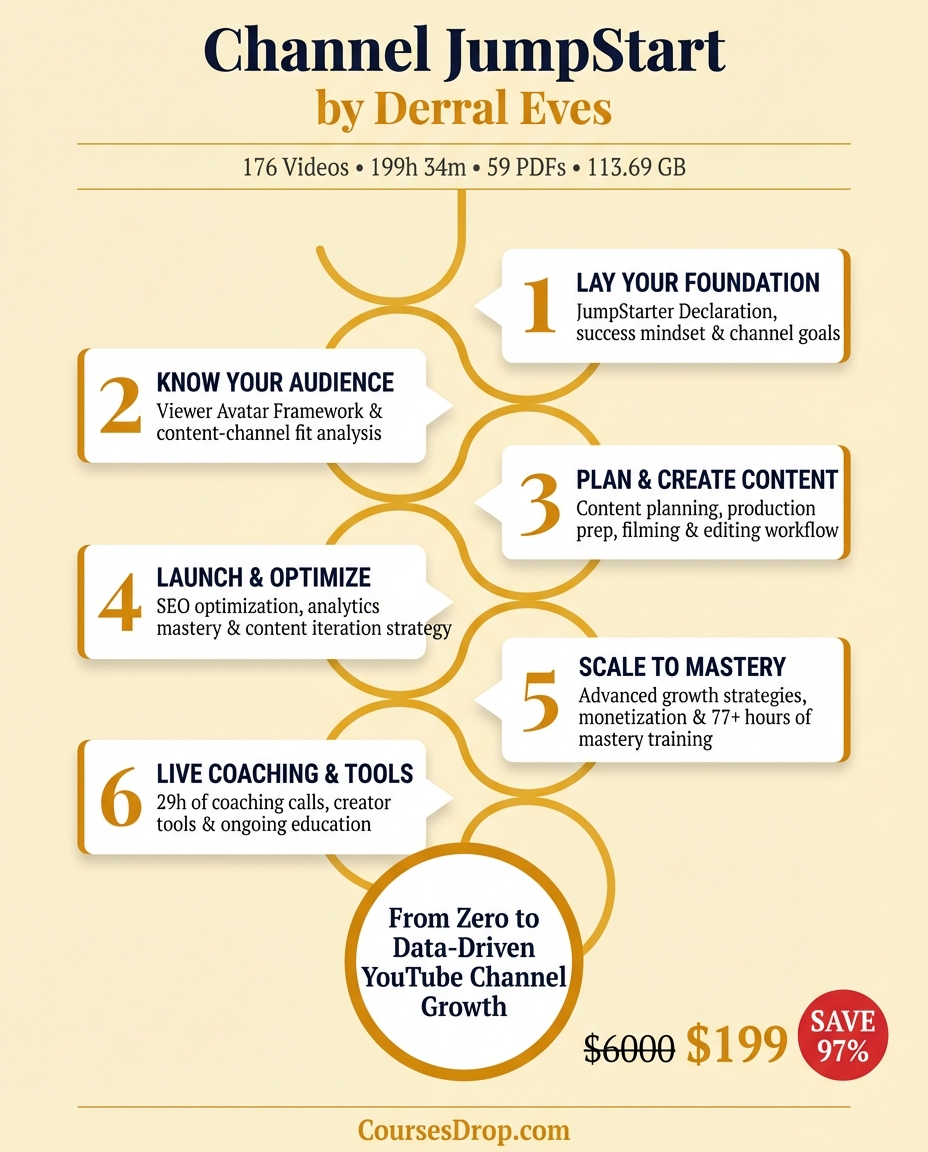
| Content | 12 modules / 86 lessons / 49.5 hours of video |
| Best For | YouTube creators at any stage who want a systematic, data-driven growth process |
| Core Topic | Audience development, content systems, and analytical frameworks for YouTube growth |
| Skip If | You want quick tactics, you post casually, you edit exclusively in non-Premiere Pro software, or you focus entirely on YouTube Shorts |
| Rating | ★★★★☆ — Exceptional systems thinking and creator credibility; massive time commitment and premium price require serious intent |
The Core Insight
The key takeaway is this: stop thinking about the YouTube algorithm. Start thinking about the YouTube viewer.
This is the organizing principle behind all 86 lessons, and it is more than a reframe. Derral Eves argues — convincingly, with data — that the algorithm is not a mysterious force you optimize against. It is a measurement system that reflects how well you understand the human being on the other side of the screen. When viewers click, watch, return, and share, the algorithm amplifies. When they bounce, skip, or ignore, it suppresses. The algorithm does not make arbitrary decisions. It aggregates viewer behavior at scale.
This means every optimization question in YouTube — "what should I title this video?" "how long should it be?" "when should I post?" — is actually a viewer psychology question. The creator who thinks in terms of viewer intent, viewer expectations, and viewer psychology will systematically outperform the creator chasing algorithmic hacks.
That reframe cascades through every framework in the course. It is not decoration. It is the architecture.
The Frameworks: The 20% That Delivers 80% of the Value
Not cliff notes. Full deconstructions. Here are the core frameworks Derral Eves teaches — and how each one builds on the last.
1. The Jumpstarter Way (Plan-Execute-Analyze-Adjust)
The Jumpstarter Way is Derral Eves' four-phase continuous improvement cycle for treating YouTube channel growth as a managed process rather than a creative lottery. The four phases are: Plan, Execute, Analyze, and Adjust — run at multiple timescales (per video, monthly, and quarterly).
Plan: Define your viewer, your content categories, and your goals before producing anything. Most creators skip this phase entirely and pay for it indefinitely in inconsistent results. Execute: Produce and publish according to plan with systematic consistency. This phase includes video production, title and thumbnail development, and publishing cadence. Analyze: Read performance data through the right lens. Not vanity metrics, but the indicators that actually predict growth — specifically the ones most creators ignore (more on this below). Adjust: Make deliberate changes based on data. Eves distinguishes between Speedboat Adjustments (quick, low-risk changes you make immediately) and Ocean Liner Adjustments (major strategic pivots you make slowly, with evidence, because abrupt turns can sink a channel). This distinction alone prevents a category of self-inflicted channel damage.The PEAA cycle is not a set-it-and-forget-it framework. It is a continuous loop you run at multiple timescales — per video, per month, per quarter.
2. The Viewer Avatar (Psychographics Over Demographics)
The Viewer Avatar is Derral Eves' framework for defining your ideal viewer not by demographics (age, location, income) but by psychographics: what does this person believe, fear, aspire to, and what content do they already consume? Before any content is planned, Eves requires a precise psychographic definition of who you are making content for.
The Recon Account Method is the tactical implementation: create an anonymous viewer account and spend deliberate time as your ideal viewer. Watch what they watch. Follow what they follow. Experience the YouTube homepage as they experience it. Most creators are too close to their own perspective to accurately model someone else's experience. The Recon Account creates the experiential distance needed to develop genuine viewer empathy.
The payoff is not abstract. Viewer Avatar drives every downstream decision: title language, thumbnail visual logic, story angle, content topic selection. When the avatar is vague, decisions default to creator preference — what the creator finds interesting, what the creator thinks is good. When the avatar is specific, decisions default to viewer psychology — what will make this particular person click, watch, and return.
3. The Content Buckets System
The Content Buckets System is Eves' framework for structuring a YouTube channel around five to seven repeatable content formats — each defined by a consistent theme, a consistent title pattern, and a consistent visual style — so that YouTube's algorithm can identify and surface related videos together as a cluster.
One of the most operationally practical frameworks in the course. Each bucket is a content category with a predictable format, a clear promise to the viewer, and a consistent delivery structure. The power of the system is compounding: as you produce more videos within each bucket, viewers develop pattern recognition and trust for what each format will deliver. They do not just subscribe to your channel. They develop expectations for specific content types, which drives both return views and algorithmic promotion.
The Content Buckets system also solves the blank-page problem. Creators who do not have defined buckets face an existential decision with every upload: "What should I make next?" Creators with defined buckets face a production decision: "Which bucket am I executing on this week, and what specific topic fits within it?" That is a categorically less draining creative challenge.
4. The Target Video Strategy
Every channel, according to Eves, needs Target Videos — specific pieces of content designed not for your existing subscribers but for attracting new viewers who do not yet know you exist. These are the videos you optimize hardest for discoverability, because their job is audience acquisition, not audience retention.
Target Videos are distinct from content designed for your existing audience. Both are necessary. The distinction matters because optimizing every video the same way fails both functions: it makes acquisition videos feel insider and retention videos feel impersonal. Eves teaches you to identify which role each video plays before you produce it, then optimize accordingly.
This is one of 7 frameworks in Channel JumpStart. The complete breakdown — including the Story Arc templates, ABC Storytelling ratios, and the 90-Day Lens baseline methodology — is on Course To Action. Free account, 10 summaries, no credit card. Or unlock all 110+ courses for $49/30 days.
5. The Story Arc (Hook-Enticement-Setup-Re-engagement-Climax-Gush-Wrap)
The Story Arc is Eves' seven-stage video structure designed around viewer retention psychology. The stages are: Hook, Enticement, Setup, Re-engagement, Climax, Gush, and Wrap — each serving a specific function in maintaining viewer attention from click to end-screen.
Hook: The first seconds that earn the viewer's continued attention. Must deliver on the title and thumbnail promise immediately — any dissonance between the click promise and the opening delivery causes immediate drop-off. Enticement: Show the viewer why staying is worth it. This is the "here is what you will get if you keep watching" signal. Setup: Establish context and stakes. This is where the video's central conflict or question is framed. Re-engagement: A mid-video renewal of the viewer's reason to stay. Not filler — a genuine escalation or surprise that resets attention. Climax: The payoff the video has been building toward. Gush: The emotional beat after the climax — the reaction, the celebration, the reflection that makes the payoff land. Wrap: The ending that closes the loop and sets up the next interaction (subscribe, watch next, comment).The seven-stage arc is not a rigid formula. It is a retention-optimized structure that experienced creators will recognize as the underlying architecture of their best-performing videos.
6. ABC Storytelling
ABC Storytelling is Eves' framework for governing the ratio and texture of content within the Story Arc. The three layers are: A-Story (60-70%, the main content the viewer came for), B-Story (20-25%, human moments and personality that build parasocial connection), and C-Story (brief re-engagement callbacks and throughlines).
A-Story (60-70%): The main content. The thing the title and thumbnail promised. This is what the viewer came for. B-Story (20-25%): Human moments. Personality, relationships, behind-the-scenes texture, authentic vulnerability. The B-Story is what makes the A-Story feel worth watching from this particular creator rather than any other. C-Story (brief): Re-engagement beats — callbacks, easter eggs, running gags, subtle throughlines that reward attentive viewers and create community culture.The ratio is specific by design. Most creators over-index on A-Story (pure information, tutorial-dense) at the cost of B-Story, producing content that is technically accurate but offers no reason to watch it from them specifically. The B-Story is what builds parasocial connection and long-term subscriber loyalty.
7. The 90-Day Lens and Baseline Analysis
The 90-Day Lens is Eves' practice of evaluating channel performance in rolling 90-day windows rather than video-by-video — preventing the noise of individual data points from corrupting the signal of actual trend data. Baseline Analysis establishes your channel's genuine performance floor: not your best day, not your worst day, but the reliable floor beneath which you should investigate and above which you are growing.
How you read your analytics determines what decisions you make. Eves argues that most creators read their data wrong — reacting to individual video performance as if each video is an independent event, when YouTube growth is a system-level phenomenon that can only be understood over time.
In summary, most channel optimization decisions should be made against the baseline, not against peaks.
The Key Data Points Eves Teaches
Channel JumpStart is unusually data-forward for a YouTube course. These are the metrics Eves returns to repeatedly because most creators either ignore them or misunderstand them:
Browse + Suggested = 80% of all YouTube views. Search accounts for less than 7%. This single statistic should recalibrate how most creators think about SEO. Searchability matters. But the overwhelming majority of YouTube views come from YouTube recommending your video to someone who was not looking for it. That means thumbnail, title, and viewer psychology drive more growth than keyword research. Average Views Per Viewer is the most overlooked critical metric. Most creators obsess over subscriber count and total views. Eves focuses on how many times the average subscriber watches your content over a given period. High average views per viewer indicates that existing subscribers are returning, which signals to the algorithm that your channel reliably delivers. This is the metric that drives sustained algorithmic promotion. 60% Average View Duration triggers aggressive promotion. Eves cites 60% AVD as the threshold at which YouTube's systems identify a video as genuinely satisfying to viewers and amplify its distribution. Below that threshold, you may still grow, but you are fighting the algorithm rather than being carried by it. The first 10 seconds must deliver on the title and thumbnail promise. Not hint at it. Not tease it. Deliver on it. The click is a contract. The viewer clicked because the title and thumbnail made a specific implicit promise about what the video would contain. Violating that contract in the opening seconds — by opening with a slow intro, an unrelated anecdote, or a "subscribe before we start" request — triggers immediate abandonment. The first 10 seconds is not a warm-up. It is the most important content in the video.What This Course Teaches Exceptionally Well
The viewer-first mental model is transformative. Replacing "algorithm" with "viewer" in every question you ask about YouTube is a genuine paradigm shift. It moves creators from reactive optimization (chasing signals) to proactive empathy (understanding humans). What makes this different is that this reframe is worth a significant portion of the course's price on its own for creators who have been stuck in algorithm-thinking. The PEAA cycle makes YouTube growth manageable. The most common reason creators plateau is that they are producing content without any systematic feedback loop. PEAA gives you the loop. It converts an emotionally volatile creative process — upload, wait anxiously for results, feel crushed or elated, repeat — into a managed iteration cycle with defined inputs, outputs, and adjustment protocols. Derral Eves' credibility is genuinely earned. This is not a weekend-course creator who got lucky with one viral video. Eves has been consulting on YouTube since before most current creators were on the platform. He helped generate over 101 billion views. He was MrBeast's growth consultant. He executive-produced "The Chosen," which became the highest crowd-funded TV project in history and used YouTube as a primary distribution and audience development platform. The frameworks he teaches are tested at a scale most creators cannot imagine. The Content Buckets system produces compounding results. The architecture of repeatable formats that build audience pattern recognition is not common knowledge in YouTube education. Most courses teach you to make good individual videos. Eves teaches you to build a content system. The distinction is the difference between a good episode and a good show.Get Every Framework from Channel JumpStart
The course costs $$6,000. The complete breakdown is $49/year.
Start free — 10 full summaries, no credit card
What This Course Does Not Cover
The main limitation is that no other review covers this — and we do. We tell you what the course DOESN'T cover.
Monetization beyond AdSense basics is absent. Channel JumpStart teaches you how to grow a YouTube audience. It does not teach you how to monetize that audience beyond the standard AdSense revenue share. No sponsorship negotiation, no merchandise, no course creation, no community memberships, no brand deal strategy. If your goal is YouTube as a revenue engine rather than an audience development platform, you will need supplementary resources for the monetization side. Premiere Pro is the assumed editing environment. Technical editing instruction in the course is built around Adobe Premiere Pro. If you edit in Final Cut, DaVinci Resolve, CapCut, or any other platform, the editing-specific lessons will require translation. This is a meaningful limitation for a significant portion of the creator market. Some lessons contain duplicate content. At 86 lessons and 49.5 hours, the course contains redundancy. Concepts are revisited across multiple modules, sometimes without meaningfully advancing the prior lesson. For a course at this price point, tighter editorial curation would be expected. YouTube Shorts creators will find limited applicability. The frameworks — Story Arc, Content Buckets, PEAA cycle — are built around long-form YouTube content. Short-form vertical video operates on different psychological and algorithmic mechanics. Shorts-focused creators will find the strategic principles broadly useful but will not find Shorts-specific tactical guidance. 49.5 hours is a genuine commitment. At the price and length, Channel JumpStart is not a casual purchase or a casual watch. If you do not have a serious, ongoing commitment to YouTube channel growth, neither the time nor the money will be recovered. This is a course for creators who are building, not experimenting.The $6,000 Question
Let us be direct about the price.
$6,000 is not a small investment by any measure. To evaluate it honestly, you need to be honest about what you are buying and what you are not.
You are buying a complete operating system for YouTube channel growth from one of the most credentialed people in the field — not a 90-minute webinar repurposed as a course, but 49.5 hours of structured, framework-dense instruction built on 20+ years of direct client work at the highest level of the platform.
You are not buying a guarantee. YouTube growth depends on execution, consistency, and variables no course can control — your niche, your competition, your production quality, and the time you invest.
The creators for whom $6,000 is a reasonable investment are those for whom a YouTube channel represents genuine business value: entrepreneurs using YouTube as a primary customer acquisition channel, professional creators whose channel is their income, and serious hobbyist-to-pro creators who have made a genuine commitment to the platform. For those creators, the systematic approach Eves teaches can compress years of trial-and-error into a structured process — and the value of that compression, at the right scale, is worth multiples of $6,000.
For casual creators, weekend posters, or people who are "curious about YouTube," this is not the right entry point. The price and commitment level are calibrated for seriousness, not exploration.
Who This Course Is Actually For
This is best suited for creators who can say yes to most of these:
- You are committed to YouTube as a primary platform, not an experiment you will try for a month.
- You have a business, brand, or creator identity that would benefit from a large, loyal YouTube audience.
- You are willing to invest 49.5 hours in foundational education before seeing significant results.
- You want a system, not a trick. You are comfortable with frameworks, data analysis, and iteration cycles.
- You have hit a plateau — consistent posting, decent content, but the channel is not growing — and you recognize that what you are doing is not working at a systems level.
- You edit in Adobe Premiere Pro or are willing to translate editing-specific instruction to your platform.
Who Should Skip This Course
Be honest with yourself about these:
- You want quick tactics or hacks. The frameworks here require genuine implementation time before results compound.
- You post casually or inconsistently. The PEAA cycle and Content Buckets system require commitment to a publishing cadence. Without that commitment, the system cannot function.
- You are a YouTube Shorts-first creator. The long-form orientation of the course means significant portions will not apply to your use case.
- You edit in Final Cut Pro, DaVinci Resolve, or other software. The editing-specific instruction is Premiere Pro-dependent.
- You are looking for monetization strategy. Channel JumpStart builds audiences. It does not teach you what to do with them commercially beyond AdSense.
- You are price-sensitive. $6,000 is a real number. If the investment creates financial stress, the psychological burden will undermine the consistent execution the course requires.
The Verdict
Channel JumpStart is a serious course from a serious practitioner, built for serious creators.
Derral Eves' core insight — that the algorithm is a measurement of viewer psychology, not an independent force — restructures how you think about every decision on the platform. The frameworks he delivers on top of that insight — PEAA, Content Buckets, Viewer Avatar, Story Arc, ABC Storytelling, the 90-Day Lens — are coherent, practical, and systematically arranged. This is not a tips-and-tricks course. It is a channel operating system.
The limitations are real: the price is premium, the time commitment is enormous, the editing instruction is Premiere Pro-specific, there is some content redundancy, and monetization beyond AdSense is not covered. These are meaningful gaps you should factor into your decision.
The most important framework is the viewer-first mental model — everything else in the course flows from it. The right person for this course is a creator or entrepreneur who has made a genuine commitment to YouTube, wants a systematic approach rather than creative intuition, and has the resources — time and money — to invest in a 49.5-hour foundational education.
Buy it if: YouTube is a central platform for your business or creator career, you have the time to implement a complete system, and you want the most credentialed strategic framework available in the YouTube education space. Skip it if: You want quick results, you post casually, you use non-Premiere Pro software, or you are Shorts-focused.Before you spend $6,000, read the full breakdown on Course To Action. Free account — 10 summaries, AI credits, no credit card. Or get all 110+ premium courses, audio summaries, and the "Apply to My Business" AI tool for $49/30 days. One payment, no auto-renewal.
The AI has read the entire course — tell it about your YouTube channel and get a custom growth strategy.
Read the summary or listen to the audio version — your call.
Course To Action publishes independent framework-level breakdowns of online courses — the 20% that delivers 80% of the value, so you can make an informed decision before you spend a dollar.
Frequently Asked Questions
Is Channel JumpStart worth $6,000?For creators and entrepreneurs who are serious about YouTube as a primary platform, the course delivers a complete growth operating system from one of the most credentialed practitioners in the field. For casual creators or those exploring YouTube as a side experiment, $6,000 is not calibrated to that level of commitment. The honest answer is: it depends entirely on how central YouTube is to your business or career goals.
How long does Channel JumpStart take to complete?The course contains 49.5 hours of video across 86 lessons and 12 modules. At one hour of lessons per day, that is approximately seven weeks to complete the video content. Implementation — actually applying the PEAA cycle, building your Content Buckets, developing your Viewer Avatar — adds additional time on top of the content consumption. Budget for three to six months of serious implementation before evaluating results.
Do I need to be an experienced YouTuber to benefit from Channel JumpStart?No. Eves designs the course for creators at any stage, including those starting from zero. The frameworks are foundational rather than advanced, which means beginners get a complete system from the start rather than having to unlearn bad habits later. Experienced creators at a plateau will find the analytical frameworks — particularly the 90-Day Lens and the Content Buckets system — most immediately applicable.
Does Channel JumpStart work for any niche?The frameworks are niche-agnostic. The PEAA cycle, Content Buckets, Viewer Avatar, and Story Arc apply regardless of whether your channel covers personal finance, cooking, gaming, or B2B software. The Recon Account Method and Target Video Strategy are specifically designed to work within your specific niche rather than prescribing a one-size-fits-all content approach.
What software does Channel JumpStart assume I use?Editing instruction in the course is built around Adobe Premiere Pro. Strategic and conceptual frameworks — the vast majority of the course content — are software-agnostic. If you use a different editing platform, the editing-specific lessons will require translation, but the strategic content is fully applicable regardless of your production setup.
Where can I read a full summary of Channel JumpStart?The complete independent breakdown — every framework extracted, every lesson documented, every limitation noted — is available at Course To Action. Free account, no credit card required. The course costs $6,000 — read the full framework breakdown before you spend that. Or get all 110+ premium courses, audio summaries, and the "Apply to My Business" AI tool for $49/30 days. One payment, no auto-renewal.
Course To Action publishes independent framework-level breakdowns of online courses — the 20% that delivers 80% of the value, so you can make an informed decision before you spend a dollar.
Read the Complete Channel JumpStart Summary
The course costs $$6,000. The full breakdown is $49/year — for every course on the platform.
Every framework deconstructed, every action step extracted, AI that applies it to your specific business. Read or listen — every summary has audio.
Start free — 10 full summaries, no credit card required