Coaching on Advanced Topics in Personal Finance by Kelsa Dickey Review (2026): Every Framework, Honest Limitations
Coaching on Advanced Topics in Personal Finance is a $997 course by Kelsa Dickey that covers 12 lessons on guiding clients through student loans, investing, home buying, HELOCs, insurance, debt settlement, and bankruptcy — without crossing into licensed financial advice. The core value proposition is a structured coaching model that lets financial coaches be genuinely useful in advanced conversations while staying firmly in the coaching role.If you're a financial coach who has ever sat across from a client asking about their student loan repayment options, whether to tap a HELOC, or what bankruptcy actually means for their future — and you felt your stomach drop because you weren't sure how to help without overstepping — this course was built for you.
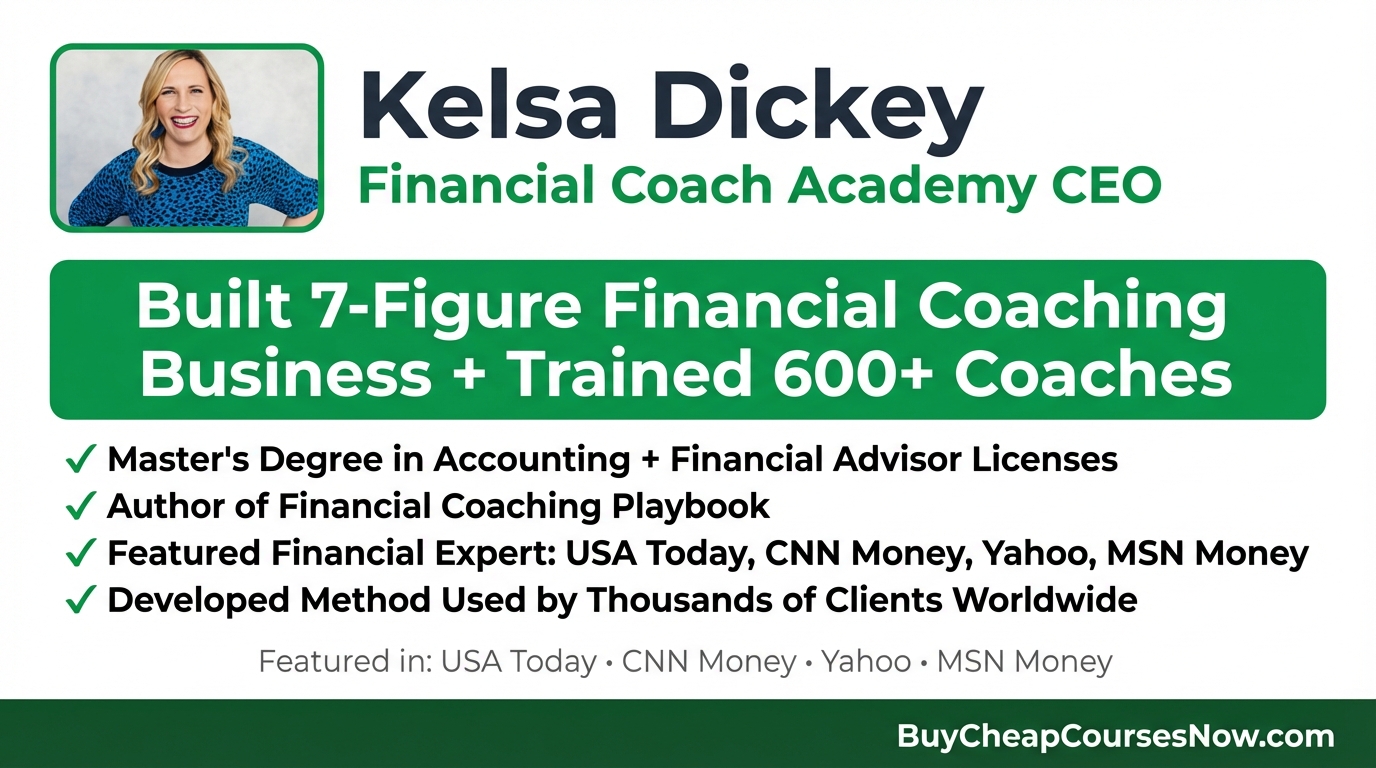
Kelsa Dickey, founder of the Financial Coach Academy and the coaching business Fiscal Fitness Phoenix, has spent more than a decade training financial coaches. This particular course is her answer to one of the most common pain points in the profession: coaches who are great with budgeting basics but freeze when conversations get complicated.
At $997 for 12 lessons, it's not a casual purchase. The complete framework-level breakdown — every lesson, every limitation — is available on Course To Action. Start free. This review will help you decide whether it's worth it.
Who Is Kelsa Dickey?
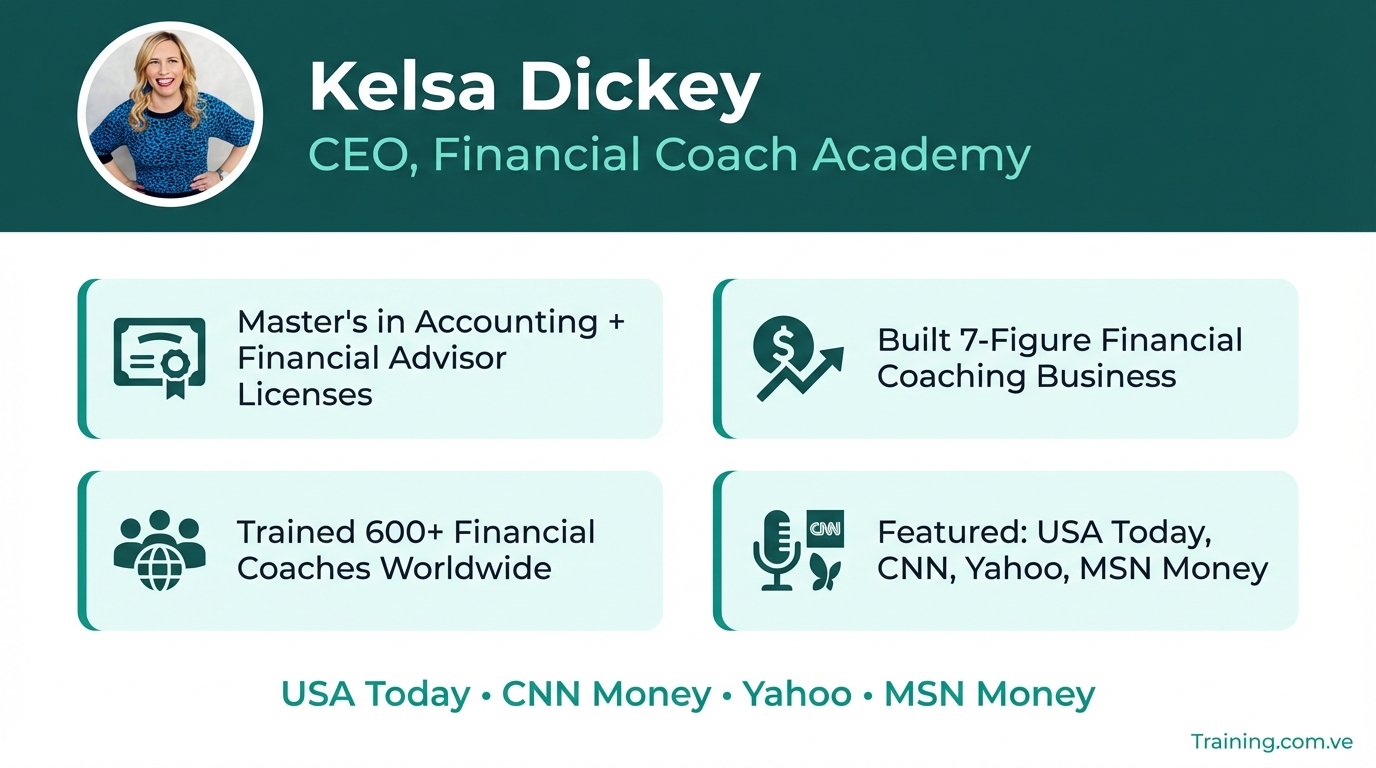
Kelsa Dickey left a career as a financial advisor and corporate accountant in 2010 to start her own financial coaching practice. That background matters here. She's not a content creator who stumbled into finance — she's someone who spent years inside the licensed advisory world, then deliberately stepped out of it to work directly with everyday people on their money behaviors and decisions.
Her company, Fiscal Fitness Phoenix, grew into a seven-figure coaching business. She then channeled what she learned into the Financial Coach Academy, training hundreds of coaches across the US. She's also the author of The Financial Coaching Playbook.
The advanced topics course is a natural extension of that work — a resource for coaches who've already mastered the basics and need a playbook for the harder conversations.
What the Course Covers
The course spans 12 lessons across the following territory:
- Student loans — federal vs. private, repayment plans, refinancing pitfalls (including a critical warning about those "pre-approved refinancing" mailers from private lenders)
- Home buying — the coaching conversation around readiness, affordability, and the emotional weight of the decision
- HELOCs (Home Equity Lines of Credit) — when clients consider tapping home equity and how to coach through the risks
- Investing — introducing clients to the Three Investment Paths (self-directed, fee-only advisor, traditional advisor)
- Insurance — helping clients understand what they have, what they need, and how to evaluate coverage
- Debt settlement — what it actually means (spoiler: you need to be 90+ days past due before creditors will negotiate), and how to coach clients who are considering it
- Bankruptcy — Chapter 7 vs. Chapter 13 distinctions explained in plain language coaches can use
The Core Framework: Three-Phase Coaching Conversation
The most transferable thing you'll take from this course is the Three-Phase Coaching Conversation, which is Kelsa Dickey's 3-step process for moving through any advanced financial topic with a client: Educate, Coach, Commit.
Educate is where the coach brings foundational knowledge to the table — enough for the client to understand the landscape they're navigating. This is where knowing that the HSA is the only triple-tax-advantaged account in the US, or that refinancing offers that arrive by mail are from private lenders (not the Department of Education), actually matters. You can't coach what you don't understand. Coach is the questioning phase. This is where Kelsa's core philosophy lives: the coach's power is not knowing the answers — it's knowing the questions. A good coach doesn't tell a client whether to refinance their student loans. They ask the questions that surface the client's values, risk tolerance, and actual financial situation. Commit is where the session closes with a clear action the client owns. Not a vague "think about it" — a specific next step they've chosen.The key takeaway is that this structure makes advanced financial topics manageable without requiring a license or a finance degree. The coach's job is to prepare the client, not to decide for them.
This is one of the core frameworks in Coaching on Advanced Topics. The complete breakdown — including topic-specific coaching templates for student loans, investing, bankruptcy, and 4 more advanced areas — is on Course To Action. Free account, 10 summaries, no credit card. Or unlock all 110+ courses for $49/30 days.
The "Prepare, Don't Advise" Model
This is the operating principle that unlocks everything else in the course.
Financial coaching exists in a gray zone. Coaches are not licensed advisors. They cannot legally recommend specific investments, insurance products, or legal strategies. But clients bring these topics up constantly, and telling them "I can't help with that" is a failure of service.
Kelsa's answer is the Research Phase vs. Decision Phase distinction. In the Research Phase, the coach helps the client gather information, understand terminology, and clarify what questions they need to answer. In the Decision Phase, the client — often with a licensed professional brought in at the right moment — makes the actual call.
What makes this different is that it's not a workaround or a legal loophole — it's a legitimate coaching model that respects professional boundaries while still providing genuine value. Coaches who internalize this distinction stop being paralyzed by complicated topics and start being genuinely useful.
What Works Well
The topic selection is practical. Student loans, home buying, HELOCs, investing basics, insurance, debt settlement, and bankruptcy — these are exactly the conversations that trip coaches up. Kelsa didn't build a course around edge cases. She built it around the specific conversations coaches have all the time but feel underprepared for. The "prepare, don't advise" framing protects you. This is the kind of professional clarity that keeps coaches out of trouble. The course makes it explicit what your role is and where the line is. The Three Investment Paths framework is immediately usable. When a client asks "should I invest on my own or get a financial advisor?" most coaches don't have a structured answer. This course gives you one — and it doesn't require you to pick a side or give advice you're not qualified to give. Specific details are memorable and teachable. The HSA triple-tax advantage. The 90+ days past due requirement for debt settlement. The Chapter 7 vs. Chapter 13 distinction. These aren't throwaway facts — they're the kind of specifics that let coaches speak credibly and ask smarter questions. The Three Components of Effective Exercise. Every lesson in the course uses an Educational component, an Action component, and a Commitment component — the same structure coaches are taught to use with clients. You're learning the model by experiencing it.Get Every Framework from This Course
The course costs $997. The complete breakdown is $49/year.
Start free — 10 full summaries, no credit card
What to Know Before You Buy
The main limitation is that this course is US-specific. The curriculum is built entirely around US financial structures — federal student loan programs, US bankruptcy law, US tax-advantaged accounts. If your clients are primarily outside the US, this course will not serve you well.
The content is deliberately surface-level. That's a feature, not a bug — but it means this is not a deep dive into any single topic. If you want to understand Chapter 7 bankruptcy at the level a bankruptcy attorney would, this isn't that. What you'll get is enough to coach the conversation, not enough to advise the outcome. There are no live components or demos. This is a recorded curriculum. There are no coaching demonstrations, no role-play examples, no community included in the base purchase. If learning by watching real coaching sessions matters to you, you'll want to set that expectation accordingly. Taxes and estate planning are not covered. The course scope is explicit about this. These are topics that require licensed professionals and are outside the "prepare, don't advise" model. This is not for consumers. If you're a person trying to figure out your own student loans or bankruptcy options, this course is not built for you. It's a professional development tool for coaches, not a personal finance guide.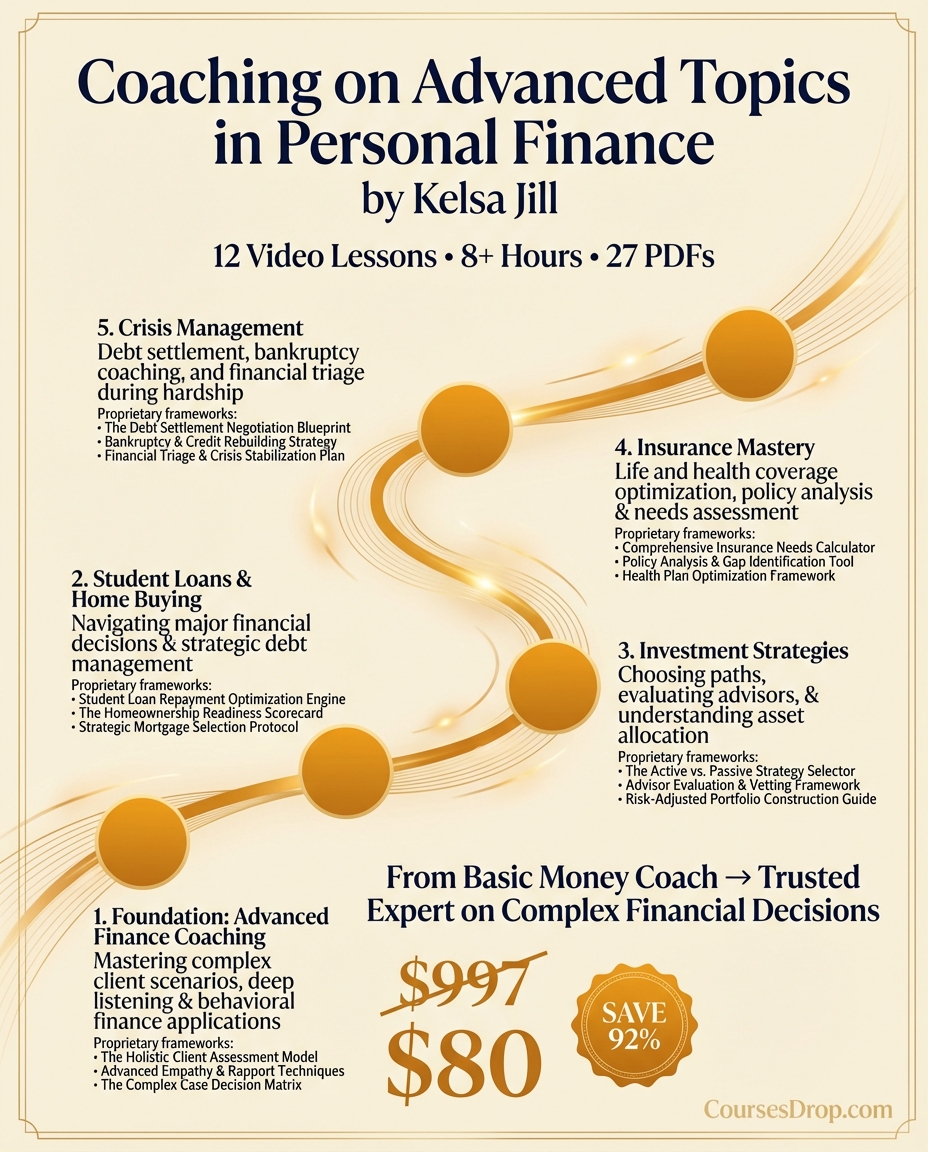
Who Should Buy This
This course is a strong fit if you are:
- A working financial coach who already handles budgeting, debt payoff, and cash flow but wants to handle advanced topics confidently
- A newer coach who knows these topics will come up and wants to be prepared before they do
- A coach who has been saying "I can't help with that" to clients and wants to stop
- A licensed CFP or financial advisor looking for continuing education in your area (the surface-level framing will frustrate you)
- A coach whose clients are primarily outside the US
- Someone looking for live coaching or community support
Is $997 Worth It?
That depends entirely on what it's worth to you to show up to client sessions prepared.
The alternative — losing clients because you can't engage with advanced topics, or stumbling into advice you're not licensed to give — has real costs. If this course prevents even one professional misstep or retains one client who would have left for a more "comprehensive" advisor, the math starts working in your favor quickly.
For coaches who are actively building a practice and know these conversations are coming, $997 for a structured playbook that covers seven major advanced topics, gives you a reusable conversation framework, and clearly defines your professional boundaries is a reasonable investment.
For coaches who are still building their basic client base and haven't encountered these topics yet, there's no urgency — you could wait until the need is immediate.
Final Verdict
"Coaching on Advanced Topics in Personal Finance" does exactly what it promises: it prepares financial coaches for the conversations they dread, without turning them into unlicensed advisors.
The Three-Phase Coaching Conversation framework alone is worth the price of admission for coaches who have been winging it in sessions. The "prepare, don't advise" model is professionally sound and immediately applicable. And the specific topic coverage — student loans to bankruptcy — maps directly onto the real questions coaches hear from real clients.
In summary: the surface-level depth is the right call for what this course is trying to do, even if it might feel light to someone who wanted deeper technical content.
If you're a US-based financial coach who wants to stop dreading the hard questions and start leading clients through them with confidence, this course delivers on that promise.
Rating: 4.2 / 5FAQ
Is Coaching on Advanced Topics in Personal Finance worth $997?For actively practicing US-based financial coaches who are already encountering advanced client questions, yes. The Three-Phase Coaching Conversation framework and the "prepare, don't advise" model provide a reusable structure for seven major topic areas. If advanced client questions are costing you confidence or referral momentum, the course pays back quickly. Skip it if you're pre-client or seeking certification.
What does Coaching on Advanced Topics in Personal Finance actually teach?It teaches financial coaches a structured framework — the Three-Phase Coaching Conversation (Educate, Coach, Commit) — for navigating advanced client topics including student loans, home buying, HELOCs, investing, insurance, debt settlement, and bankruptcy. The course focuses on the "prepare, don't advise" model: how to be genuinely useful without crossing into regulated financial advice.
What does Coaching on Advanced Topics in Personal Finance NOT cover?The course does not cover taxes and estate planning in depth (treated only as referral topics), international financial structures, live coaching or role-play demonstrations, or the coach's own business finances. It is also not a certification program — it will not qualify you to give licensed financial advice.
Who is Coaching on Advanced Topics in Personal Finance best for?Practicing US-based financial coaches who are already past the budgeting basics and encountering — or expecting — advanced client questions about investing, debt resolution, tax-advantaged accounts, or loan decisions.
Where can I read a full summary of Coaching on Advanced Topics in Personal Finance?The complete independent framework-level breakdown — every lesson, every named framework, honest limitations — is at Course To Action. Free account, no credit card required — you get 10 summaries on the house. The course itself costs $997. If you want to read summaries of all 110+ courses on the platform (with audio and the "Apply to My Business" AI tool), it's $49/30 days — one payment, no auto-renewal.
Before you spend $997, read the full breakdown on Course To Action. Free account — 10 summaries, AI credits, no credit card. Or get all 110+ premium courses, audio summaries, and the "Apply to My Business" AI tool for $49/30 days. One payment, no auto-renewal.
The AI has read the entire course — tell it about your coaching practice and get a custom advanced-topics preparation plan.
Read the summary or listen to the audio version — your call.
Course To Action publishes independent framework-level breakdowns of online courses — the 20% that delivers 80% of the value, so you can make an informed decision before you spend a dollar.
Reviewed by Course Navigator. This review is based on publicly available course information and curriculum details. We have no affiliate relationship with Kelsa Dickey or the Financial Coach Academy.
Read the Complete Summary
The course costs $997. The full breakdown is $49/year — for every course on the platform.
Every framework deconstructed, every action step extracted, AI that applies it to your specific business. Read or listen — every summary has audio.
Start free — 10 full summaries, no credit card required