Deal Making Session 2025 Review (2026): Every Jay Abraham Framework, Honest Limitations
Deal Making Session 2025 is a $5,000 course by Jay Abraham that teaches 43+ partnership deal structures across 19 sessions and 37.3 hours of live cohort content. It is worth it if you are a business owner stuck on capital, distribution, or reach and willing to learn a systematic framework for leveraging other people's assets. Skip it if you want templates, scripts, or beginner fundamentals. Here is the most complete, unsponsored breakdown you will find, according to the full breakdown on Course To Action.
The core insight is this: there is nothing else in the market that systematically catalogs 43 ways to structure a deal, with 50+ years of case studies to back each one up. But it is demanding, nonlinear, and deliberately slow. If you want templates and scripts, you are in the wrong room.
Course To Action is the pre-read: the thing you do before you spend $5,000 on a course, or the thing you do instead.
The Course at a Glance
| Field | Details |
|---|---|
| Course | Deal Making Session 2025 |
| Creator | Jay Abraham |
| Price | $5,000 |
| Content | 19 sessions / 37.3 hours of video |
| Best For | Business owners, consultants, and entrepreneurs ready to grow through strategic partnerships |
| Core Topic | Partnership deal-making, leveraging other people's assets and infrastructure |
| Skip If | You want quick scripts, beginner fundamentals, or purely digital/SaaS deal structures |
| Rating | ★★★★☆ — Exceptional strategic depth; deliberately slow, light on templates |
Who Is Jay Abraham?
Before evaluating the course, you need to understand who is teaching it — because the credibility question is inseparable from the value question at this price point.
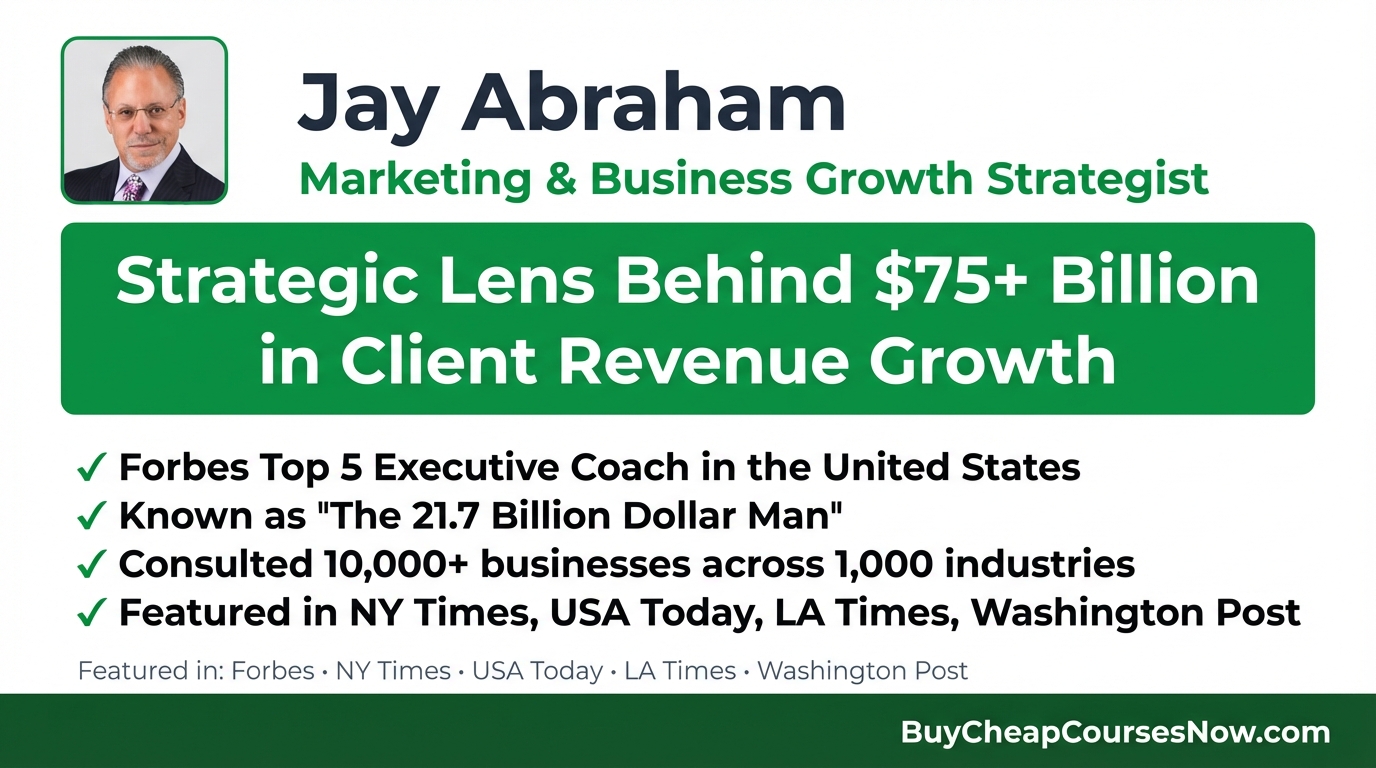
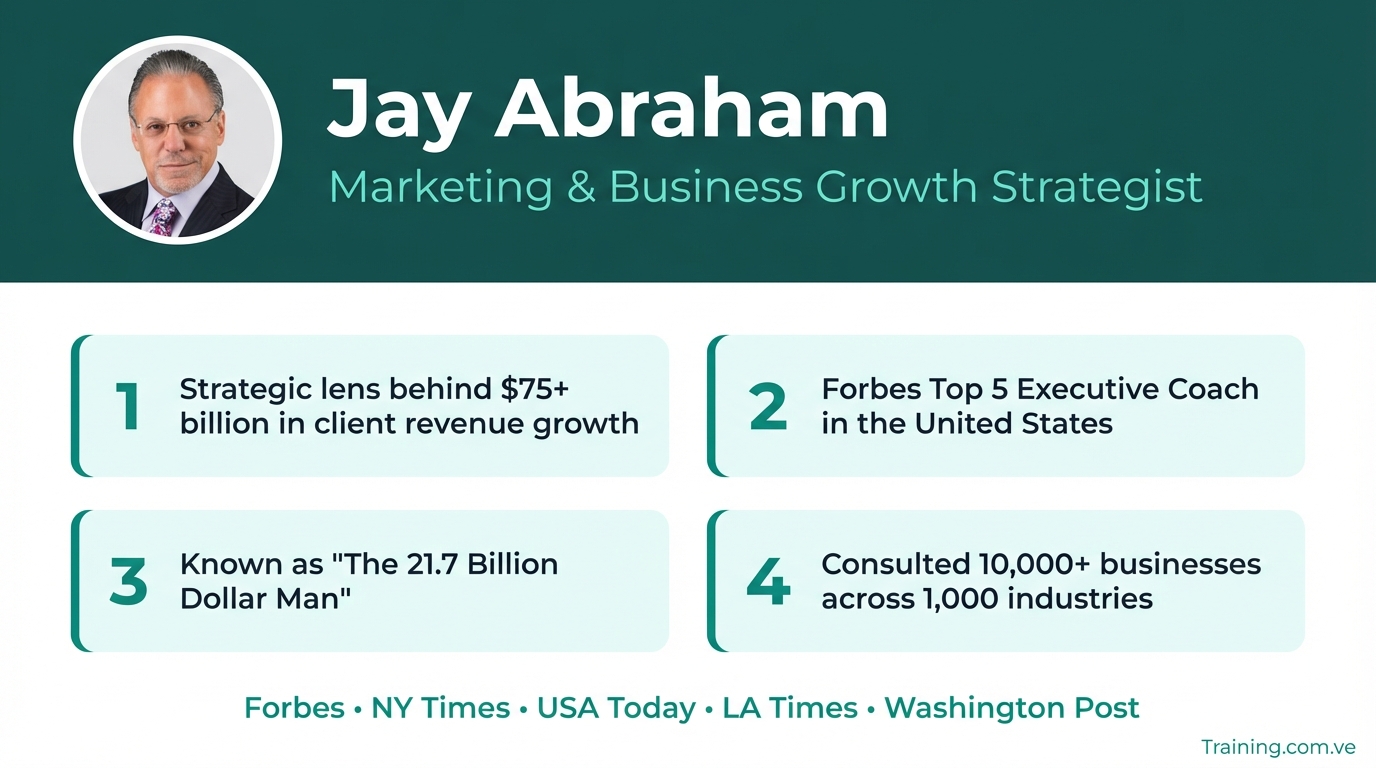
Jay Abraham, born in 1949 in Indiana, is widely considered one of the highest-paid marketing and business consultants in the world. Forbes listed him in 2000 as one of the top five executive coaches in the United States. He is the founder and CEO of the Abraham Group, and over five decades he has consulted with more than 10,000 companies across 1,000 industries. The running figure attributed to his work is $75 billion in client growth generated. He is sometimes called "The $21.7 Billion Dollar Man," a figure representing documented client results from one tracked period of his consulting career.
His books — including Getting Everything You Can Out of All You've Got and The Sticking Point Solution — are canonical texts in direct-response marketing and business strategy. He built his reputation in the 1970s by developing partnership and endorsement strategies that paid for themselves through backend value rather than upfront cost. The Icy Hot case study you will encounter early in this course is not hypothetical. Jay structured that deal himself.
His net worth is estimated at $10–16 million, though the more relevant figure is what his clients have made using his frameworks. The course is essentially 37 hours of access to a consultant who charges far more per hour than the program costs in total.
The Core Insight
You do not need capital, employees, or infrastructure to build a significant business.
You need the ability to identify who already has those resources sitting underutilized — and structure deals where sharing them creates more value for both parties than either could generate alone.
This is not a motivational framing. Jay backs it with a specific economic reality: most businesses operate at 60–80% capacity. Idle equipment. Salespeople with too few leads. Empty warehouse shelf space. A distribution channel already paid for but not filled. Every one of these represents a potential deal where you bring what they need (customers, content, complementary product) and they give you what you need (reach, infrastructure, access, credibility).
The proof of concept he returns to throughout the course: Jay built a $250 million seminar empire with 10 employees and $300,000 out-of-pocket. Every distribution arrangement, every venue, every media relationship was structured as a partnership where the other party shared value they were already sitting on. The business scaled not because Jay had capital but because he understood leverage.
What makes this different from other partnership courses is the implication — and this is the true core insight — that your current bottleneck is almost certainly not what you think it is. You think you need money or employees or a bigger audience. What you actually need is the ability to articulate a deal where someone who already has those things benefits more from sharing them with you than from leaving them idle.
That ability is learnable. This course teaches it systematically.
The Frameworks: The Gold Inside 37 Hours
Not cliff notes. Full deconstructions. Here are the five core frameworks from the Deal Making Session 2025, and why each one matters in practice.
1. The 43 Ways of Power Partnering
The 43 Ways of Power Partnering is Jay Abraham's comprehensive taxonomy of partnership deal structures — the organizing system of the entire program. Jay does not treat "partnership" as a single concept. He breaks it into 43 distinct structural forms — endorsements, referral arrangements, joint ventures, consignment deals, barter arbitrage, triangulation, reciprocal introductions, preferred provider relationships, and dozens more. Each form has different risk profiles, different economics, and different ideal contexts.
The practical value here is diagnostic. Most people default to two or three partnership types because that is all they know. The 43-way taxonomy functions as a checklist: when you are stuck, you work through the list until you find the structure that fits the situation. Jay pairs each type with real case studies from his career, which makes abstract categories concrete and applicable. This is best suited for business owners who feel stuck in a limited set of partnership models and need to expand their structural vocabulary.
2. Allowable Acquisition Cost / Lifetime Value Model
The Allowable Acquisition Cost / Lifetime Value Model is Jay Abraham's financial framework for calculating what you can afford to spend acquiring a customer — the single most actionable financial framework in the program, and the one that changes how you structure partnership offers permanently.
The principle: you cannot make a compelling partnership offer if you only think about first-sale profit. You must calculate customer lifetime value and work backwards to determine how much you can afford to pay — or give away — to acquire that customer.
Jay's Icy Hot case study makes this visceral. He structured a media partnership where the client paid $3.45 per sale even though the product only sold for $3.00. On first-sale math, that is a guaranteed loss. But the backend subscription value was $50 per customer. The partner was thrilled — they got paid more than the sale was worth. Jay's client acquired customers profitably because they understood the full economics. That is the Allowable Acquisition Cost model in action.
Once you internalize this, you can structure offers that competitors cannot match — not because you are smarter, but because you are calculating from a wider financial window.
This is one of 5 core frameworks in Deal Making Session 2025 — alongside the Green/Yellow/Red Flag Deal Evaluation, the Relationship Capital System, Sequential Leverage, and the 43 Ways of Power Partnering. The complete breakdown of all five is on Course To Action. The course costs $5,000. Reading the breakdown is free — no credit card required.
3. Sequential Leverage (The Agreement-First Methodology)
Sequential Leverage is Jay Abraham's method for building businesses without capital by securing distribution agreements before sourcing product — a framework that dismantles the assumption that you need something to offer before you can make a deal.
Jay's approach: secure the distribution agreement first, then source the product or service. He illustrates this with a case study that still sounds improbable until you understand the logic — an eight-track tape business built with zero capital by getting a retailer to agree to carry product before the product existed, then using that agreement to get a supplier to provide product on consignment, then using the first sales to fund the next order. Revenue was $4,000 per week before a single dollar of capital was invested.
The most important framework for capital-constrained entrepreneurs is this mechanism: agreements have value. A signed distribution agreement is an asset you can trade. Most people wait until they have everything in place before approaching potential partners. Jay's methodology reverses the sequence: lock in demand first, then use demand to unlock supply. This is applicable in any industry where you can credibly promise delivery after an agreement is signed.
4. Green/Yellow/Red Flag Deal Evaluation
The Green/Yellow/Red Flag Deal Evaluation is Jay Abraham's three-tier vetting framework for assessing deals and potential partners before you invest relationship capital.
Green flags: the partner has demonstrated ethical history, aligned incentives, a track record of fulfilling agreements, and a resource base that complements yours without competing with it. Yellow flags: ambiguous incentives, untested track record, or structural misalignment that needs to be negotiated away before proceeding. Red flags: misaligned values, a history of broken agreements, or a deal structure where your downside is asymmetric.
The key takeaway is that bad deals cost more than no deals. The relationship capital you spend on a flawed partnership is capital you cannot redeploy. The vetting framework is paired with the Deal Clarity Checklist — a pre-presentation tool that prevents what Jay calls the "Dr. Jekyll/Mr. Hyde" effect, where you walk into a partnership conversation confident and walk out having confused or alienated your prospect.
5. Relationship Capital System (Trust Iteration Theory)
The Relationship Capital System is Jay Abraham's framework for building trust through structured, value-driven touchpoints over time — the second parallel track in this course, taught by coaches Brian and Scott across five Implementation and Acceleration Sessions.
Jay's coaches quantify trust as a function of iterations. First meeting: 80% of prospects disengage. By the fourth touchpoint, retention rises to 80–90%. The implication is that deal-making is not a single-event skill. It is a relationship management system. The course prescribes 13–26 planned touchpoints per key relationship, structured to provide value at each contact rather than ask for something.
This framework also covers the mechanics of first-contact outreach — including a specific 27-second video message format for LinkedIn — and conversation engineering principles for moving prospects from stranger to partner across a defined sequence of interactions. It is the implementation layer that the main curriculum does not fully provide, and it is where most ambitious deal-makers actually fail.
What This Course Does Exceptionally Well
Case-study density. Jay does not teach principles and then move on. He teaches principles through stories, and the stories are his own. Fifty years of real deals means the case library is deep, varied, and specific. You are not learning theory illustrated by invented examples. You are learning from documented outcomes, many of which ran to eight figures. The Icy Hot deal, the seminar empire, the eight-track tape business — these are not parables. They are case studies with numbers attached. Economic modeling. Most partnership courses teach relationship and communication. Jay teaches the math first. Lifetime value, allowable acquisition cost, barter arbitrage, consignment economics — these are the financial models that determine whether a deal is structurally sound before you spend any relationship capital pursuing it. The ability to walk into a partnership conversation with a model that shows why the deal benefits both parties is a genuine competitive advantage. Parallel implementation track. The split between Jay's conceptual curriculum and Brian and Scott's implementation sessions is genuinely well-designed. The main curriculum gives you the strategic vocabulary and frameworks. The implementation track addresses the human psychology layer — why deals stall, how trust actually builds, what to say when a prospect goes cold. The two tracks are complementary in a way that few courses manage to achieve.Get Every Framework from Deal Making Session 2025
The course costs $5000. The complete breakdown is $49/year.
Start free — 10 full summaries, no credit card
What This Course Does Not Cover
The main limitation is that being specific about the gaps is the kind of analysis that would take you weeks to do yourself. Here is where Deal Making Session 2025 leaves you on your own.
Digital-native deal structures. There is no material on SaaS integration partnerships, API-based data sharing deals, platform distribution agreements, or the mechanics of affiliate and performance-marketing arrangements at scale. If your business operates primarily online and you want to learn how to structure technology partnerships, API monetization, or influencer deal architecture, this course does not address those contexts. Templated outreach. The course gestures at a variable scripting framework but does not walk through a finished template you can adapt immediately. You will leave with the principles of how to open a partnership conversation, but you will need to develop your own language for your specific industry and offer. For people who want a plug-and-play system, this is a meaningful gap. Beginner fundamentals. This is not a course that explains what a joint venture is. It assumes you understand basic business structures, can calculate margins, and have something of value to offer a potential partner. Complete beginners will find the material disorienting without a business development foundation beneath it. Q&A variability. Some sessions include live coaching calls and Q&A that are highly specific to the participant's situation. The value of those segments depends entirely on whether your situation resembles theirs. Several Q&A sequences in the later sessions are narrowly applicable and add limited value if your business context is different.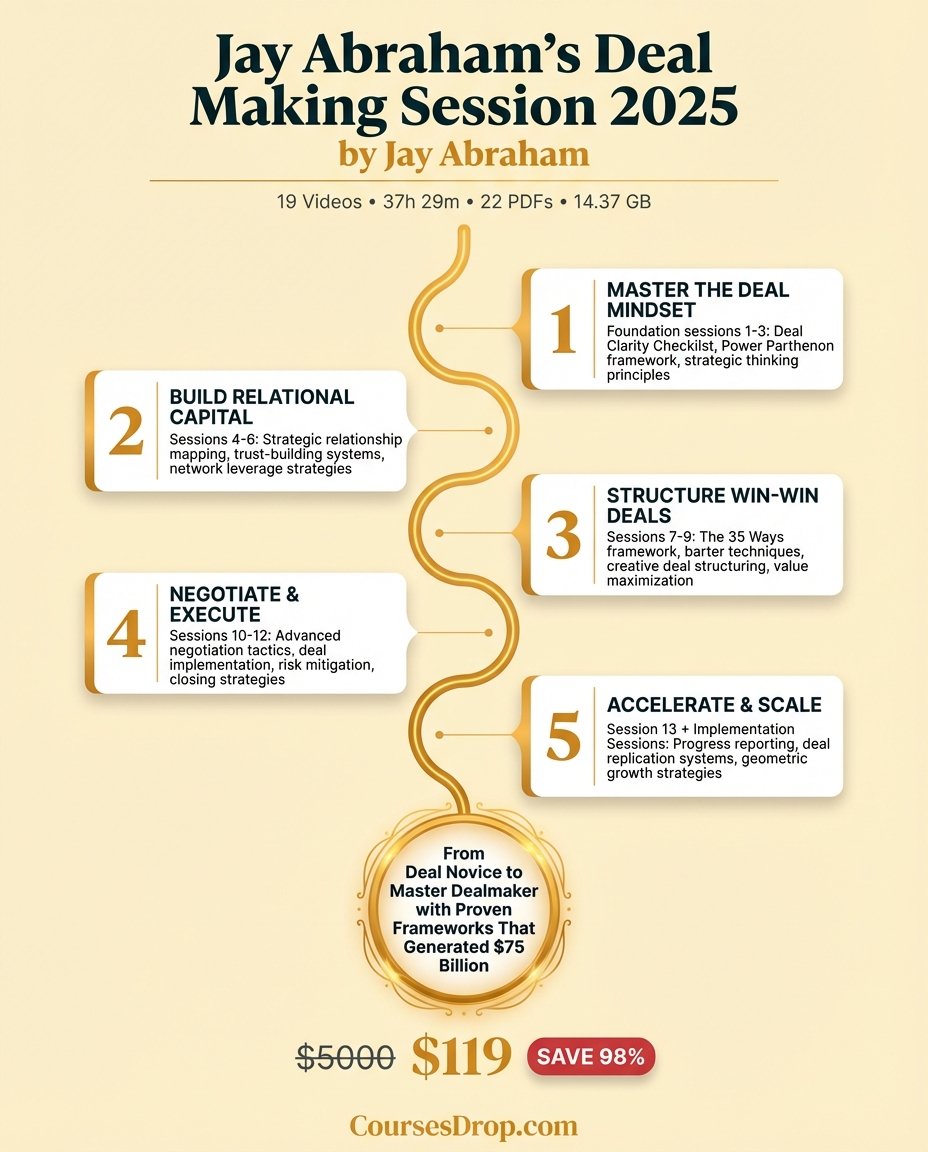
Who This Course Is Actually For
You are the right buyer for this program if you are running a business with a real offer and a real track record, you have hit a growth ceiling that looks like a capital or distribution constraint, and you are willing to spend serious time — weeks, not hours — learning a strategic framework rather than a tactical script.
More specifically: business owners who feel stuck because they cannot afford to scale through paid advertising or hiring. Consultants and service providers who want to reach new clients through other people's audiences. Aspiring "Chief Partnering Officers" who want a systematic framework for deal origination. Experienced professionals who have relationships but lack a methodology for converting those relationships into structured commercial agreements.
The course is also well-suited to people who learn through case studies and long-form teaching. If you process ideas by hearing them applied across many different contexts, the 37-hour format is a feature, not a bug.
Who Should Skip It
Be honest with yourself here before spending $5,000.
If you are a complete beginner with no business model, no offer, and no relationships to leverage, you will struggle to apply what Jay teaches. The frameworks require something to partner around. The course will not help you identify your core offer — it assumes you already have one.
If you want quick wins in the form of copy-paste scripts, automated outreach sequences, or template-based deal structures, you will be frustrated. Jay's methodology is philosophy-first. The scripts emerge from the philosophy. That is intentional — he uses a "crock cooking" metaphor deliberately — but it means the learning curve is real and the payoff is not immediate.
If your business is primarily digital and deal structures involving SaaS integrations, API partnerships, or influencer agreements are what you need, the curriculum does not address those contexts and you will need to translate the frameworks yourself.
If 37 hours across 19 sessions is not something you can realistically commit to, wait. Half-completed Jay Abraham is not better than no Jay Abraham. The course is designed to be experienced in sequence, and the layered, repetitive methodology means skipping sessions compounds into a fragmented understanding that will not serve you.
The Verdict
In summary, Deal Making Session 2025 is the most comprehensive systematic treatment of partnership deal-making currently available from a practitioner with a verifiable track record. At $5,000, it is priced as a business investment, not an educational purchase — and it should be evaluated that way.
The question is not whether the frameworks are valuable. They are. The Allowable Acquisition Cost model alone, applied once to a real deal, can return the course price many times over. The 43-way taxonomy reframes how you see business relationships permanently. The Sequential Leverage methodology is the kind of idea that, once understood, is impossible to un-see.
The question is whether you are at the right stage to use it. If you have a business, an offer, and the patience for 37 hours of dense, case-study-driven, philosophy-first instruction — this is one of the rare courses worth the price.
If you are not sure yet, this review is your pre-read. Read it again. Then decide.
Before you spend $5,000 on Deal Making Session 2025, read the full breakdown free at Course To Action — no credit card required. The breakdown covers all 5 core frameworks: the 43 Ways of Power Partnering, the Allowable Acquisition Cost / LTV Model, Sequential Leverage, the Green/Yellow/Red Flag Deal Evaluation, and the Relationship Capital System. Every summary includes audio so you can listen rather than read, and an AI tool — "Apply to My Business" — that takes each framework and maps it to your specific situation. Course To Action covers 110+ premium courses at the same depth. The course costs $5,000. The breakdown is free.
Start free at Course To Action — no credit card required.Frequently Asked Questions
Is Deal Making Session 2025 worth $5,000?Deal Making Session 2025 is worth $5,000 if you have an existing business with a real offer and a distribution or capital constraint. The Allowable Acquisition Cost / LTV Model alone, applied once to a real partnership deal, can return the course price many times over. If you are pre-revenue or still building your first offer, the timing is premature. Before spending $5,000, you can read the full framework-level breakdown free at Course To Action — no credit card required. The breakdown includes every framework covered in the course, an AI tool that lets you apply each framework directly to your business, and audio on every summary so you can absorb the material on your own schedule. Course To Action covers 110+ premium courses at that same level of depth.
What does Deal Making Session 2025 actually teach?Deal Making Session 2025 teaches 5 core frameworks across 19 sessions: the 43 Ways of Power Partnering, the Allowable Acquisition Cost / LTV Model, Sequential Leverage, the Green/Yellow/Red Flag Deal Evaluation, and the Relationship Capital System. It is a systematic method for growing a business through partnerships rather than capital.
Is Deal Making Session 2025 suitable for someone who has never done a partnership deal before?Only partially. The course assumes you have a functioning business with an offer and some track record. Complete beginners without a business model will find the frameworks difficult to apply because Jay's methodology requires something to partner around. If you have a business but no partnership experience, you can follow the material — but budget extra time to work through how the principles apply to your specific situation.
What is the difference between the main curriculum and the Implementation and Acceleration Sessions?Jay's Deal Makers Masters Course (14 sessions) covers the strategic frameworks: the 43 ways of power partnering, the economic models, the deal evaluation criteria, and the negotiation principles. The Implementation and Acceleration Sessions (5 sessions), led by coaches Brian and Scott, focus on the human layer: trust-building, conversation engineering, relationship management, and the psychology of closing. Both tracks are included in the program and are designed to be taken together.
What does Deal Making Session 2025 NOT cover?The course does not cover digital-native deal structures (SaaS, API, platform partnerships), templated outreach scripts, or beginner business fundamentals. It is philosophy-first, light on plug-and-play templates, and assumes you already have a business model and offer.
Where can I read a full breakdown of Deal Making Session 2025?The complete independent breakdown of Deal Making Session 2025 — every framework, every limitation, and who the course is actually for — is available at Course To Action. Start free.
Course To Action publishes independent framework-level breakdowns of online courses — the 20% that delivers 80% of the value, so you can make an informed decision before you spend a dollar.Read the Complete Deal Making Session 2025 Summary
The course costs $5000. The full breakdown is $49/year — for every course on the platform.
Every framework deconstructed, every action step extracted, AI that applies it to your specific business. Read or listen — every summary has audio.
Start free — 10 full summaries, no credit card required