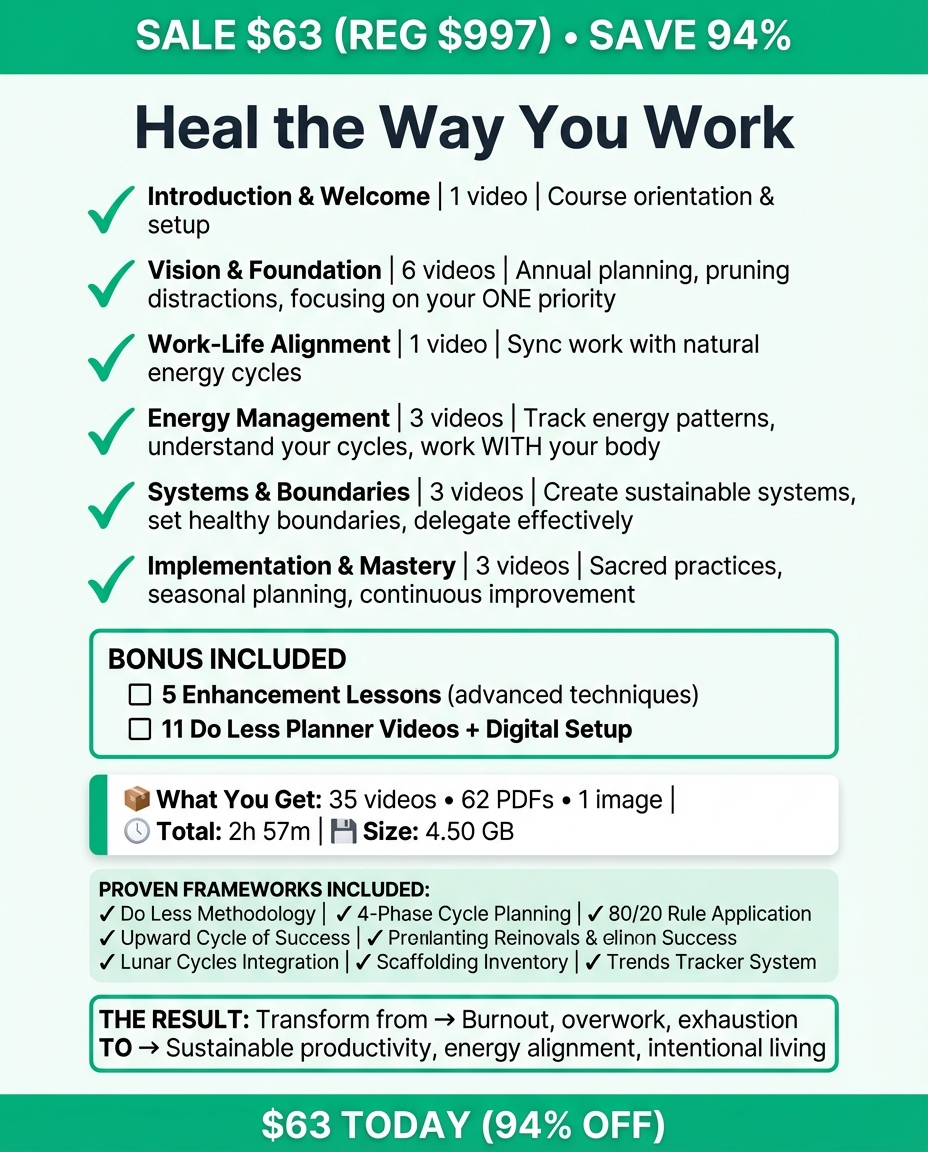
Heal the Way You Work Review (2026): Every Framework, Honest Limitations
Heal the Way You Work is a $997 course by Kate Northrup that teaches 7 frameworks for replacing the standard 24-hour productivity model with a cyclical planning system built around a woman's 28-day hormonal rhythm. It is worth it if you are a woman entrepreneur who recognizes a cyclical burnout pattern and wants a planning system grounded in physiology rather than willpower. Skip it if your problem is tactical — revenue, client acquisition, offer design — rather than structural. According to the full breakdown on Course To Action, this is one of the most genuinely original productivity courses available for women entrepreneurs.
I went through all 35 lessons. I extracted every framework, mapped every phase model, and identified exactly what it covers and what it leaves out. Here is the most complete, unsponsored breakdown you will find.
The core insight is that the 24-hour productivity clock was never built for people with 28-day hormonal cycles. The course names something real and gives you a functional system for it. It is also genuinely short, contains roughly 30% spiritual and metaphysical content, and will not teach you how to grow your revenue. That distinction matters enormously. Keep reading.
The Course at a Glance
| Field | Details |
|---|---|
| Course | Heal the Way You Work |
| Creator | Kate Northrup |
| Price | $997 |
| Content | 35 lessons / approximately 3-4 hours total |
| Best For | Women entrepreneurs, solopreneurs, and mothers overwhelmed by conventional productivity demands |
| Core Topic | Cyclical planning system aligning your business calendar with your menstrual cycle or the lunar cycle |
| Skip If | You need tactical business growth, you are skeptical of spiritual frameworks, or you are a man |
| Rating | ★★★★☆ — Genuinely original system; requires a specific audience to deliver value |
The Core Insight
The 24-hour productivity cycle was never designed for people with 28-day hormonal cycles.
This is the organizing premise behind all 35 lessons. The standard productivity canon — time-blocking, deep work, morning routines, peak performance windows — is built on a 24-hour model of human energy. Wake up, execute, sleep, repeat. For men, whose primary hormone cycle runs roughly 24 hours, this is a reasonable fit. For women, whose primary hormonal cycle runs approximately 28 days, it is a systematic mismatch.
What makes this different is that Kate Northrup's argument is not about willpower or strategy failure. It is about scheduling failure. You are trying to run a 28-day operating system on a 24-hour productivity model, and the system is crashing because of the architecture, not the user.
The solution the course proposes is not more discipline. It is alignment. Schedule rest during the phase when rest is natural. Schedule initiation and new ideas during the phase when creative energy surges. Schedule visibility, client-facing work, and launches during the phase when social energy peaks. Schedule detail work and analysis during the phase when focus is sharpest. Do more by doing less — at the right time.
That is a genuinely countercultural productivity claim. The course builds a practical system around it.
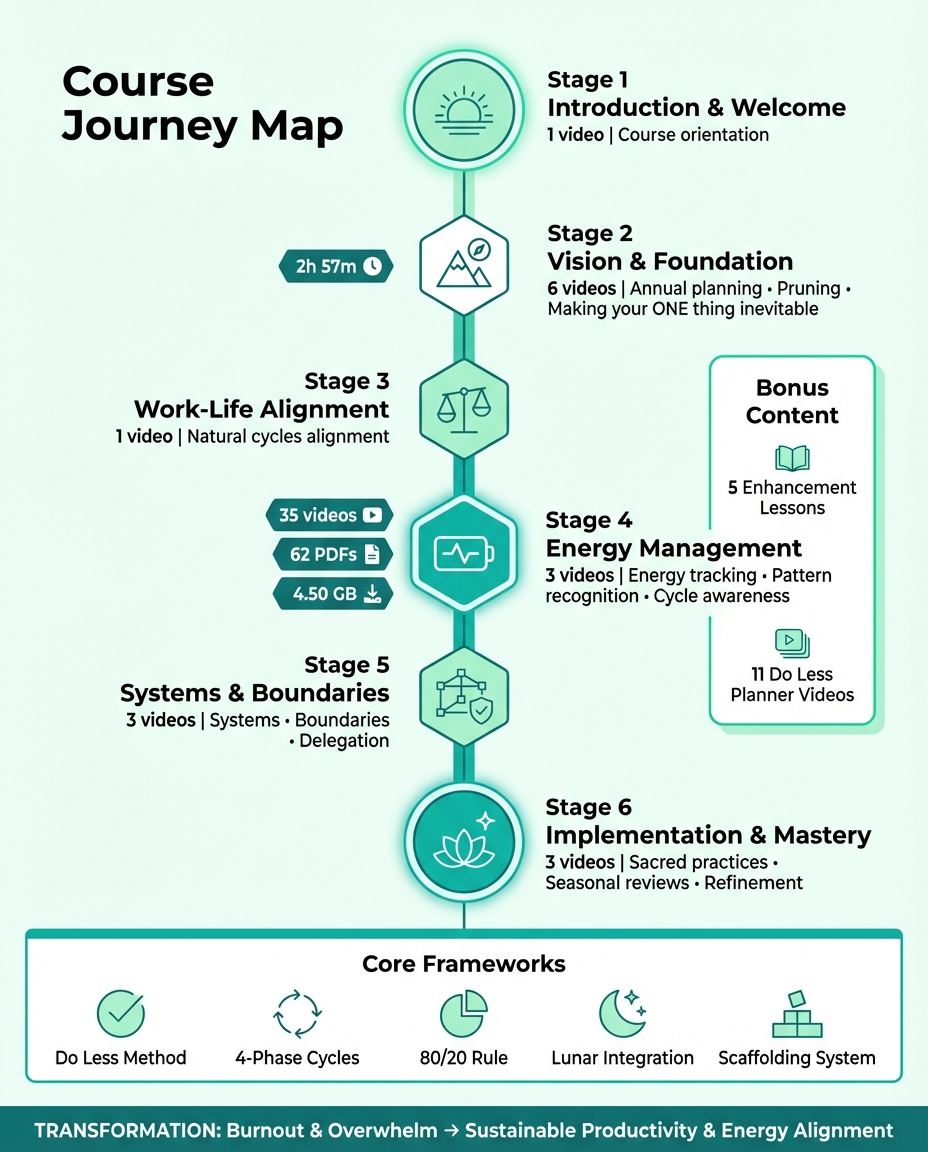
The Frameworks: The 20% That Delivers 80% of the Value
Not cliff notes. Full deconstructions. Here are the seven core frameworks Kate Northrup teaches — and how each one builds on the system.
1. The Four-Phase Cyclical Energy Model (Winter / Spring / Summer / Autumn)
The Four-Phase Cyclical Energy Model is Kate Northrup's foundational framework for mapping four phases of the menstrual cycle — or, for those not tracking their cycle, four phases of the lunar cycle — onto four seasonal archetypes with distinct energy signatures and optimal business activities.
Winter (menstruation / new moon): Rest phase. Energy is lowest. Cognitive overhead is highest for complex tasks. Optimal activities: reflection, journaling, releasing what is no longer working, visioning without execution pressure. Business implication: do not schedule launches, client calls, or high-stakes decisions here. Schedule recovery and review. Spring (follicular phase / waxing moon): Initiation phase. Energy begins to rise. Clarity and creativity emerge. This is the phase for beginning new projects, drafting content, planning next cycles, and brainstorming. Business implication: this is your idea-generation and project-launch window. Summer (ovulation / full moon): Visibility phase. Social energy peaks. Communication is easiest. Persuasion and magnetism — the qualities needed for sales calls, networking, public speaking, launching, and video — are most naturally available. Business implication: front-load high-visibility and revenue-generating activities here. Autumn (luteal phase / waning moon): Focus phase. Energy is decreasing but concentration is high. This is the phase for editing, analysis, detail work, systems building, and completing what was begun in Spring and Summer. Business implication: administrative tasks, financial review, and project completion belong here, not in Summer.The diagnostic the course asks you to run first: are you tracking your menstrual cycle? If yes, use that as your primary reference. If not (postmenopausal, on hormonal contraception, or simply not tracking), use the lunar cycle as an external proxy. The phases map identically.
The key takeaway is that most women who take this course immediately recognize they have been scheduling Summer-phase activities (launches, visibility, client-facing work) during Winter and Autumn, which is why those activities feel like dragging lead through water. Moving them to the appropriate phase is where the "do less, achieve more" result lives.
2. The Do Less Weekly Planning Ritual
The Do Less Weekly Planning Ritual is Kate Northrup's 3-step operational practice that applies the Four-Phase model week-to-week. The ritual is designed to take ten minutes.
First, identify which phase you are currently in. This takes thirty seconds if you are tracking your cycle or checking the lunar calendar.
Second, select three priorities for the week — only three — that are appropriate to the current phase. Northrup is explicit: three priorities, not ten. The constraint is the practice.
Third, create a half-page to-do list. Not a full page. Not a two-page capture. Half a page, built around the three priorities, filtered by what the current phase can actually support.
The point of the half-page constraint is not minimalism for its own sake. It is phase-realistic planning. A Winter-phase week cannot support a Summer-phase task list. Building a shorter list aligned to actual capacity is more productive than building an aspirational list that will be abandoned by Wednesday.
3. Prune Before You Plan
Prune Before You Plan is Kate Northrup's 5-step cutting process applied before any planning session. The premise is that most productivity bottlenecks are not planning failures — they are elimination failures. The calendar is full of commitments, projects, and obligations that were added during a high-energy phase and never removed.
The five steps:
Step 1 — List everything currently on your plate. Full capture, no filter. Step 2 — Identify what is draining versus energizing. Mark each item honestly. No rationalizing the draining things as necessary. Step 3 — Apply the 80/20 filter. Which 20% of your current activities produce 80% of your desired results? (Northrup uses the Two-Column Exercise here — see below.) Step 4 — Cut or delegate the bottom half. Not the bottom 20%. The bottom 50%. This is the step where the system diverges sharply from conventional productivity advice. Step 5 — Protect the white space created. Do not immediately fill it. The open space is the point. It is where initiation-phase ideas can surface and where recovery from Summer-phase output happens.The Prune Before You Plan process is most useful at the seasonal transition points — particularly entering Winter phase, when the temptation is to push through rather than release.
Heal the Way You Work teaches 7 frameworks: the Four-Phase Cyclical Energy Model, the Do Less Weekly Planning Ritual, Prune Before You Plan, the Upward Cycle of Success, the Sacred Practices Calendar, the Daily Energy Tracker, and the 80/20 Two-Column Exercise. The complete breakdown of all 7 — every framework, every limitation — is on Course To Action. Start free with 10 summaries, no credit card required. The course is $997; access to the full Course To Action breakdown starts at $49 for 30 days.
4. The Upward Cycle of Success (Emergence → Visibility → Culmination → Fertile Void)
The Upward Cycle of Success is Kate Northrup's 4-stage macro-level planning model that maps the Four-Phase seasonal framework onto the arc of a business initiative — a launch, a project, a product cycle — rather than a single week.
Emergence: The Spring-phase equivalent at project scale. A new idea or direction is forming. It needs space and low-pressure exploration, not execution. Visibility: The Summer-phase equivalent. The initiative is ready for the world. Launch windows, public commitments, and client acquisition belong here. Culmination: The Autumn-phase equivalent. The initiative is complete or completing. Integration, analysis of results, documentation of what worked. Fertile Void: The Winter-phase equivalent. Before the next initiative begins, there is intentional emptiness. Northrup teaches this as the most productive phase for long-term output and the most systematically eliminated phase in conventional business planning.The most important framework is the Upward Cycle of Success because it gives business owners a language for why launching a new product immediately after completing the previous one degrades output over time. The Fertile Void is not slack. It is the source of the next Emergence.
5. The Sacred Practices Calendar
The Sacred Practices Calendar is Kate Northrup's scheduling framework with one rule: block personal time first.
This inverts the standard calendar logic. In conventional scheduling, business commitments and revenue-generating activities are scheduled first, and personal time is fit into whatever remains. The Sacred Practices Calendar schedules rest, movement, connection, and renewal first — particularly during Winter and Autumn phases — then schedules business work around that protected time.
The practical implementation involves identifying what Northrup calls "sacred practices" — the specific activities that most reliably restore your energy (not the ones you think should restore your energy). These go on the calendar first, in the appropriate phases, with the same level of commitment as client calls.
The counterintuitive result the course claims: total output increases because sustainable output replaces burst output followed by recovery debt.
6. The Daily Energy Tracker
The Daily Energy Tracker is Kate Northrup's tracking tool for building phase-cycle awareness before applying the planning system. The tracker is simple: at the end of each day, note your energy level, your mood, and the primary type of work that felt natural.
The tracker's purpose is calibration. The Four-Phase model gives you a general map. Your actual cycle gives you the specific terrain. Some women find their Summer phase lasts six days, others find it lasts ten. Some find their Winter arrives three days before their period begins. The Daily Energy Tracker builds the data set that makes the planning system precise rather than approximate.
Northrup recommends tracking for at least one full cycle before applying the planning frameworks with confidence.
7. The 80/20 Two-Column Exercise
The 80/20 Two-Column Exercise is Kate Northrup's structured elimination tool applied during the Prune Before You Plan process. Create two columns. Column one: list all your current business activities, commitments, and projects. Column two: next to each, estimate the percentage of your results (revenue, impact, satisfaction) it produces.
The exercise almost always produces a lopsided result — a small number of activities generate a disproportionate share of results, and a large number of activities generate marginal returns while consuming significant time.
The framework uses that asymmetry as the cutting guide. Activities in the low-result column are candidates for elimination or delegation, regardless of how long they have been on the list or how much effort was spent building them. Sunk cost is explicitly not a reason to keep a draining activity.
What This Course Teaches Exceptionally Well
The core diagnosis is accurate and underserved. The insight that most productivity advice is built on a 24-hour hormonal model and therefore systematically misfit for people with 28-day cycles is a legitimate and useful observation. It explains a real pattern — chronic exhaustion, cyclical burnout, phases of high output followed by crashes — that standard productivity frameworks treat as a discipline problem. Northrup is not the first to make this argument (it builds on work from Alisa Vitti and others), but she operationalizes it with more business-specific practicality than most. The planning tools are immediately applicable. The Do Less Weekly Planning Ritual, the Sacred Practices Calendar, and the Prune Before You Plan process can be implemented in the first week without any additional resources. They are specific, low-overhead, and directly tied to the course's central premise. The permission structure has real value. In summary, a significant portion of what this course delivers is explicit permission to rest when you are in a rest phase, to not launch when you are in an Autumn-phase energy state, to build white space into your calendar before it is stolen by commitments. For women whose identity is entangled with productivity and overwork, this permission — from someone with credibility and a business framework to back it — has genuine therapeutic utility.Get Every Framework from Heal the Way You Work
The course costs $$997. The complete breakdown is $49/year.
Start free — 10 full summaries, no credit card
What This Course Does Not Cover
We tell you what the course DOESN'T cover. No other review does this.
This is a planning system, not a business growth system. There is no marketing strategy, no offer design, no revenue model, no client acquisition framework in these 35 lessons. Northrup is clear about this positioning, but it bears emphasis: you can implement every framework in this course flawlessly and not generate a single new dollar of revenue. The course optimizes how you work, not what you are working on. Approximately 30% of the content is spiritual or metaphysical. Northrup is the author of "Money A Love Story" and "Do Less," and her work consistently integrates spiritual and cyclical philosophy alongside practical tools. The lunar cycle, feminine archetypes, and concepts like the Fertile Void carry a layer of spiritual meaning that is not separable from the practical framework. The main limitation is that if you are a purely analytical thinker who requires evidence-based frameworks, roughly a third of the course will feel like friction rather than value. The course is short. Three to four hours of total content across 35 lessons means the average lesson is six to seven minutes. For a $997 investment, the content density is high and the total runtime is low. This is not inherently a flaw — the frameworks are well-constructed for their length — but if you are accustomed to multi-module, multi-week programs, the brevity will be noticeable. There is no community component. No cohort, no group coaching, no peer accountability structure. The implementation support is self-directed. For solopreneurs who rely on community accountability to apply what they learn, this is a meaningful gap. The framework assumes you have a business to plan around. Solopreneurs and established service providers are the intended audience. If you are pre-revenue, the planning system has nothing to organize yet.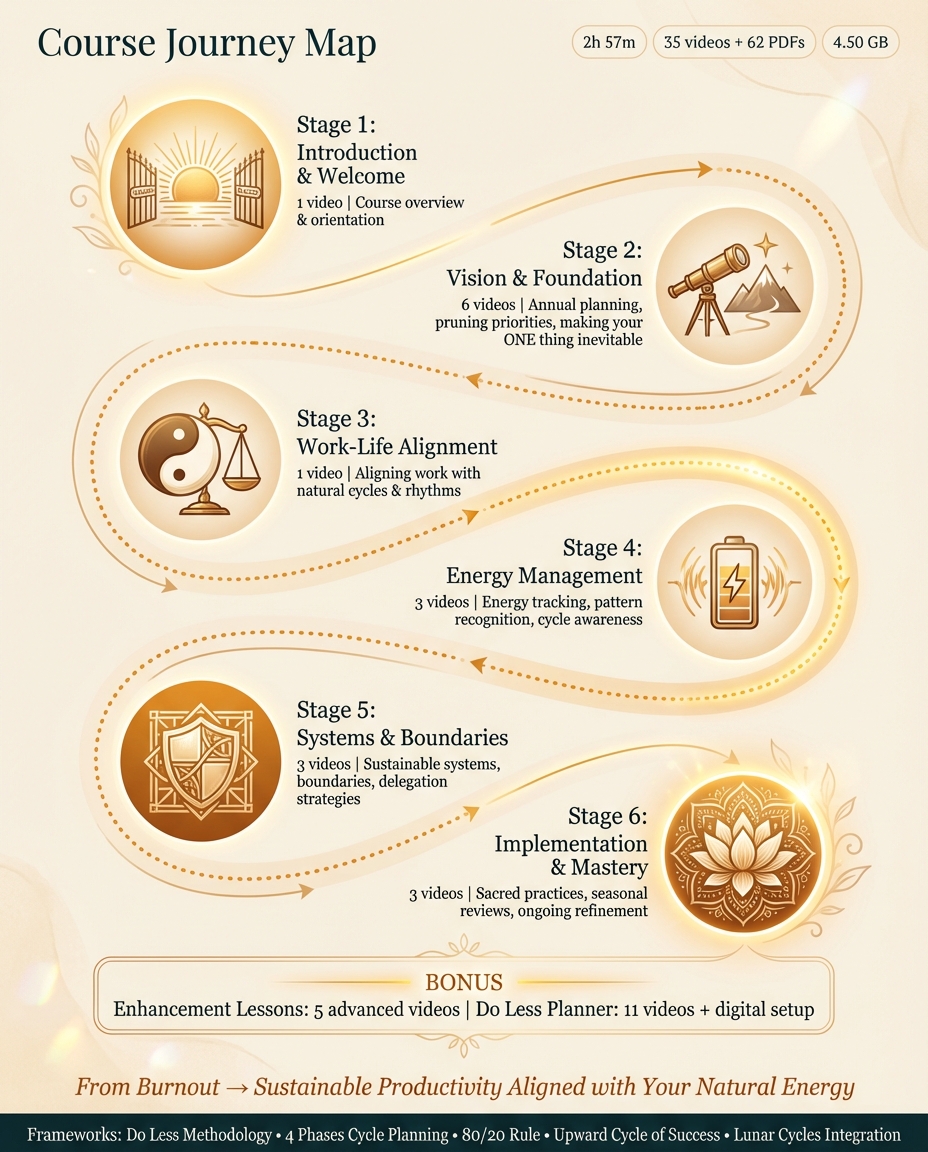
Who This Course Is Actually For
This is best suited for you if you can say yes to most of these:
- You are a woman running a service-based business or freelance practice who has tried conventional time management systems and found them sustainable only in bursts.
- You recognize a cyclical pattern in your own energy and output — months of high output followed by crashes, phases where everything feels hard that are followed by phases where everything flows — but you have been trying to override it rather than work with it.
- You are open to a framework that includes both practical planning tools and spiritual or feminine-energy concepts. The two are woven together throughout.
- You are a solopreneur or mother with a business, where the demands on your time are non-delegable and where overextension has direct personal costs.
- You are already generating revenue and looking for a system that makes the work more sustainable, not a system that generates new revenue.
- You are familiar with or curious about Kate Northrup's broader body of work — "Do Less," The Origin Company — and want a practical implementation of those principles.
Who Should Skip This Course
Be honest with yourself about these:
- You need business strategy. If your primary problem is revenue, client acquisition, or offer design, this course will not address it. The planning system requires a functioning business to plan around.
- You are a man. The language, frameworks, and community positioning are explicitly built for women. The menstrual cycle mapping is the primary framework; the lunar cycle is offered as a proxy. Neither is a neutral fit for men.
- You are primarily analytical and spiritual content creates friction for you. If you will spend 30% of a course intellectually resistant to the framing, the other 70% will underperform.
- You want depth matched to the price point. Three to four hours for $997 is a high cost-per-hour ratio. The frameworks are real, but if your evaluation metric is content volume, this will disappoint.
- You are in a growth phase and need execution tools rather than sustainability tools. This system is designed to optimize an established working life, not to accelerate an early-stage business.
The Verdict
Heal the Way You Work is a genuinely original productivity system for a genuinely underserved audience. The Four-Phase Cyclical Energy Model is well-constructed and immediately applicable. The Do Less Weekly Planning Ritual and Prune Before You Plan process are specific enough to implement without additional support. The central diagnosis — that conventional productivity systems are architecturally mismatched for people with 28-day cycles — is accurate, useful, and stated with more practical clarity than most competitors in this space.
The limitations are real and worth naming directly. The course is short relative to its price. A third of the content requires openness to spiritual framing. It will not generate revenue. There is no community.
Buy it if: You are a woman entrepreneur in an established business who recognizes a cyclical burnout pattern, is open to a planning system grounded in both feminine physiology and intuitive principles, and wants a framework for working sustainably rather than harder. Skip it if: You need business strategy, you are skeptical of spiritual frameworks, or you are looking for content volume matched to the $997 price.Start free on Course To Action — 10 summaries, no credit card required. Read the full breakdown of all 7 frameworks in Heal the Way You Work (the Four-Phase Cyclical Energy Model, Do Less Weekly Planning Ritual, Prune Before You Plan, the Upward Cycle of Success, the Sacred Practices Calendar, the Daily Energy Tracker, and the 80/20 Two-Column Exercise), then use the "Apply to My Business" AI tool to apply any framework — the cyclical energy model, the Prune Before You Plan audit, the Upward Cycle of Success — to your specific situation before you spend $997. Every summary and every lesson has audio. Course To Action covers 110+ premium courses. Access starts at $49 for 30 days or $399/year — one payment, no subscription, no auto-renewal.
Start free at Course To ActionFrequently Asked Questions
Is Heal the Way You Work worth $997?Heal the Way You Work is worth $997 if you are a woman entrepreneur with an established business who recognizes a cyclical burnout pattern and wants a planning system built around her physiology rather than against it. The 7 frameworks — particularly the Four-Phase Cyclical Energy Model and the Upward Cycle of Success — are genuinely original and immediately applicable. Skip it if your primary problem is tactical (revenue, client acquisition, offer design) rather than structural. Before spending $997, you can read the full framework-level breakdown on Course To Action for free — 10 summaries, no credit card required — and use the "Apply to My Business" AI tool to see how the frameworks apply to your specific situation before you commit.
What does Heal the Way You Work actually teach?Heal the Way You Work teaches 7 named frameworks: the Four-Phase Cyclical Energy Model, the Do Less Weekly Planning Ritual, Prune Before You Plan, the Upward Cycle of Success, the Sacred Practices Calendar, the Daily Energy Tracker, and the 80/20 Two-Column Exercise. Together they form a cyclical planning system that replaces 24-hour productivity models with a 28-day rhythm-based approach.
What does Heal the Way You Work NOT cover?The course does not cover marketing strategy, offer design, revenue models, client acquisition, or any business growth tactics. It also has no community component, no cohort, and no live coaching. Approximately 30% of the content is spiritual or metaphysical in framing. The total runtime is 3-4 hours across 35 lessons.
Who is Heal the Way You Work best for?Heal the Way You Work is best for women entrepreneurs, solopreneurs, and service providers who have tried conventional productivity systems and found them sustainable only in bursts. It is specifically designed for women who recognize a cyclical pattern in their energy and output and are open to a framework that integrates practical planning tools with feminine cyclical philosophy.
Does Heal the Way You Work work if I am postmenopausal or not tracking my menstrual cycle?Yes. Northrup explicitly designs the course for this situation. The lunar cycle is offered as an external proxy that maps identically to the Four-Phase model — Winter to new moon, Spring to waxing moon, Summer to full moon, Autumn to waning moon. The practical frameworks function the same way regardless of whether you are using a menstrual or lunar reference. That said, the menstrual cycle mapping is the primary framework, and the lunar cycle is positioned as an alternative rather than an equal.
How does Heal the Way You Work compare to Alisa Vitti's In the FLO or WomanCode?Alisa Vitti is the most well-known figure in the cycle-syncing-for-productivity space. Her work focuses more heavily on the hormonal and nutritional science of the menstrual cycle, with detailed protocols for diet, exercise, and lifestyle across phases. Northrup's framework is more business-planning-specific and more spiritually inflected. If you want the science of why cycle syncing works at a physiological level, Vitti goes deeper. If you want a practical business planning system built on cyclical principles, Northrup is more operationally specific. They are complementary rather than redundant.
Where can I read a full summary of Heal the Way You Work?The complete independent breakdown of Heal the Way You Work — every framework extracted, every lesson documented, every limitation noted — is available at Course To Action. Start free.
Course To Action publishes independent framework-level breakdowns of online courses — the 20% that delivers 80% of the value, so you can make an informed decision before you spend a dollar.
Read the Complete Heal the Way You Work Summary
The course costs $$997. The full breakdown is $49/year — for every course on the platform.
Every framework deconstructed, every action step extracted, AI that applies it to your specific business. Read or listen — every summary has audio.
Start free — 10 full summaries, no credit card required