I Do Course Review (2026): Every Framework, Honest Limitations
Bottom line up front: The I Do Course is a $997, 52-lesson program by Shelly Bullard that applies Neville Goddard's Law of Assumption specifically to manifesting marriage. It is the most rigorously structured course in this niche, and the identity-shift framework it teaches is meaningfully different from generic manifestation content. The core insight is that you do not manifest what you want — you manifest who you are. That said, it only works if you already believe manifestation is a real mechanism — and its narrow romantic focus means you won't repurpose the material elsewhere. According to the full breakdown on Course To Action, the course contains six named frameworks across 22.8 hours.What the I Do Course Actually Teaches
Most manifestation courses say some version of "feel good and it will come." Shelly Bullard's I Do Course says something more specific: you don't manifest what you want — you manifest who you are.
The entire 22.8 hours is built around one core insight borrowed from Neville Goddard's Law of Assumption: your external reality is a printout of your internal self-concept. If you internally identify as "single and unchosen," your circumstances will keep confirming that identity regardless of how many vision boards you make. The shift required is not emotional or behavioral — it is ontological. You have to become a married person on the inside before the outside can catch up.
That framing is either deeply resonant or completely unpersuasive depending on your prior beliefs, which is the first thing to know before spending $997.
The Core Frameworks
Three Manifesting Principles
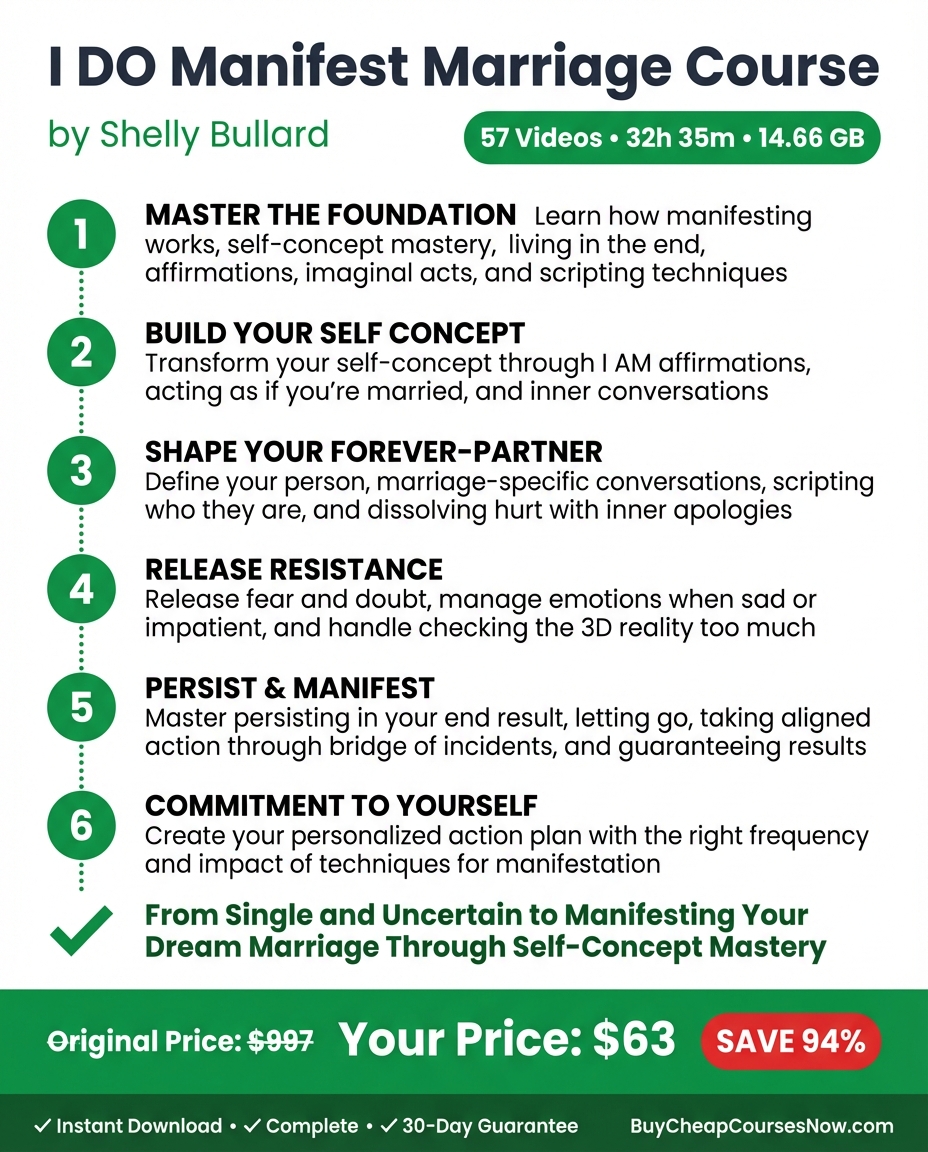
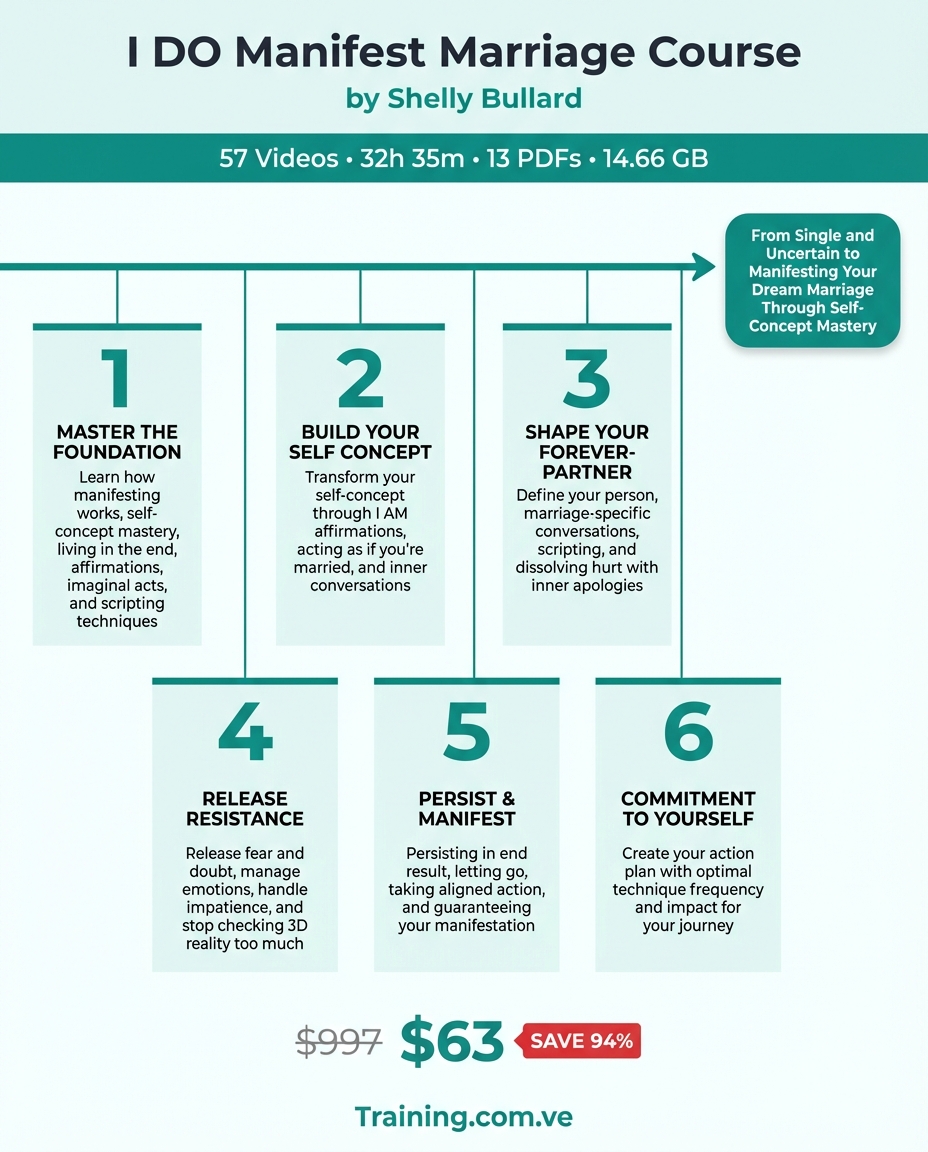
Shelly organizes the course around three interlocking principles:
- Self-Concept — Your identity is the primary creative force. The course opens here because everything else depends on it.
- EIYPO (Everyone Is You Pushed Out) — Other people's behavior toward you reflects your own beliefs about yourself. Your partner's reluctance to commit is, in this framework, a mirror of your own internal doubt about being someone worth committing to.
- Living in the End — Borrowed directly from Neville Goddard, this principle asks you to imagine not the journey to marriage but the state of already being married, and to assume that state in the present.
Three-Phase Daily Protocol
The Three-Phase Daily Protocol is Shelly Bullard's structured daily practice for installing a new identity. The steps are: morning scripting, afternoon affirmation saturation, and night imaginal acts. This is where the I Do Course earns its structure points. Rather than leaving you with principles and a vague instruction to "feel it," Shelly gives you a concrete daily protocol:
- Morning scripting — Written exercises to lock in the married identity at the start of the day
- Afternoon saturation — Sensory visualization and audio tools to keep the new self-concept active mid-day
- Night imaginal acts — Neville Goddard's signature technique: falling asleep in an imagined scene of already having what you want
Two-Factor Model
The Two-Factor Model is Shelly Bullard's framework for mapping the two internal variables that determine manifesting outcomes. This is arguably the most intellectually interesting piece of the course. Shelly proposes that manifesting a specific person involves two variables:
- 60-70%: Your own self-concept (the part you can directly change)
- 30-40%: Your partner's own beliefs, operating under their own Law of Assumption
The I Do Course contains 7 named frameworks: Three Manifesting Principles, Three-Phase Daily Protocol, Two-Factor Model, Certainty Percentage Framework, Bridge of Incidents, Two-Step Affirmation Method, and Nine Common Challenges Framework. The complete breakdown of all 7 is on Course To Action — free to start, no credit card required (10 free summaries on the free tier). The I Do Course costs $997. A Course To Action membership is $49 for 30 days.
Other Notable Frameworks
- Certainty Percentage Framework — A diagnostic tool to measure how certain you feel in your married identity (and what's eroding that certainty). The key takeaway is that practice intensity should be calibrated to your actual certainty level, not a one-size-fits-all prescription.
- Bridge of Incidents — The concept that external circumstances will reorganize themselves through a logical chain of events; you don't need to engineer the path
- Two-Step Affirmation Method with Bridge Affirmations — A more nuanced affirmation approach that addresses the gap between where you are and where you want to be, without forcing you to lie to yourself
- Nine Common Challenges Framework — A troubleshooting module for the most common sticking points (doubt, impatience, evidence of absence, third-party interference, etc.)
Who Built This Course
Shelly Bullard is a manifestation teacher and therapist who has been publishing content in this space for over a decade. Her other major course, Embodied Millionaire, applies the same Law of Assumption framework to financial identity. Her credibility in the I Do Course is reinforced by one specific claim: she documented using these exact techniques to manifest her own fiancé. Whether you weight that as evidence or anecdote depends on your priors, but it distinguishes her from teachers who work purely theoretically.
The Real Strengths
1. Identity-level depth. Most manifestation content operates at the level of feelings and affirmations. The I Do Course operates at the level of identity, which is a meaningfully different and arguably more powerful intervention point. The EIYPO principle in particular reframes relationship dynamics in a way that even skeptics often find psychologically interesting. 2. Structural specificity. The Three-Phase Daily Protocol solves the implementation problem that kills most manifestation practice. You know exactly what to do, when, and why. 3. The Two-Factor Model's honesty. Acknowledging that your partner has their own beliefs — and that this accounts for roughly a third of the equation — is more intellectually credible than frameworks that treat other people as purely passive. 4. The troubleshooting module. The Nine Common Challenges Framework means the course anticipates failure modes rather than just selling you the ideal path. That kind of pre-mortem thinking is underrepresented in this category.Get Every Framework from This Course
The course costs $997. The complete breakdown is $49/year.
Start free — 10 full summaries, no credit card
The Real Limitations
The main limitation is the course's narrow scope combined with a high entry point.
1. It requires prior belief. The I Do Course is not designed to convert skeptics. It opens assuming you believe manifestation works and builds from there. If you're on the fence, the $997 price is a significant bet on a premise the course won't defend. 2. Exclusively marriage-focused. Every framework, every exercise, every metaphor is organized around romantic partnership and marriage specifically. You cannot easily adapt this material to manifesting career outcomes, financial change, or health. If you're looking for a general-purpose manifestation framework, this is the wrong entry point. 3. No relationship skills layer. The course teaches inner work as the complete solution. There is no module on communication, attachment patterns, how to meet people, or how to navigate relationship stages practically. If your situation involves real-world relationship complexity, the I Do Course will not address that directly. 4. Repetition across 22.8 hours. Several reviewers and the course structure itself suggest that the core content could be delivered in significantly less time. The length feels padded in places, with the same principles re-introduced across multiple lesson clusters. For a $997 course, tighter editing would improve the experience.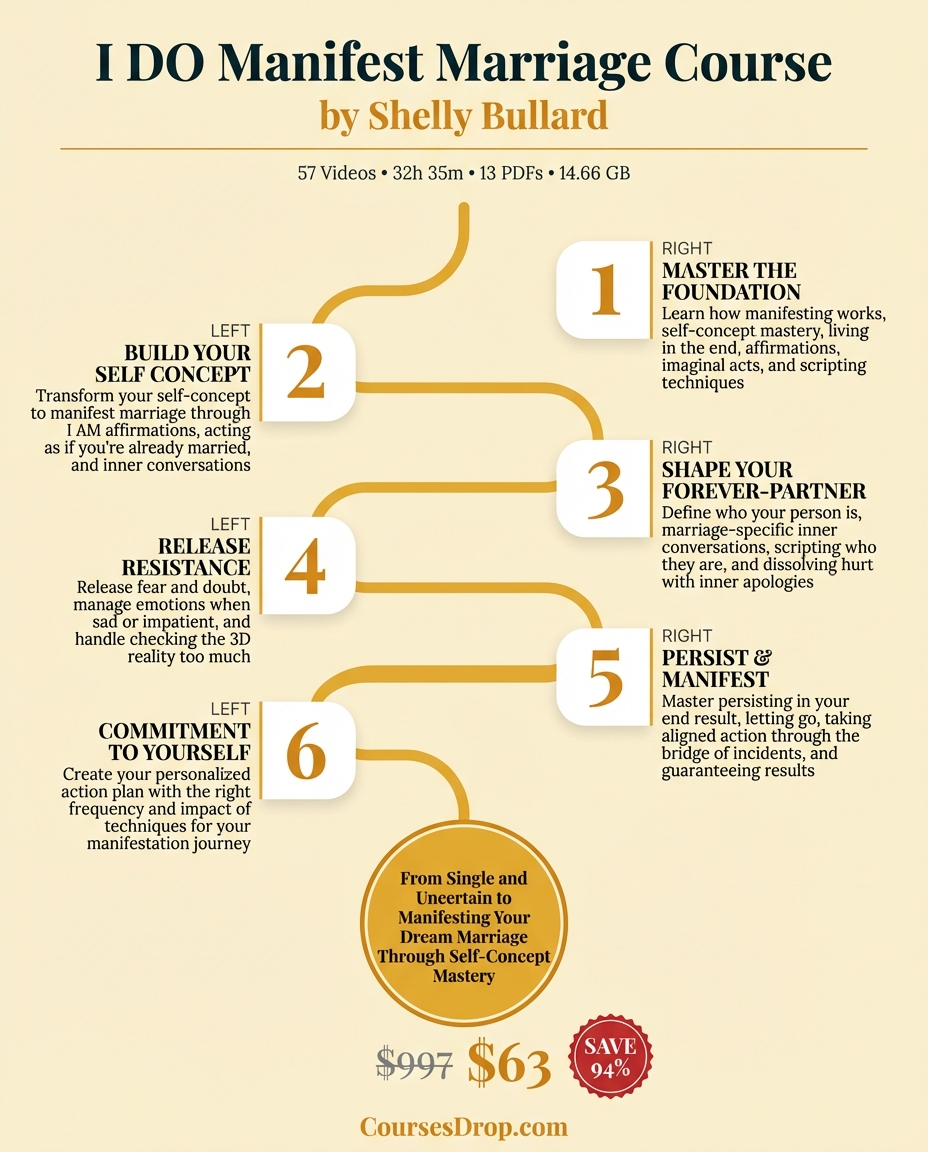
Pricing and Value
At $997, the I Do Course sits at the premium end of the manifestation course market. In summary, the price is defensible if:
- You are a committed manifestation practitioner who has already spent money on general-purpose programs and wants something marriage-specific
- You are a specific-person manifester who has been stuck in generic advice and needs a structured daily protocol
- You resonate with Neville Goddard's Law of Assumption framework specifically
Who This Is For
This is best suited for committed manifestation practitioners who want a rigorous, marriage-specific system.
Buy the I Do Course if:- You already believe in manifestation and want the most rigorous marriage-specific application of the Law of Assumption
- You've been single in a pattern you recognize as identity-level rather than circumstantial
- You're working on manifesting a specific person and want a framework that acknowledges their role in the equation
- You respond well to structured daily protocols rather than open-ended practices
- You're skeptical about manifestation and need evidence it works before investing
- You want dating strategy, communication skills, or practical relationship tools
- You're looking for a general-purpose manifestation framework you can apply across life domains
- You need couples-level intervention or therapeutic support
FAQ
Is the I Do Course worth $997?The I Do Course is worth $997 if marriage is your specific, current goal and you already believe in manifestation as a mechanism. It contains seven named frameworks — including the Three-Phase Daily Protocol, the Two-Factor Model, and the Certainty Percentage diagnostic — that give you a structured daily system rather than vague principles. If you need convincing that manifestation works, the course will not provide that, making the price harder to justify. Before spending $997, you can read the full framework breakdown free on Course To Action — 10 free summaries, no credit card required — and use the AI "Apply to My Business" tool to see how these frameworks apply to your specific situation.
What does the I Do Course actually teach?The I Do Course teaches identity-based manifestation applied specifically to marriage. The core claim is that you manifest who you are, not what you want. It provides a structured Three-Phase Daily Protocol (morning scripting, afternoon affirmation saturation, night imaginal acts), the Two-Factor Model for understanding manifesting variables, and the Certainty Percentage diagnostic for calibrating practice intensity.
What does the I Do Course NOT cover?The I Do Course does not cover dating strategy, communication skills, conflict resolution, attachment theory, or general relationship development. It does not address manifestation for career, financial, or health outcomes. It also does not engage with skeptical perspectives or offer evidence-based frameworks — it assumes manifestation works from the outset.
Who is the I Do Course best for?The I Do Course is best for someone who specifically wants to be married (not just in a relationship), already accepts manifestation as a valid framework, has been stuck in inconsistent results, and is willing to commit to structured daily identity practice. It is particularly relevant for specific-person manifesters who want a framework that acknowledges their partner's own agency.
How does the I Do Course compare to other manifestation courses?The I Do Course is narrower in scope but deeper in structure than most manifestation courses. Where general programs cover multiple life domains with broad principles, the I Do Course applies the Law of Assumption exclusively to marriage through a concrete daily protocol. The Two-Factor Model and the Certainty Percentage diagnostic are frameworks not typically found in competing courses.
Where can I read a full breakdown of the I Do Course?The complete independent breakdown — every framework, every limitation, and a detailed analysis of who should and should not buy it — is available at Course To Action.
Final Verdict
The most important framework is the identity-first approach: the I Do Course is the most coherently structured manifestation program specifically targeting marriage that exists in this niche. The identity-first framework is intellectually stronger than surface-level affirmation content, the daily protocol solves the implementation problem, and Shelly Bullard's personal story gives the teaching unusual credibility. The limitations — narrow focus, no skeptic on-ramp, no relationship skills, and some repetition — are real and worth weighing at the $997 price point.
Before you spend $997, start free on Course To Action. The free tier gives you 10 summaries with no credit card required. Read the full breakdown of all 7 frameworks — Three Manifesting Principles, Three-Phase Daily Protocol, Two-Factor Model, Certainty Percentage Framework, Bridge of Incidents, Two-Step Affirmation Method, and Nine Common Challenges Framework — and use the AI "Apply to My Business" tool to apply frameworks like the Certainty Percentage or the Two-Factor Model directly to your situation (3 credits). Every summary and every lesson has audio. Course To Action covers 110+ premium courses. Membership is $49 for 30 days or $399/year — one payment, no subscription, no auto-renewal.
Start free at Course To Action — no credit card required. Course To Action publishes independent framework-level breakdowns of online courses — the 20% that delivers 80% of the value, so you can make an informed decision before you spend a dollar.Affiliate disclosure: Course Navigator may earn a commission if you purchase through links on this page. This does not affect our editorial assessment. We reviewed the course independently.
Read the Complete Summary
The course costs $997. The full breakdown is $49/year — for every course on the platform.
Every framework deconstructed, every action step extracted, AI that applies it to your specific business. Read or listen — every summary has audio.
Start free — 10 full summaries, no credit card required