LifeOS Review (2026): Every Framework, Honest Limitations, and Whether Ali Abdaal's $297 System Is Worth It
LifeOS is a $297 course by Ali Abdaal that teaches a complete personal productivity operating system across 38 lessons and 7 modules, covering everything from long-range vision-setting to daily focus habits. It is worth it if you are a solo founder or knowledge worker who feels perpetually busy but not genuinely productive. Skip it if you already have a functioning system or need business strategy rather than personal productivity.
According to the full breakdown on Course To Action, LifeOS is the best structured introduction to a complete personal productivity system at this price point, taught by someone who has genuinely lived it rather than just theorized about it. It has two real limitations — and knowing them upfront will tell you whether the $297 is right for you or not.
The Course at a Glance
| Field | Details |
|---|---|
| Course | LifeOS |
| Creator | Ali Abdaal |
| Price | $297 |
| Content | 7 modules / 38 lessons / live cohort recordings |
| Best For | Solo founders, entrepreneurs, and knowledge workers who feel perpetually busy but not productive |
| Core Topic | A complete personal productivity operating system built on Vision and Action |
| Skip If | You already have a functioning system; you want business strategy; you want app-specific tutorials |
| Rating | 4 out of 5 — One of the most cohesive productivity systems available; limited for teams and advanced users |
The Core Insight
Most productivity problems are not knowledge problems. They are memory problems.
You know what matters. You decided what your priorities are. Then life happened — meetings, notifications, urgent requests from other people — and three weeks later you realize you have been completely reactive. The goals you set in January have not moved. You forgot what you decided.
The core insight is this: Ali Abdaal's central thesis is deceptively simple. The reason productive people stay productive is not that they have better willpower or more discipline. It is that they have built systems that keep reminding them what they decided. A five-minute Morning Manifesto and a fifteen-minute Weekly Review do more for your output than any app, any optimization hack, or any time-blocking scheme.
The problem is not effort. It is direction. And LifeOS is a complete operating system for maintaining direction.
The Frameworks: The 20% That Delivers 80% of the Value
Not cliff notes. Full deconstructions. Here are the five core frameworks that carry the course — and how each one builds on the last.
1. The LifeOS Framework: Six Components Across Two Pillars
The LifeOS Framework is Ali Abdaal's organizing architecture for the entire course. Everything else is built inside this structure.
Vision Pillar — the three components that answer what you want and why:- Life Compass: Your values and priorities, made explicit and documented. Not a vague sense of what matters — a written reference point you can check decisions against.
- Future Sketch: A flexible, non-pressurized description of what your life looks like in five to ten years. Abdaal distinguishes this from rigid ten-year plans — it is meant to orient direction, not constrain possibility.
- Quarterly Quests: Ninety-day goals that replace annual goal-setting. Short enough to stay emotionally real, long enough to accomplish something substantial. The name signals intent: goals should feel like quests, not obligations.
- Focused Hours: Tracked blocks of deep, distraction-free work. Abdaal's target is three to five focused hours per day — not eight, not twelve. The insight: most people's real focused work, when honestly measured, is closer to ninety minutes. Three to five is the ambitious and achievable target.
- Productive Days: The daily structure that makes focused hours happen consistently. Anchored by the Morning Manifesto (see below).
- Balanced Weeks: The weekly rhythm that prevents the common failure mode of being relentlessly productive Monday through Thursday and completely depleted by Friday.
2. The Focused Hour Formula: 5-50-5
The Focused Hour Formula is Ali Abdaal's specific protocol for a single block of deep work.
Five minutes: Set up. Clear your environment, close irrelevant tabs, set a timer, write down the one thing you are doing in this block. Fifty minutes: Work. No phone, no notifications, no multitasking. The fifty-minute window is deliberately sub-hour — it creates a contained unit that feels completable, not endless. Five minutes: Close down. Write what you accomplished, note the next action, and fully close out the context before anything else starts.The sixty-minute total is practical design. Most calendar systems default to sixty-minute blocks. The 5-50-5 fills that block with a clean protocol that has a beginning, middle, and end — which matters psychologically. Open-ended work sessions bleed into each other. Contained sessions compound.
The course pairs this with the concept of Four Horsemen of Deep Focus: the four primary destroyers of focused work (environment distractions, internal distractions, unclear tasks, and low energy). The 5-50-5 addresses all four through its setup ritual.
3. The Three Focus Menus
The Three Focus Menus is one of the most practically useful frameworks in the course, and the one most people would not find on their own.
Abdaal identifies three types of focus sessions, each requiring a different kind of cognitive mode:
Activation Focus: Starting new work. High cognitive cost, high resistance. Requires the most intentional setup and the most forgiving environment for imperfect output. Reactivation Focus: Returning to existing work after a break or interruption. The main challenge is context reconstruction — remembering where you were, what the next step is, what decisions you had made. Abdaal teaches a specific note-taking convention inside active projects specifically to minimize this reconstruction cost. Recharge Focus: Sessions designed to maintain cognitive capacity rather than deplete it further. Abdaal argues that scheduling recharge focus is not laziness — it is system maintenance. A system that runs at 100% without maintenance degrades faster than one that includes scheduled recovery.The key takeaway is that most productivity advice treats all work sessions as identical. They are not. Conflating them means you often apply the wrong strategy to the wrong type of session, then wonder why your productivity system is not working.
LifeOS teaches 6 frameworks — the LifeOS Framework, Focused Hour Formula (5-50-5), Three Focus Menus, Morning Manifesto, GPS Method, and Weekly Review. The complete breakdown of all six, plus every limitation, is on Course To Action. Free tier includes 10 summaries, no credit card — or read the full course for $49/30 days vs. $297 here.
4. The Morning Manifesto: Prime, Align, Organize
The Morning Manifesto is Ali Abdaal's daily ritual that anchors the Action pillar. Abdaal calls it a manifesto rather than a routine deliberately — the word signals that it is a declaration of intent, not a checklist.
Prime (approximately two minutes): Activate a positive mental state before touching work. Abdaal's preferred methods include a brief gratitude practice, movement, or reading something inspiring. The purpose is neurological: you cannot do your best thinking from a stress or anxiety state. Priming addresses this before the day applies pressure. Align (approximately two minutes): Review your Quarterly Quests and confirm that what you are planning to do today is actually connected to what you decided matters. This is the anti-drift mechanism. Without this step, it is trivially easy to spend a full day on reactive work that serves other people's agendas while your own priorities gather dust. Organize (approximately one minute): Time-block the day. Specifically, protect time for at least one Focused Hour block before committing to meetings, emails, or requests. The Organize step is intentionally last — you do not organize until you have primed and aligned, because organizing a stress state produces a defensive, reactive schedule rather than an intentional one.Total time: five minutes. This is not an accident. Abdaal is explicit that the Morning Manifesto must be short enough to do every day without friction. A thirty-minute morning routine is a weekend project. A five-minute manifesto is a daily habit.
5. The GPS Method: Goal, Plan, System
The GPS Method is Ali Abdaal's framework for building a Quarterly Quest that actually has a chance of working.
Goal: What do you want to achieve in the next ninety days? Stated specifically enough that you will know whether you achieved it. Plan: What are the major milestones or steps between now and the goal? Not an exhaustive task list — a map of the terrain. System: What is the recurring, schedulable action that, done consistently, makes the goal inevitable? This is the most important framework is the most frequently skipped step. Goals and plans are the what. The system is the how-on-Tuesday-at-3pm.Abdaal's argument is that most people stop at Goal and occasionally at Plan, but almost never build the System. The System is what survives contact with a busy week. A goal without a system is a wish. A system without a goal is busy work. The GPS Method ensures you have all three.
What This Course Teaches Exceptionally Well
The Vision pillar is genuinely rare. The overwhelming majority of productivity courses are entirely tactical — here is how to use your calendar, here is a to-do system, here is how to batch your email. LifeOS takes a full three modules to build Vision before touching Action. The Future Sketch and Quarterly Quests modules, in particular, teach a relationship with goals that is ambitious without being anxiety-inducing. For someone who has abandoned annual goal-setting because it always feels like failure by February, the ninety-day framing is a genuine revelation. Procrastination is reframed accurately and usefully. Abdaal teaches that procrastination is an emotional problem, not a knowledge problem. You do not procrastinate on tasks because you do not know how to do them. You procrastinate because you have an emotional response — fear of failure, boredom, anxiety about imperfection — that you are trying to avoid. This reframe immediately makes procrastination more tractable. The intervention is emotional, not informational. This is best suited for people who know what to do but cannot make themselves do it consistently. The cohort recordings are substantive. Live Q&A sessions add real texture that pre-recorded lessons cannot replicate. Watching Abdaal respond to specific, real-world problems — "I keep planning my week on Sunday but abandoning the plan by Tuesday" — gives the frameworks a lived quality. You see the system being stress-tested in real time.Get Every Framework from LifeOS
The course costs $$297. The complete breakdown is $49/year.
Start free — 10 full summaries, no credit card
What This Course Does Not Cover
We tell you what the course DOESN'T cover. No other review does this.
There is no team productivity content. LifeOS is entirely a personal operating system. If you manage a team, lead a company with direct reports, or need productivity frameworks that work across multiple people, this course will not help you with that. It is designed for the individual contributor or solo founder. There are no app-specific tutorials. Abdaal references Notion, Obsidian, and similar tools in passing, but the course does not teach you to build your LifeOS inside any specific application. The frameworks are app-agnostic by design — which is a legitimate choice — but if you want step-by-step implementation guidance inside a specific tool, you will need to find that elsewhere. The Vision pillar requires genuine emotional engagement. The Future Sketch and Life Compass modules ask you to do reflective work that some people find uncomfortable or premature. If you are in a period of significant life uncertainty — career change, relationship transition, geographic upheaval — the Vision exercises can feel impossible to complete honestly. The main limitation is that the course does not acknowledge this constraint. There is no business strategy. LifeOS teaches you to execute effectively on your priorities. It does not help you determine whether your business model is right, whether you are in the right market, or whether your offer is worth building. Being productive toward the wrong goal is worse than being unproductive — and LifeOS will make you more productive without addressing whether the goal is right. The course promotes Abdaal's Productivity Lab membership. This is not a dealbreaker, but it is worth knowing. Several lessons point toward the Lab as the ongoing community and accountability layer. The course is complete without it, but the upsell is present.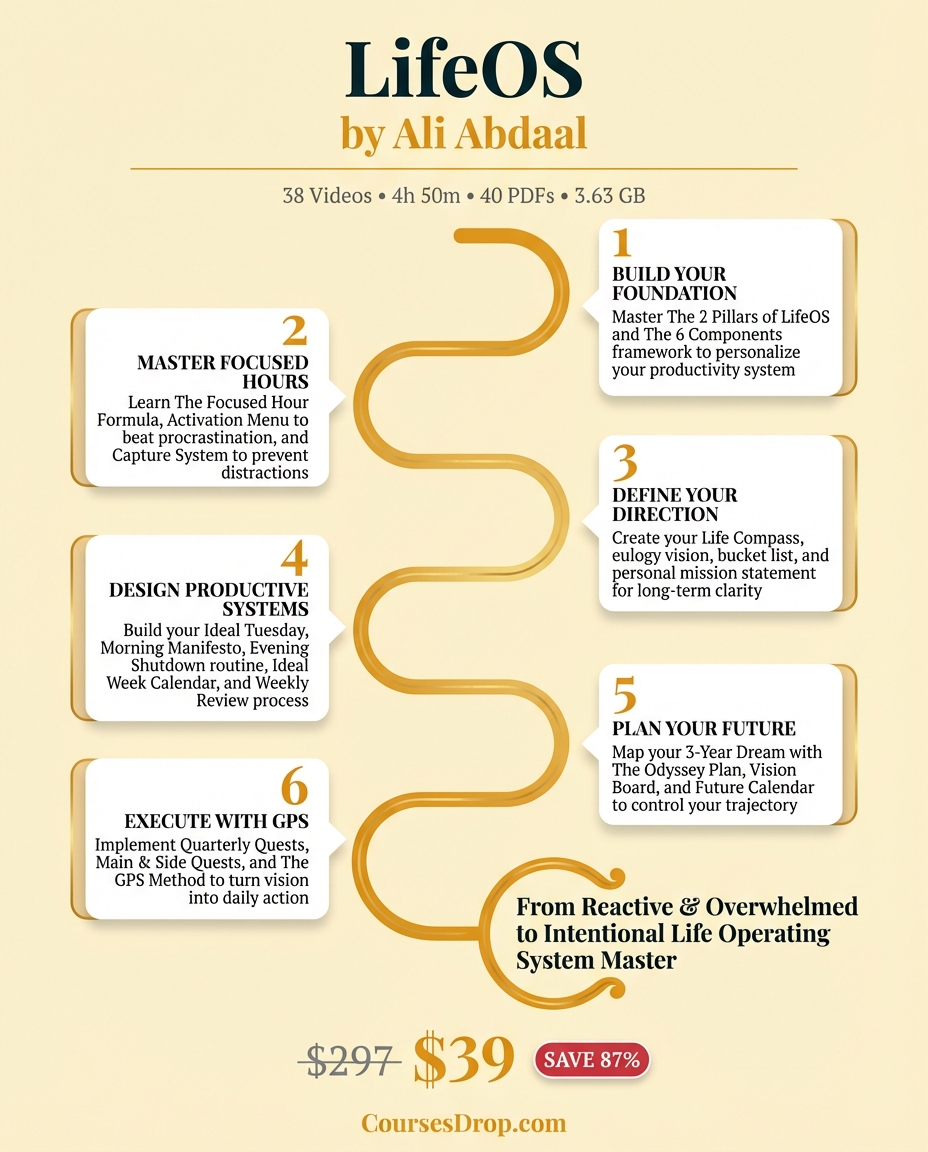
Who This Course Is Actually For
You are the right person for LifeOS if you can say yes to most of these:
- You are a solo founder, freelancer, entrepreneur, or knowledge worker who controls your own schedule and feels like you are not using that control well.
- You have read productivity books — Getting Things Done, Deep Work, Atomic Habits — and found them individually useful but could not integrate them into a coherent daily practice.
- You know what you want to build but keep finding yourself three months later having worked hard and moved the needle less than you expected.
- You are willing to do the Vision work — the reflective, emotional, values-clarifying exercises — not just the tactical stuff.
- You want a system you built yourself rather than a tool someone else built for you to use.
Who Should Skip This Course
Be honest with yourself about these:
- You already have a functioning productivity system. If your current setup works — if you consistently move your most important work forward, you know what matters each week, and you finish the week without chronic guilt — there is not enough new here to justify $297.
- You are looking for business strategy. LifeOS will not tell you what to build or how to position it. It will only help you execute better on what you have already decided to build.
- You want app-specific implementation guidance. If your problem is "I don't know how to set up Notion," this course is not the fix.
- You manage a team. The system is entirely personal. None of the frameworks extend to team coordination, delegation, or collaborative productivity.
- You are in active crisis mode. If the problem is financial, relational, or health-related and urgent, a productivity operating system is the wrong tool. Stabilize first.
The Verdict
In summary, LifeOS is one of the most coherent and complete personal productivity courses available. The Vision-before-Action architecture is genuinely rare. The Morning Manifesto, Focused Hour Formula, and GPS Method are frameworks you will actually use — not because they are clever, but because they are built around how real weeks work, with real friction and competing demands.
Abdaal's authority here is earned. He built his YouTube channel and book — "Feel Good Productivity" — while working as a doctor in the NHS. He did not theorize about productivity under pressure. He practiced it under extreme conditions and documented what worked.
The $297 price is fair for what you get: a complete system that replaces the productivity book stack rather than adding to it, taught by someone with genuine credibility, with live cohort recordings that add texture and real-world application.
Buy it if: You are a solo founder or knowledge worker who feels perpetually busy but not genuinely productive, you have tried individual productivity tactics without building a coherent system, and you are willing to do the Vision work alongside the Action tools. Skip it if: You already have a system that works, you need business strategy, or you manage a team and need something beyond individual productivity.Start free on Course To Action — no credit card, 10 free summaries. Use the AI "Apply to My Business" feature (3 credits) to map any of the 6 frameworks directly to your situation. Every summary includes audio. Course To Action covers 110+ courses; full access is $49/30 days or $399/year, no subscription, no auto-renewal.
Start free at Course To ActionFrequently Asked Questions
Is LifeOS worth $297?LifeOS is worth $297 if you are a solo founder or knowledge worker without a functioning productivity system. The course delivers 6 interconnected frameworks — the GPS Method, Morning Manifesto, Focused Hour Formula, Three Focus Menus, Weekly Review, and the overarching LifeOS Framework — that together form a complete operating system. If you already have a system that works, or if your problem is business strategy rather than personal productivity, skip it.
What does LifeOS actually teach?LifeOS teaches a complete personal productivity operating system built on two pillars: Vision (Life Compass, Future Sketch, Quarterly Quests) and Action (Focused Hours, Productive Days, Balanced Weeks). The core frameworks include the GPS Method for goal-setting, the 5-50-5 Focused Hour Formula for deep work, and the Morning Manifesto for daily orientation. It covers 38 lessons across 7 modules.
What does LifeOS NOT cover?LifeOS does not cover team productivity, app-specific implementation, business strategy, or revenue generation. It is a personal operating system for individual contributors and solo founders. If you need frameworks for delegation, collaborative planning, or determining whether your business model is right, you will need a different course.
Who is LifeOS best for?LifeOS is best suited for solo founders, freelancers, entrepreneurs, and knowledge workers who control their own schedule but feel they are not using that control well. The ideal student has read productivity books like Deep Work and Atomic Habits but could never integrate them into a coherent daily practice. It is particularly valuable for people who know what to do but cannot make themselves do it consistently.
Do I need to use a specific app to implement LifeOS?No. The course is deliberately app-agnostic. Abdaal references tools like Notion and Obsidian in passing, but the frameworks are designed to work in whatever system you already use — or in a simple paper notebook. The course is about the structure and the habits, not the software.
Where can I read a full summary of LifeOS?The most complete independent breakdown of LifeOS — every framework extracted, every lesson documented, every limitation noted — is available at Course To Action. It covers what the course teaches, what it does not teach, and who it is genuinely for. Start free with 10 summaries, no credit card required. The AI "Apply to My Business" feature (3 credits) lets you map any framework directly to your situation, and every summary includes audio.
Course To Action publishes independent framework-level breakdowns of online courses — the 20% that delivers 80% of the value, so you can make an informed decision before you spend a dollar.
Read the Complete LifeOS Summary
The course costs $$297. The full breakdown is $49/year — for every course on the platform.
Every framework deconstructed, every action step extracted, AI that applies it to your specific business. Read or listen — every summary has audio.
Start free — 10 full summaries, no credit card required