Mad Scientist Research Review (2026): Every Framework, Honest Limitations
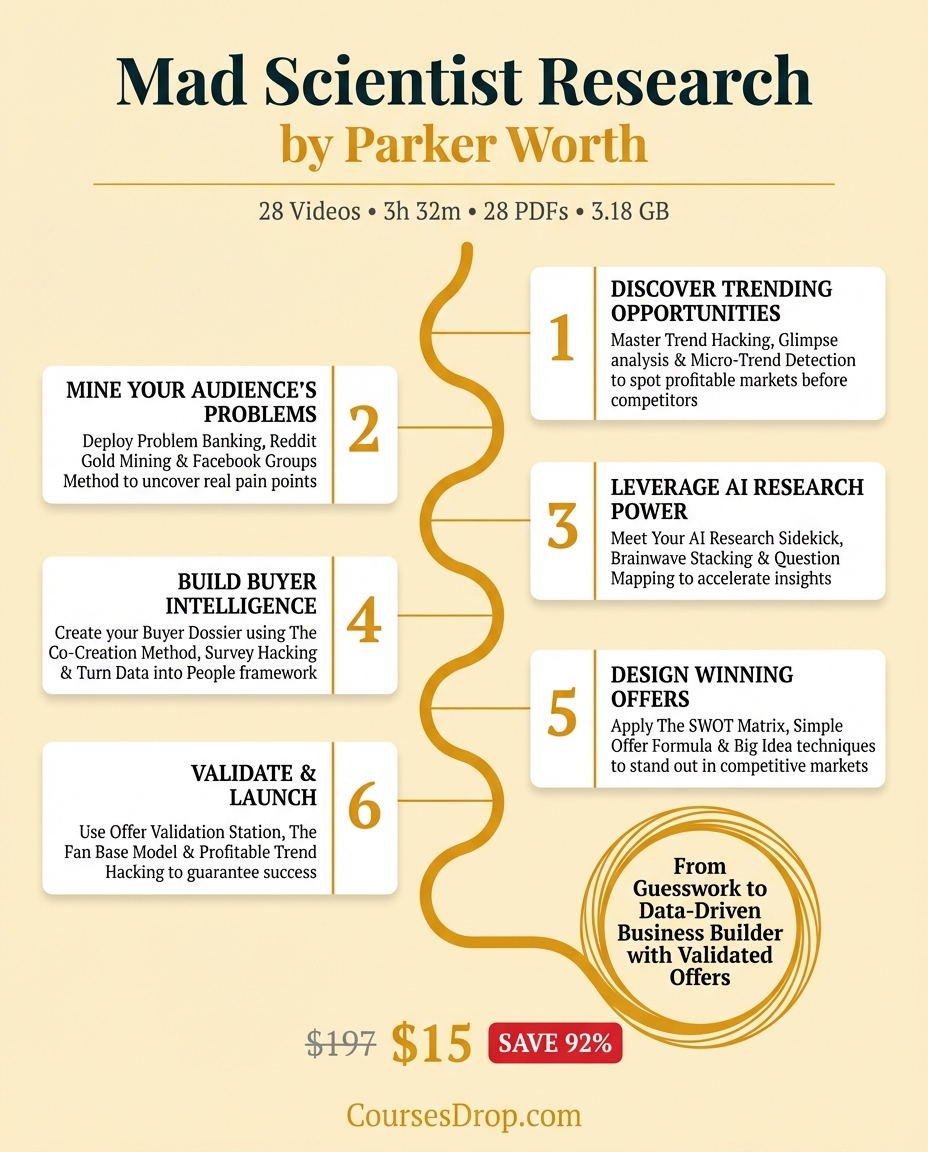
Mad Scientist Research is a $197 course by Parker Worth that teaches 10 frameworks for validating business ideas using free tools, Reddit mining, and AI prompts across 28 lessons. It is worth it if you are a solo creator who keeps building things nobody buys. Skip it if you are an experienced marketer or need execution guidance beyond validation. The core insight is that most entrepreneurs fail not because their execution is weak but because they build for customers who do not exist — and Worth's system fixes that at the root, according to the full breakdown on Course To Action.
I went through all 28 lessons, extracted every framework, mapped every module, and documented exactly what the course covers and where it runs out of road. Here is the most complete, unsponsored breakdown you will find.
The short version: if you are a solo creator, freelancer, or early-stage entrepreneur who has ever built something nobody wanted — or who is about to build something and is not sure how to confirm there is real demand first — this is one of the most practical and efficiently taught validation courses at this price point. The Reddit mining framework alone is worth the $197. And the course has real gaps: it stops well before execution, it skips deep offer creation, and the first two lessons repeat themselves.
That distinction matters. Keep reading.
The Course at a Glance
| Field | Details |
|---|---|
| Course | Mad Scientist Research |
| Creator | Parker Worth |
| Price | $197 |
| Content | 28 lessons |
| Best For | Solo creators skipping validation; anyone entering a new niche |
| Core Topic | Validating business ideas in under an hour using free tools, Reddit, and AI |
| Skip If | You are an experienced marketer, want deep offer creation, or need execution guidance |
| Rating | ★★★★☆ — Excellent on research fundamentals; thin on what comes next |
The Core Insight
Most entrepreneurs fail not because their execution is weak but because they build for customers who do not exist.
This is the organizing principle behind every one of the 28 lessons. Parker Worth's argument is that validation is not a step you do after you have an idea — it is the process that generates the idea in the first place. Spend five to ten minutes daily collecting complaints, frustrations, and emotional outbursts from Reddit threads and Facebook groups. Organize them into a structured Problem Bank. Let the clusters tell you what to build.
What makes this different is that the insight is not new — Steve Blank has been saying something similar for fifteen years — but what Parker delivers is a specific, tool-driven, executable system that works for someone without a research budget, a team, or an audience. The free-tool stack (Google Trends, Reddit, AI prompts, Facebook groups) means there is no paywall between you and the methodology.
That accessibility is genuine. The constraint, which we will cover, is that the course is entirely front-loaded on research and discovery. The moment you have a validated idea, you are largely on your own.
The Frameworks: What Parker Actually Teaches
Not summaries. Full deconstructions of the core frameworks across the 28 lessons.
1. The Market GPS Framework
The Market GPS Framework is Parker Worth's 3-coordinate system for navigating market research before you start building. The three coordinates are: where demand already exists (trends), where pain is concentrated (problems), and where competition confirms viability (competitor analysis). The critical reframe here is on competition: most beginners see competitors as a threat. Parker trains you to read competition as a demand signal. If nobody else is selling to this market, that is not a gap — that is a warning.
2. The Problem Bank (Three-Layer System: Fragments → Brain Stacks → Master Needs)
The most important framework is the Problem Bank — this is the 20% that delivers 80% of the value in the course.
The Problem Bank is Parker Worth's 3-layer daily research system for turning raw online complaints into validated product requirements. Layer one is Fragments: raw emotional phrases lifted directly from Reddit comments, Facebook group posts, and online reviews. The key instruction Parker gives is counterintuitive — do not paraphrase. Copy the exact words people use when they are frustrated. That specific language is copywriting research, not just market research.
Layer two is Brain Stacks: clusters of related Fragments grouped by theme. When you have twenty complaints about "never knowing if my content will actually perform," that cluster is a Brain Stack signaling an anxiety, not just a topic.
Layer three is Master Needs: the single, distilled human desire underneath each Brain Stack. Clusters about content performance anxiety resolve to a Master Need for predictability and control. That Master Need is what you design products and messaging around.
The practical instruction is five to ten minutes daily. Parker demonstrates the full workflow live in the course — the tool-heavy demo style makes this one of the most learnable frameworks in the program.
This is one of 10 frameworks in Mad Scientist Research. The complete breakdown — including the Demand Validator Prompt, Brainwave Stacking, and the Customer Whisperer Method — is available on Course To Action. Free account, 10 summaries, no credit card.
3. Brainwave Stacking and Question Mapping
Brainwave Stacking is Parker Worth's structured ideation method for generating multiple product formats, content angles, and positioning options from a single validated Master Need. Question Mapping then stress-tests each option: Who specifically has this problem? How urgently? What have they already tried? What did those attempts cost them? This is the framework that moves you from "I see a problem" to "I see a specific person with a specific unsolved problem who has already proven they will spend money on solutions."
4. Google Trends — 5-Year View Protocol
The Google Trends 5-Year View Protocol is Parker Worth's tactical framework for reading demand trajectories that most people miss. His instruction is specific: always look at five years, not twelve months. A trend that looks flat or declining over twelve months may be in a long-term growth arc that is not visible in the shorter window. He pairs this with micro-trend detection — identifying emerging subtopics within a larger category before they peak. The positioning advantage is time: you can build content and offers for a trend before the main wave of competition arrives.
5. Reddit Gold Mining
Reddit Gold Mining is Parker Worth's most operationally distinctive framework for extracting authentic customer language from anonymous online communities. Parker makes the argument — convincingly, with evidence — that Reddit is the best free market research tool available precisely because of its anonymity. People do not perform on Reddit the way they do on Instagram or LinkedIn. They complain genuinely, ask questions they are embarrassed to ask elsewhere, and describe failed purchases with specificity that no survey would capture.
The methodology covers subreddit selection, thread filtering (recent and highly upvoted), the specific types of comments to screenshot (complaints with emotional language, questions that appear repeatedly, responses describing previous failed solutions), and how to feed those raw phrases directly into the Problem Bank. Parker demonstrates this live across multiple niches, which makes the abstract method concrete.
6. The Simple Offer Formula and One-Sentence Positioning Template
The Simple Offer Formula is Parker Worth's bridge between research and product. Once the Problem Bank has surfaced a Master Need, the formula generates a basic offer structure: who it is for, the specific problem it solves, the mechanism of solution, and the transformation promised. The One-Sentence Positioning Template renders this into a single line: "[Specific person] finally gets [specific outcome] without [specific frustration they have already experienced]."
The main limitation is that this is functional but thin. The template produces a working positioning statement, not a complete offer strategy. If you need pricing architecture, launch sequencing, or detailed product design, this framework is a starting point, not a destination.
7. The Customer Whisperer Method (PAS)
The Customer Whisperer Method is Parker Worth's application of the classic Problem-Agitate-Solution copywriting structure to market research output. It takes the emotional phrases from the Problem Bank and organizes them into PAS sequences — identifying the raw problem in the customer's own words, the agitation (what the problem costs them emotionally or practically), and the solution framing that speaks to their specific failed alternatives. The output is copy that reads like the customer wrote it, because the raw material came from the customer.
8. The Competitor Analysis Funnel Stack
The Competitor Analysis Funnel Stack is Parker Worth's structured process for reverse-engineering what your competitors are selling, how they are positioning it, and where the gaps are. Parker walks through examining competitor landing pages, offer structures, testimonials, and pricing. The Funnel Stack is specifically about reading what customers say about competitor products — in reviews, in forums, in Facebook group complaints — to identify what existing solutions are missing. That gap is where positioning opportunity lives.
9. The Demand Validator Prompt (AI Mega-Prompt)
The Demand Validator Prompt is Parker Worth's capstone AI tool — a structured prompt sequence that compresses what previously required weeks of manual research into a single session. Parker demonstrates the prompt with multiple tools and niches, showing how to use AI to surface customer language, identify demand clusters, stress-test positioning hypotheses, and generate initial content angles. The caveat he acknowledges — and the course is honest about this — is that AI tool pricing and capability change. The prompt structure is the lasting asset; the specific tool is a variable.
10. The Four Validation Methods
The Four Validation Methods are Parker Worth's stack of four approaches to confirming demand before building: manual Reddit and forum research, Google Trends confirmation, competitor demand reading, and direct community testing (silent surveys and engagement monitoring in relevant Facebook groups). Parker teaches these as a stack, not as alternatives. Running all four creates a convergence of signals that is significantly more reliable than any single method alone.
What This Course Teaches Exceptionally Well
The tool-driven demo style makes abstract concepts executable. Parker does not explain the Reddit Gold Mining framework and then leave you to figure out the application. He opens Reddit, selects subreddits, filters threads, and narrates his thinking in real time. For visual learners and practitioners who need to see a method before they can replicate it, this teaching style is far more effective than slideshow-and-lecture formats. The Problem Bank is a genuinely original system. The three-layer structure — Fragments to Brain Stacks to Master Needs — creates a compounding research asset. Most beginners do ad-hoc research that evaporates after the project. The Problem Bank is designed to accumulate. After thirty days of five-minute daily sessions, you have a structured database of real market intelligence that most funded companies do not have. The Reddit insight is correct and underused. The key takeaway is that Reddit's anonymity produces more honest market signal than any survey, focus group, or social media platform — and Parker explains the mechanism, not just the tactic, which means you can adapt it as Reddit evolves. The AI integration is practical, not superficial. The Demand Validator Prompt is not "use ChatGPT to brainstorm." It is a structured prompt sequence that mirrors the manual research methodology. The AI output quality depends on prompt quality, and Parker's prompt architecture is genuinely well-constructed.What This Course Does Not Cover
We tell you what the course DOES NOT cover. No other review does this.
There is almost no execution content. Mad Scientist Research ends at a validated idea and a one-sentence positioning statement. What you do with that validated idea — building the product, designing the funnel, writing the sales page, structuring the launch — is outside the scope of the course. Parker is explicit that this is a research and validation course. But if you buy expecting a complete business-building system, you will need several other programs to follow this one. Offer creation is surface-level. The Simple Offer Formula and positioning template are functional starting points. They are not a substitute for a complete offer development framework. If you need to understand pricing strategy, guarantee design, or offer stacking, this course does not provide it. The first two lessons are repetitive. The core premise — validate before you build — is introduced, then reintroduced, then stated again before the methodology begins. This is a minor structural inefficiency, but it is worth knowing if you are impatient to reach the frameworks. Some free tools have meaningful limitations. The course demonstrates tools in their free tiers. Several of those tools have usage caps, restricted features, or have altered their free access since the course was recorded. The methodology survives the tool limitations, but the specific workflows demonstrated may require adaptation. AI pricing and capability may have changed. The Demand Validator Prompt section is the most time-sensitive content in the course. The prompt structure ages well; the specific tool recommendations and pricing comparisons may not.Get Every Framework from Mad Scientist Research
The course costs $$197. The complete breakdown is $49/year.
Start free — 10 full summaries, no credit card
Who This Course Is Actually For
This is best suited for solo creators, freelancers, and early-stage entrepreneurs. You are the right person for Mad Scientist Research if you can say yes to most of these:
- You are a solo creator, freelancer, or early-stage entrepreneur who has launched something that did not sell and is not sure why.
- You are entering a new niche and want to confirm demand before investing significant time or money.
- You are a content creator who wants your content to resonate with a specific audience instead of performing general niche coverage.
- You write copy — for yourself or clients — and want to source customer language from primary research rather than intuition.
- You are a freelancer looking for underserved segments where you can position yourself against less informed competition.
- You want to use AI tools for market research but need a structured methodology rather than ad-hoc prompting.
Who Should Skip This Course
Be honest with yourself about these:
- You are an experienced marketer who already has a validated research process. The frameworks here will be familiar territory.
- You need deep offer creation guidance. The course validates the idea; it does not build the product or the funnel.
- You need execution support — launch strategy, sales copy, funnel architecture. This course stops before any of that begins.
- You are a large team or enterprise researcher with an actual research budget. The free-tool stack is designed for solo operators.
Parker Worth: Who Is Teaching This
Parker Worth describes a path from high school dropout to multi-six-figure creator, with stops including electrical work, real estate, and a series of failed online business attempts before 2017. His credibility for this specific course rests on specific public outcomes: growing from problem-focused content to 18K followers, generating $20K from a launch to an 800-subscriber list, and reaching 311K views from a single trend-hacked post. He has reported 50 million impressions on X and claims 1,208 repeat customers across his body of work.
His mentors include Ian Stanley, Derek Johanson, Shane Hunter, Kieran Drew, and James Camp — names that circulate in the direct response copywriting and creator monetization space. Worth's teaching approach is practitioner-first rather than credential-first, which is both appropriate for the content and worth noting: there is no academic research backing, no case study volume, and limited third-party verification of the results he cites. What he does have is a demonstrably functional system that he teaches by showing rather than telling.
The Verdict
In summary, Mad Scientist Research by Parker Worth is the right course for a specific and common problem: you have an idea (or several ideas) and you are about to invest time and money without confirming anyone will pay for the solution. The Problem Bank framework alone, applied consistently for thirty days, will generate more actionable market intelligence than most early-stage entrepreneurs collect across years of building.
The research methodology is real, the tools are free and accessible, and the teaching style — demo-heavy, tool-driven, practitioner-focused — makes the frameworks executable rather than merely understandable. At $197, the price is honest for what is delivered.
The honest limitation is scope. This is a research and validation course. It does not tell you how to build, launch, price, or sell what you discover. If you need a complete business system, you need additional programs. If you need to stop building things nobody wants, this is the right place to start.
Buy it if: You are a solo creator, freelancer, or early-stage entrepreneur who needs a repeatable system for confirming market demand before you build — and you want that system to use free tools you can implement today. Skip it if: You are an experienced marketer, you need offer creation or launch strategy, or you want a course that takes you from idea to revenue in a single program.Frequently Asked Questions
Is Mad Scientist Research worth $197?Yes, if you are a solo creator who has built something that did not sell or who is about to invest in a new idea without validated demand. The Problem Bank framework alone — applied consistently for thirty days — produces more actionable market intelligence than most early-stage entrepreneurs collect in years. The $197 is modest relative to the cost of building and launching a product nobody wants.
What does Mad Scientist Research actually teach?Mad Scientist Research teaches 10 frameworks for validating business ideas using free tools. The core system is the Problem Bank (Fragments, Brain Stacks, Master Needs), supported by Reddit Gold Mining, Brainwave Stacking, Google Trends 5-Year View Protocol, the Simple Offer Formula, Customer Whisperer (PAS), Competitor Analysis Funnel Stack, Demand Validator AI Prompt, and Four Validation Methods. The course spans 28 lessons and approximately two hours of video.
What does Mad Scientist Research NOT cover?The course does not cover execution. There is no guidance on building the product, designing a sales funnel, writing a full sales page, structuring a launch sequence, or scaling. Offer creation is surface-level. If you need a complete business-building system, Mad Scientist Research is the validation step only — you will need additional courses for everything after.
Who is Mad Scientist Research best for?Solo creators, freelancers, content creators, and early-stage entrepreneurs at the idea validation stage. Especially those who have launched products that did not sell and want a structured research process to prevent that from happening again. The system requires no existing audience, no budget, and no prior research experience.
How much time does the course require?The 28 lessons run approximately two hours of video time. The daily practice component — building your Problem Bank — is five to ten minutes per day. Parker designs this as a compounding habit rather than a one-time research session.
Does the course teach copywriting?Partially. The Customer Whisperer Method (PAS) and the One-Sentence Positioning Template generate copy-ready language from your research. The course does not teach copywriting as a standalone discipline — it teaches how to extract customer language that makes your copy more resonant.
The course costs $997. The full breakdown — plus 110+ other premium courses — is $49 for 30 days. Before you spend $997, read what the course actually teaches AND what it doesn't. Read the Full Breakdown — Free — free account, no credit card. Every summary includes audio, so you can listen while you commute.
Course To Action publishes independent framework-level breakdowns of online courses — the 20% that delivers 80% of the value, so you can make an informed decision before you spend a dollar.Read the Complete Mad Scientist Research Summary
The course costs $$197. The full breakdown is $49/year — for every course on the platform.
Every framework deconstructed, every action step extracted, AI that applies it to your specific business. Read or listen — every summary has audio.
Start free — 10 full summaries, no credit card required