Manifest by Melanie Ann Layer — Is It Worth $3,333?
Manifest is a $3,333 relationship course by Melanie Ann Layer and her partner Kevin Bruce Scott that covers eight frameworks for identifying and changing the inner patterns driving your relationship outcomes. It is worth it if you are a high-achieving woman stuck in masculine energy overdrive at home, or a couple where connection has gone transactional. Skip it if your problem is tactical, not psychological, or if you need structured workbooks and slides.
If you've landed on this review, you're probably sitting with some version of the same question: is a $3,333 relationship course actually going to change anything, or is this another beautifully produced program that sounds transformative in the sales video and sits in your inbox by February? According to the full breakdown on Course To Action, the answer depends entirely on who you are and what you're actually trying to solve.
Manifest is a 29.2-hour intensive taught live by Melanie Ann Layer — the founder of Alpha Femme and a $100M coaching empire — and her partner Kevin Bruce Scott. Unlike most relationship courses, which are built around expert theory delivered to camera, Manifest is taught by two people who are actively in the relationship they're teaching. They argue on calls. They repair in real-time. They use their own story — bankruptcy, sleeping in a car, a proposal in a parking lot — as the primary case study. That's either exactly what you need or not what you came for, depending on your situation.
Before going further, a note on how this review was built. Rather than skimming the sales page or reading a summary of a summary, the research behind this write-up went through the full 29.2 hours of curriculum — every lesson, every framework, and every limitation. What follows is a complete breakdown of what the course actually contains.
At a Glance
| Detail | Info |
|---|---|
| Creator | Melanie Ann Layer & Kevin Bruce Scott |
| Price | $3,333 |
| Total Lessons | 18 |
| Content Hours | 29.2 hours |
| Format | Live group coaching calls with Q&A |
| Difficulty | All levels (emotionally demanding) |
| Category | Relationships & Personal Development |
| Best For | High-achieving women struggling to turn off masculine energy at home; couples where connection has gone transactional; singles who keep attracting emotionally unavailable partners |
| Skip If | You need business strategy, you're in an unsafe relationship, or you're put off by spiritual/energetic language |
The Core Insight
Here is the single idea that makes this course worth understanding, even if you never spend a dollar:
You do not attract the relationship you want. You attract the relationship you currently are.The core insight is that this sounds like a bumper sticker until Melanie builds the full architecture around it. The argument is specific: every pattern in your current relationship — or your pattern of being perpetually single, or your pattern of attracting emotionally unavailable partners — is a precise energetic match for where you are right now. Not who you want to be. Who you actually are, at the level of your unresolved triggers, your childhood wounds, and the gap between the version of yourself you perform and the version that runs the show when the oxytocin fades at three to six months.
Most relationship work tries to fix the relationship. This course argues that's working at the wrong layer. The work is becoming the person who matches the relationship you want before the relationship, which requires confronting uncomfortable truths about your triggers, your energy patterns, and the emotional capacity you actually have versus the capacity you believe you have.
That's the premise the entire 29.2 hours is built on.
The Frameworks
1. Energetic Match Framework
The Energetic Match Framework is Melanie Ann Layer's foundational model for understanding relationship patterns: you are always an energetic match for what you currently have. To attract a different relationship, you must first become the person who is an energetic match for that relationship.
What makes this practically useful is how Melanie teaches you to audit your current match. The exercise is two lists: what are you an energetic match for right now (look honestly at your patterns, not your intentions), and what do you desire to be an energetic match for? The gap between those two lists is your actual inner work roadmap — not a vague directive to "love yourself more," but a specific map of the distance between your current emotional maturity and the relationship you want.
2. For Me / For You / For Us Decision Model
The For Me / For You / For Us Decision Model is Layer's three-phase framework for how healthy relationship decisions evolve:
- For Me: Early in dating, every decision should be entirely based on what you want. Choosing based on someone else's needs before you've established your own is how you end up six months in wondering whose life you're living.
- For You: Once committed, you develop the capacity to hold space for your partner's needs without defensiveness or score-keeping.
- For Us: Long-term decisions become about the partnership — but only after completing the first two phases. Jumping directly to "for us" without establishing a strong "for me" first is the mechanical cause of most relationship resentment.
This is one of 7 frameworks in Manifest. The complete breakdown — including the Acknowledgment vs Mothering distinction, the Oak Tree in a Tornado Model, and Circular Dating — is available on Course To Action. Free account, 10 summaries, no credit card.
3. Masculine / Feminine Energy Dynamics
This is the conceptual backbone of the entire course. Masculine energy is giving, doing, fixing, and leading. Feminine energy is receiving, being, allowing, and flowing. These are not gender assignments — both partners need access to both and need to switch fluidly based on what the moment requires.
The failure mode Melanie targets specifically is high-achieving women who have built significant careers by running in masculine energy and then bring that same energy home. A partner in masculine energy needs feminine energy to create attraction and polarity. When both partners are stuck in the same energy — both executing, both leading, both fixing — attraction flattens and the relationship starts feeling like a business partnership.
The February 24th 2025 bonus module is the most comprehensive treatment of this, covering empowered versus disempowered versions of each energy and how to switch consciously rather than reactively.
4. Emotion-First Communication Protocol
The Emotion-First Communication Protocol is Layer's three-step framework from Day 7 for interrupting the defensive spiral in difficult conversations. The core distinction: "I feel sad" is categorically different from "I feel like you never listen." The first is a feeling. The second is an accusation with the word "feel" as camouflage.
The full protocol: name the actual emotion before you attach the story to it. Ask "Is this a good time to talk?" before initiating difficult conversations. Open with reassurance ("I want us to be okay") to calm both nervous systems before the difficult content. This sequence interrupts the defensive spiral that converts 80% of legitimate grievances into arguments about the argument.
5. Acknowledgment vs. Mothering
The Acknowledgment vs. Mothering distinction is Kevin Bruce Scott's framework for understanding why certain forms of positive feedback kill attraction. Men need genuine recognition — they do not need praise or performance evaluations.
Acknowledgment sounds like: "This feels so good, thank you." It communicates impact. You're describing how his action landed in you.
Mothering sounds like: "Good job!" It's a grade. It positions the speaker as the evaluator and the partner as the child being assessed. Mothering kills attraction because it fundamentally miscalibrates the power dynamic.
The most important framework for men specifically is this one applied in reverse — the same principle works when men acknowledge women. The content is delivered from Kevin's lived experience, which gives it a specificity that theory-based teaching typically lacks.
What It Teaches Well
1. The male perspective, from an actual man. Most relationship courses are either written for women by women or written for women by male therapists explaining male behavior from the outside. Kevin teaches Day 5 himself, from inside his own experience — the one-emotion paradigm (men are socially conditioned to have access to only anger as an acceptable emotional output), the guilt and shame avoidance that causes emotional shutdown, and the physical health consequences of sustained emotional suppression. This is best suited for anyone — man or woman — who wants to understand why male emotional shutdown happens and what to do about it. 2. Live modeling of principles under real conditions. The teaching style is unusual and genuinely effective. Melanie and Kevin don't just explain how to handle conflict — they sometimes surface conflict during calls and work through it in front of students. When they model energetic switching or repair after a tense moment, you're watching the principle in operation, not listening to a description of how it works in theory. That's a teaching format almost no course replicates. 3. The connection between self-treatment and partner-treatment. One of the quieter but most resonant insights in the course: how you treat yourself when you make a mistake is precisely how you will treat your partner when they make one. Perfectionism toward yourself produces a relationship culture of criticism and conditional acceptance. Creating space for your own mistakes — laughing at them, recovering from them quickly, not spiraling into shame — directly produces a relationship culture where partners feel safe to try, fail, and grow.Get Every Framework from This Course
The course costs $$3,333. The complete breakdown is $49/year.
Start free — 10 full summaries, no credit card
What It Doesn't Cover
This section matters. The main limitation is that Manifest has a specific scope, and knowing the boundaries is essential before spending $3,333.
Zero business strategy. Despite being marketed to entrepreneurs, there is no business content in this course. Not a framework, not a concept, not a passing reference to revenue, clients, or scaling. If you're expecting any professional development crossover, you will be disappointed. This is entirely a relationship course sold to an entrepreneurial audience. No structured workbooks or written materials. The entire course is verbal — live coaching calls with homework prompts delivered conversationally. There are no slides, no downloadable worksheets, no written curriculum to review. If you learn better from reading, the experience will feel significantly less structured than the content volume suggests. No LGBTQ+ relationship dynamics. The course assumes heterosexual relationships and the traditional masculine/feminine polarity model throughout. The framing is universal in aspiration but heteronormative in execution. There is no content addressing same-sex dynamics or non-binary partnership structures. Significant repetition across Q&A sessions. Roughly 40% of total content is live Q&A. Individual questions from participants address similar themes repeatedly across sessions. If you're efficient with time, the Q&A sections require patience — the same core concepts get reworked across similar individual situations. Spiritual framing presented as fact. The manifestation and energetic match language is embedded throughout the curriculum and presented as mechanism rather than metaphor. Analytically-minded students who want a clean separation between the psychological frameworks (which are rigorous) and the energetic framing (which is faith-adjacent) will not find that separation here.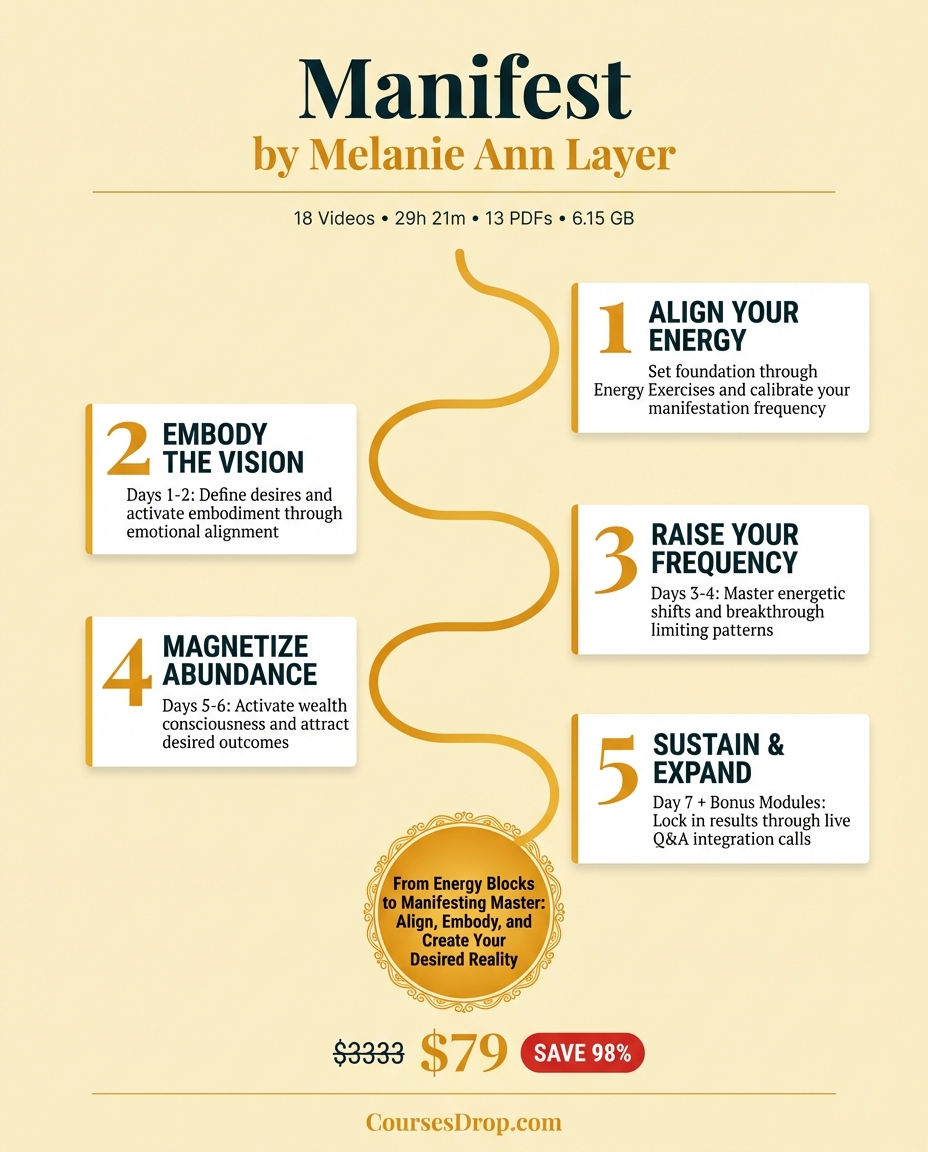
Who It's Actually For
Manifest was built for a specific person, and it delivers well for that person.
You are a high-achieving woman who has built a successful professional life. You run in masculine energy at work because it works there — you're decisive, you lead, you execute. You come home and you can't turn it off. Your partner has gone passive or emotionally distant, and you're not sure whether that's about him or about the dynamic you've created together.
Or: you are single and you keep selecting the same type of partner. The face changes, the situation changes, and the pattern remains. Every therapist you've worked with agrees you're self-aware. The pattern is still there.
Or: you are in a committed relationship that functions well but feels more like a logistical partnership than a romance. The structure is intact. The polarity is gone.
Or: you are a man who genuinely wants to understand what emotional availability actually requires — not the slogan, but the specific behavior — and you need someone to teach it from inside lived male experience.
Who Should Skip It
Pass on Manifest if any of the following are true.
You are in a relationship where your safety — emotional or physical — is genuinely at risk. This course teaches energetic reframing and inner work, which has no application to unsafe situations. The frameworks assume both partners are operating in good faith.
You need a structured curriculum with chapters, exercises, and measurable milestones. This is 29 hours of organic, live conversation with a strong teaching sensibility but no traditional course architecture.
You entered this looking for business content. The marketing of this course targets entrepreneurs, but the course itself contains no business application.
Spiritual and energetic language actively disrupts your ability to engage with a course. The framing here is deep and consistent, not incidental.
You are a man looking for a program designed specifically for you. Kevin's perspective is invaluable throughout, but he's teaching as a supporting voice in a program designed primarily for a female audience.
The Verdict
In summary, Manifest is one of the few relationship courses that makes the radical commitment of using the teachers' own relationship as the primary case study. That's a risk. It means the content is messier, more honest, and more emotionally demanding than a polished studio-shot curriculum. It also means you spend 29 hours watching two people actually live the principles they're teaching, which is a different category of evidence than listening to a coach describe what healthy partnership looks like in theory.
The key takeaway is that the frameworks — the Energetic Match model, the For Me/For You/For Us progression, the Emotion-First Communication Protocol — are genuinely useful and teachable. The male perspective Kevin provides in Day 5 is the single most concentrated and honest treatment of male emotional programming in any relationship course this review has covered.
The limitations are real. No structure, significant repetition, no business crossover despite the entrepreneur marketing, no LGBTQ+ content, and a $3,333 price point that requires seriousness of purpose.
If you're the person this course is designed for — a high-achieving woman stuck in masculine energy, or a couple where the connection has gone transactional, or someone who keeps recreating the same relationship pattern despite years of self-development work — this is likely the most directly applicable content you will find.
If you're not that person, $3,333 is a significant price to pay for content that wasn't built for you.
The course costs $3,333. The full breakdown — plus 110+ other premium courses — is $49 for 30 days. Before you spend $3,333, read what the course actually teaches AND what it doesn't. Read the Full Breakdown — Free — free account, no credit card. Every summary includes audio, so you can listen while you commute.
Frequently Asked Questions
Is Manifest worth $3,333 if you're already in therapy? Therapy and Manifest address different layers. Most therapy operates at the level of patterns, history, and conscious behavior. Manifest focuses specifically on the energy dynamics and emotional protocols inside a partnership — how you communicate in real-time, how you maintain polarity, how you handle conflict without triggering each other's childhood wounds. They can run in parallel without overlap, but they're not substitutes for each other. What does Manifest actually teach? Manifest teaches eight named frameworks for understanding and changing the inner patterns that drive relationship outcomes. The core frameworks include the Energetic Match Framework, the For Me/For You/For Us Decision Model, the Emotion-First Communication Protocol, the Acknowledgment vs. Mothering distinction, the Oak Tree in a Tornado model, and the Masculine/Feminine Energy Dynamics model. The entire course is taught live by Melanie Ann Layer and Kevin Bruce Scott. The platform also has an AI tool that applies frameworks to YOUR specific relationship patterns — 3 credits included free. Do you need to be in a relationship to get value from Manifest? No. Significant portions of the course — especially the Energetic Match Framework and the Circular Dating content — are explicitly built for single people. The argument is that the inner work comes before the relationship, and several of the most powerful sessions are designed for women who are single and want to understand what they're an energetic match for right now. How does Manifest compare to other relationship courses? Most relationship courses teach communication frameworks and attachment theory from an academic or therapeutic base. Manifest teaches from inside a real, ongoing relationship with all the vulnerability and imperfection that implies. The closest comparison would be live couples coaching, but delivered at scale. The content density is high but the structure is loose — a significant trade-off depending on your learning style. Is this course just for women? The primary audience is women, and the majority of the teaching addresses feminine energy dynamics, receiving, and the specific challenges of high-achieving women in relationships. Kevin's contributions — particularly Day 5 — make this more accessible and valuable for men than most relationship programs, but the framing and primary content are designed for a female audience. What does Manifest NOT cover? Manifest does not cover business strategy, structured workbook exercises, LGBTQ+ relationship dynamics, or any professional development content. Despite being marketed to entrepreneurs, it is entirely a relationship course. The format is live coaching calls with no slides or written materials.Course To Action publishes independent framework-level breakdowns of online courses — the 20% that delivers 80% of the value, so you can make an informed decision before you spend a dollar.
Read the Complete Summary
The course costs $$3,333. The full breakdown is $49/year — for every course on the platform.
Every framework deconstructed, every action step extracted, AI that applies it to your specific business. Read or listen — every summary has audio.
Start free — 10 full summaries, no credit card required