Market Like a CEO Review (2026): Every Framework, Honest Limitations
Market Like a CEO is a $347 course by Jereshia Hawk that delivers six original messaging frameworks across 20 text-and-audio lessons. It is built for coaches and consultants selling high-ticket offers ($5K–$50K+) whose content is consistent but whose sales have plateaued. The core insight is that your messaging was built for a previous price point, and no amount of tactical optimization will fix a strategic misalignment at the identity level. The full course breakdown is available on Course To Action.
Before going further, a note on how this review was built. The research behind this write-up engaged the full curriculum -- every lesson, every framework, every diagnostic tool and reflection prompt. What follows is an honest breakdown of what the course actually contains, what it delivers with genuine excellence, and where it falls short.
At a Glance
| Detail | Info |
|---|---|
| Creator | Jereshia Hawk |
| Price | $347 |
| Total Lessons | 20 |
| Format | Text and audio — no video |
| Difficulty | Intermediate |
| Category | Marketing & Messaging |
| Best For | Coaches and consultants selling $5K–$50K+ offers who are posting consistently but plateauing on sales |
| Skip If | You're a beginner without clients yet, or you need social media templates and tactical how-tos |
The Core Insight
Here is the single idea that makes this course worth understanding, even if you never buy it:
Your high-ticket messaging is not landing because you are teaching people what you do instead of speaking to who they are becoming.At the $10K+ price point, expertise is the cost of entry -- not the differentiator. Buyers at that level already assume you know your craft. What they are silently evaluating is something entirely different: Can I trust myself to succeed at this level? Does this person understand my specific life context? Will I feel safe here? These are identity questions, not deliverable questions, and your content is probably not addressing them.
What makes this different is Hawk's argument that most experienced business owners are unconsciously stuck in what she calls Principle-level messaging -- educational content that explains concepts, shares how-tos, and demonstrates expertise. This content works well at low-ticket price points, where you need to establish credibility. At high-ticket, it is the wrong frequency entirely. The conversion gap lives in Belief-level messaging: content that addresses the invisible internal decisions your buyer is already making before they ever reach out. Content that says the hard truths, names the specific objections, and reflects the identity shifts your clients actually navigate.
The most damning observation in the course is this: most business owners already say all of this -- on sales calls, in DMs, inside their coaching programs. The private content is exactly right. The gap is that the private truth stays private while the public content defaults to the generic, the educational, and the safe. Closing that gap -- bringing what you say privately into public view -- is what makes inbound leads arrive pre-sold and shortens sales cycles dramatically.
The Frameworks
1. The Will vs. Skill Framework
The Will vs. Skill Framework is Jereshia Hawk's 2x2 diagnostic matrix for understanding why a prospect is not buying. It is the foundational model in Market Like a CEO and the single most actionable tool in the entire curriculum.
Skill objections come in two forms: Principle (they don't understand the concept behind what you offer) and Process (they don't understand how delivery works). Will objections also split two ways: Desire (they must already want the transformation -- you cannot manufacture this through marketing) and Belief (they must believe in themselves and in you as the guide).
The key takeaway is this: most coaches over-invest, heavily and chronically, in Principle-level content -- the educational, the explanatory, the demonstrative. But Belief-level messaging is what closes high-ticket sales, and it is the most neglected quadrant in the average business owner's content library. Hawk recommends auditing your last 90 days of content, labeling each piece by quadrant, and counting the distribution. If 80% or more lands in Principle, you have found your gap.
2. Three Levels of Buyer Identity Shifts
The Three Levels of Buyer Identity Shifts is Hawk's framework for addressing a problem most content strategies ignore: your buyer is not in a single static state. They are moving through stages of readiness, and messaging that works beautifully at one stage actively fails at another.
Hawk maps three distinct stages. At Pre-Purchase, the prospect is still deciding whether to invest -- messaging must walk them from problem-aware to solution-aware to you-aware. At Post-Purchase/Mid-Program, the client has made the investment but their identity has not yet caught up to the decision -- they are in the messy middle, and messaging at this stage reinforces commitment and manages doubt. At Post-Program, the client has achieved results and is ready for the next level -- messaging here drives retention, upsells, and referrals by naming the next-level problem.
The trap most business owners fall into: they unconsciously create content from their own current level of awareness -- the Post-Program perspective -- which misses the Pre-Purchase buyer entirely. Hawk illustrates this with a doula analogy that makes the concept immediately concrete.
This is one of 5 frameworks in Market Like a CEO. The complete breakdown — including the Will vs. Skill Framework, the 3-Step Authentic Identity Framework, and the Messaging Rhythm Framework — is available on Course To Action. Free account, 10 summaries, no credit card.
3. Lifetime Value Focus vs. Lead Generation Focus
The Lifetime Value Focus vs. Lead Generation Focus is Hawk's framework explaining why high-ticket sales stall even when the marketing volume stays high. It identifies two fundamentally different lead generation models that must match the trust level your offer requires.
The Lead Generation Focus works for low-ticket offers ($1,500 and under): volume-based, paid ads, automated funnels, impulse mechanics. The Lifetime Value Focus is what high-ticket offers ($2K–$50K+) actually need: relational sales, organic long-form content, referrals, speaking on other people's stages, and scaling through retention rather than new lead acquisition. The most common and costly mismatch: a business evolves its pricing upward into high-ticket territory but keeps the low-ticket marketing strategy running. The result is leads who don't convert, a growing email list that won't buy at the current price, and the false conclusion that the offer is wrong -- when the problem is the marketing model.
4. The 3-Step Authentic Identity Framework
The 3-Step Authentic Identity Framework is Hawk's answer to the visibility block -- the nervous system hesitation that leads business owners to water down their opinions, soften their message, and default to generic language that feels safe but doesn't convert. The framework operates as a practical filter for deciding what to share publicly without feeling overexposed.
Step 1: Identify which aspects of your identity you want to magnify and monetize -- specifically the ones that shape your worldview and leadership perspective, not every personal detail. Step 2: Filter personal from strategic -- share what strengthens your positioning, shapes your unique lens, or humanizes you in a way your audience can see themselves in; protect what is sacred or still being processed emotionally. Step 3: Let it evolve -- what you magnify today will shift as you grow, and that evolution is growth, not inconsistency.
Hawk draws directly from her own experience as a biracial woman who code-switched through corporate America before building a multi-seven-figure coaching business. Her framing of visibility as a safety issue -- not a strategy issue -- is the most distinctive and psychologically honest thread in the course.
5. The Messaging Rhythm Framework (Monthly / Quarterly / Annual)
The Messaging Rhythm Framework is Hawk's systems layer that turns the course from insight into infrastructure. She argues that messaging is not a project you complete -- it is the one always-evolving asset in your business, and it requires intentional recurring attention or it calcifies into the version of you from two years ago.
Monthly: a 15-minute pulse check on lead quality, conversion rates, and content resonance -- make one small adjustment if anything is off. Quarterly: a one-hour mini messaging audit reviewing best-performing content, identifying patterns in hooks, and generating the next 90 days of topics using a Custom GPT Prompt loaded with updated buyer snapshots. Annually: a deep identity evolution review, surfacing new objections appearing in sales and reassessing what best-fit clients need to believe now. Hawk recommends scheduling each as a recurring calendar event immediately -- the act of scheduling it is the difference between insight and integration.
What It Teaches Well
1. The diagnostic precision of the Will vs. Skill audit. The 90-day content audit exercise is the kind of simple, scalable diagnostic that produces immediate, uncomfortable clarity. Most business owners have never looked at their content library through this lens, and the results are usually revealing. In summary, this alone is worth the price of entry. 2. Reframing visibility as a nervous system issue. The lesson on visibility blocks is the most psychologically distinctive content in the course. Hawk doesn't frame messaging hesitation as a mindset problem to be solved with affirmations. She frames it as a nervous system safety response -- the brain learned that standing out can make you a target, so it triggers preemptive self-censoring. This reframe removes judgment and opens a more honest path toward change. 3. Making the private-to-public shift concrete. The Course repeatedly returns to a principle that most marketing courses never name directly: the best content you can create is the truth you already share on sales calls and inside your programs, brought into public view. Hawk gives this principle enough concrete structure -- through the Client Snapshot Template and the GPT Prompt -- that it becomes actionable rather than aspirational.Get Every Framework from Market Like a CEO
The course costs $347. The complete breakdown is $49/year.
Start free — 10 full summaries, no credit card
What It Doesn't Cover
No other review of this course will tell you this section. It matters.
Zero social media tactics. There are no Instagram caption templates, no posting schedules, no advice on hashtags, engagement pods, or algorithmic behavior. If you are looking for tactical platform guidance, this course is not the right purchase. No funnel architecture or email marketing mechanics. Market Like a CEO operates entirely at the strategic and psychological level. Paid advertising, automated sequences, landing page copy, and lead magnet strategy are all outside its scope. No offer building, pricing guidance, or sales process structure. The course assumes you already have a high-ticket offer, existing clients, and a sales mechanism in place. It does not teach you how to build any of these. Arrive without them and you will not have the raw material the frameworks require. No clear lesson progression. All 20 lessons live in a single flat module with no markers indicating where one phase ends and another begins. The main limitation is that the middle lessons can feel repetitive before the practical tools arrive in lessons 16–18. The conceptual density is front-loaded and the implementation tools are back-loaded, which can create a patience test in the middle. No video content. Every lesson is text and audio only -- zero video hours logged. If you learn best through visual demonstration or prefer watching over reading, this format will feel limiting.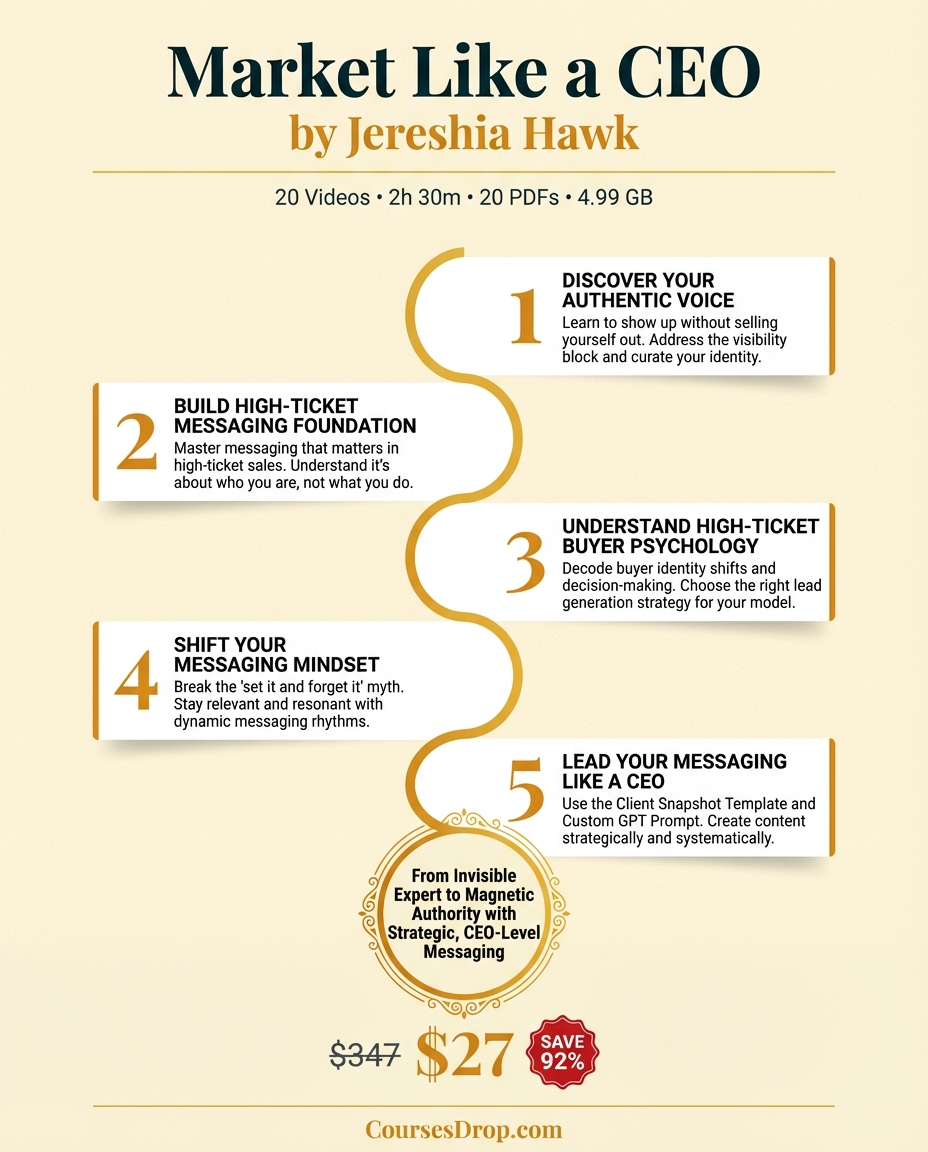
Who It's Actually For
This is best suited for a specific person who is already past the beginning stages.
You are a coach, consultant, or service provider selling high-ticket offers ($5K–$50K+). You have been posting consistently for months or years. You have clients and results to reference. The content you create is solid -- it just isn't converting at the level your offer commands. Or: you have delegated content creation to a team and the messaging has lost its edge -- the conversions are down and something feels off but you can't name it.
This course is also particularly well-suited for business owners transitioning from low-ticket digital products to high-touch, high-ticket offers -- specifically because the Lifetime Value Focus framework names the exact marketing mismatch that causes that transition to stall.
Hawk's work resonates most deeply with women, BIPOC entrepreneurs, and those who have experienced the tension between visibility and safety -- particularly those who have navigated code-switching in professional environments. Her personal context makes those lessons land in a way that generic marketing advice does not.
Who Should Skip It
Pass on this course if you are still in the early stages of building a business and have not yet made consistent sales. The Client Snapshot Template and the Will vs. Skill audit both require you to have real clients and a real content history to work from. Without that raw material, the frameworks have nothing to operate on.
Pass on it if you need social media tactics, a content calendar, templates, or plug-and-play copy frameworks. This course will not give you those things. It asks for deep self-reflection and honest audit -- not execution shortcuts.
Pass on it if you are selling exclusively low-ticket products ($500 and under) and your business model requires volume-based lead generation. The Lifetime Value Focus model is specifically calibrated for high-touch, relationship-driven offers.
Verdict
Market Like a CEO is a rare messaging course because it ignores the surface entirely. No templates. No caption formulas. No algorithm strategies. Instead, Jereshia Hawk goes after the deeper problem that most experienced business owners are actually facing: their messaging was built for a previous version of their business, and no amount of tactical optimization will fix a strategic misalignment at that level.
The most important framework is the Will vs. Skill Framework -- the most actionable diagnostic tool in the course and worth the investment on its own. The Three Levels of Buyer Identity Shifts resolves the specific confusion that comes from creating content at the wrong awareness level. The Messaging Rhythm Framework turns scattered insight into a repeatable operational system.
The limitations are real. No tactics. No video. No structured progression. Single flat module. The course will frustrate anyone who needs step-by-step templates rather than strategic depth. But for the person it is actually built for -- the experienced business owner whose messaging has plateaued alongside their business growth -- the diagnosis this course provides is precise, honest, and uncomfortably accurate.
If your offer has evolved but your marketing has not caught up, this is where the next investment belongs.
The course costs $347. The full breakdown — plus 110+ other premium courses — is $49 for 30 days. Before you spend $347, read what the course actually teaches AND what it doesn't. Read the Full Breakdown — Free — free account, no credit card. Every summary includes audio, so you can listen while you commute.
Frequently Asked Questions
Is Market Like a CEO worth $347? Yes, for the right person. If you have an existing high-ticket offer ($5K+), existing clients, and existing content to audit, the Will vs. Skill Framework and Three Levels of Buyer Identity Shifts alone are worth the price. These frameworks will change what you write next week. If you are a beginner without clients, the course has nothing to work with. What does Market Like a CEO actually teach? Market Like a CEO teaches six original messaging frameworks for diagnosing and fixing the gap between consistent content activity and flat high-ticket sales. The core model is the Will vs. Skill Framework, a 2x2 matrix for identifying whether your content is addressing the right type of buyer objection. It also covers buyer identity stages, lead generation model mismatches, visibility blocks, and a recurring messaging audit system. What does Market Like a CEO NOT cover? Zero social media tactics, no Instagram templates, no posting schedules, no funnel architecture, no email marketing mechanics, no offer building, no pricing guidance, and no sales call structure. The course operates entirely at the strategic and psychological level and assumes you already have a high-ticket offer and clients in place. Who is Market Like a CEO best for? Coaches, consultants, and service providers selling high-ticket offers ($5K–$50K+) who have been posting consistently but whose sales have plateaued. It is also well-suited for business owners transitioning from low-ticket to high-ticket offers, and for those who have delegated content creation and find their messaging has lost its conversion power. Is Market Like a CEO worth it if you're already working with a brand strategist or copywriter? Yes — and possibly more so. A brand strategist or copywriter can execute messaging, but they can only work with what you give them. This course upgrades the source material: the strategic clarity, identity framework, and buyer-level understanding that your team then executes. If your messaging has lost its soul despite having professional help, the gap is almost always at this source level. Where can I read a summary of Market Like a CEO? The most complete independent breakdown is available at Course To Action, which covers every named framework, honest limitations, and what the course does not teach — free with your account. The platform also has an AI tool that applies frameworks to YOUR marketing strategy — 3 credits included free. Course To Action publishes independent framework-level breakdowns of online courses — the 20% that delivers 80% of the value, so you can make an informed decision before you spend a dollar.Read the Complete Market Like a CEO Summary
The course costs $347. The full breakdown is $49/year — for every course on the platform.
Every framework deconstructed, every action step extracted, AI that applies it to your specific business. Read or listen — every summary has audio.
Start free — 10 full summaries, no credit card required