MasteryOS 2.0 Review (2026): Every Framework, Honest Limitations, and Who It's Actually For
MasteryOS 2.0 is a $495 course by Ross Harkness that covers 8 modules and 132 lessons spanning self-mastery and personal brand building. The core insight is that self-improvement and brand growth are the same project — fix the internal operating system first, and the external results follow as a byproduct. Ross grew from zero to 450,000+ followers across Twitter and Instagram and crossed six figures in three years, building the system he now teaches from inside the problem. The full breakdown of every framework is available on Course To Action.
Before going further: this review was built from full engagement with the complete curriculum — all 8 modules, 132 lessons. What follows is an honest breakdown of what the course actually teaches, where it delivers, and where it doesn't.
At a Glance
| Detail | Info |
|---|---|
| Creator | Ross Harkness |
| Price | $495 |
| Total Lessons | 132 |
| Modules | 8 |
| Difficulty | Beginner |
| Category | Personal Development & Personal Branding |
| Best For | Aspiring personal brand builders (0–10K followers), young entrepreneurs who feel they're underperforming, content creators who consume more than they produce |
| Skip If | You already have strong productivity habits, you're generating $500K+ and need scaling systems, or you want depth on YouTube, TikTok, or LinkedIn |
The Core Insight
Here is the idea that the entire 132 lessons are built around:
Self-mastery and business success are not separate pursuits -- they are the same pursuit.Your income, your brand, your content quality, your consistency -- all of them are direct readouts of how well you manage your mind, your actions, and your craft. The person who can sit in a 90-minute deep work block without touching their phone, who has dismantled the limiting belief that they don't deserve to charge premium prices, who shows up daily to create content even when the algorithm ignores them -- that person is not disciplined because they are successful. They are successful because they are disciplined.
What makes this different is the framing. MasteryOS doesn't treat self-mastery and personal branding as separate categories glued together for a higher price point -- they are deliberately sequenced. You can't build a durable personal brand on a broken operating system. Ross teaches the OS first, then teaches you what to do with it.
The Frameworks
1. Three Pillars of Self-Mastery
The Three Pillars of Self-Mastery is Ross Harkness's foundational model for identifying which domain is creating a ceiling on your results. All sustainable progress comes from developing three areas simultaneously:
- Mind: Removing limiting beliefs, building empowering mindsets, managing self-talk
- Actions: Goal setting, habits, consistency, time blocking, anti-procrastination
- Craft: Choosing your domain, deep work, long-term thinking, skill compounding
2. The Conscious Alignment Hub
The Conscious Alignment Hub is Ross Harkness's Notion-based operating system that connects your Utopia (a meticulous description of your ideal life), your Nether (the worst version of your life in equal detail), your goals, your identity statements, your daily actions, your time blocks, your habit tracking, and your weekly reviews into a single coherent document.
Every decision gets filtered through one question: does this action move me toward Utopia or toward Nether?
The core insight is that the Hub is where the course goes from motivational content to an actual system. Without it, the other modules remain good ideas. With it, they become an operating procedure.
3. 3-Step Mindset Rewiring Process
The 3-Step Mindset Rewiring Process is Ross Harkness's framework for dismantling limiting beliefs through evidence accumulation rather than affirmation. The three steps are:
- Identify a limiting belief through self-talk analysis, behavioral patterns, or recurring fears
- Gather counter-evidence -- specific examples from the world or your own life that prove the belief is false
- Take contradicting action -- do something that directly contradicts the belief and document the result
4. Build, Sweat, Learn
Build, Sweat, Learn is Ross Harkness's daily structure framework with three non-negotiable anchors:
- Build: Deep, productive work in the morning on your primary craft or business
- Sweat: Physical training in the afternoon -- Ross is direct that physical health and mental performance are not separable
- Learn: Education in the evening -- reading, courses, skill development
This is one of 7 frameworks in MasteryOS 2.0. The complete breakdown — including the Conscious Alignment Hub, the Content Pyramid, and the Five-Part Thread Structure — is available on Course To Action. Free account, 10 summaries, no credit card.
5. Content Pyramid
The Content Pyramid is Ross Harkness's three-tier content architecture that eliminates the "what do I post?" paralysis that stalls most early-stage creators.
Niche (umbrella topic) → 3 Content Pillars → 9 SubtopicsNine ready-made content angles, all connecting back to the core niche and target avatar. Paired with the Three Content Purposes Framework -- every post serves either Growth (broad, shareable), Authority Building (demonstrates expertise), or Relationship Building (humanizes, builds trust) -- this gives a new creator enough structure to produce content without a blank-page problem.
6. Five-Part Thread Structure
The Five-Part Thread Structure is Ross Harkness's formula for writing high-performing Twitter threads:
- Hook: You/your + specific numbers + power words + clear benefit
- Lead: Consequence of inaction or a personal story that creates stakes
- Value: Each tweet independently retweetable, not dependent on the thread for context
- Summary: Optional consolidation
- CTA: Follow, buy, or sign up -- one action only
7. Five Marketing Awareness Levels
The Five Marketing Awareness Levels is Ross Harkness's adaptation of Eugene Schwartz's awareness model applied to social media content strategy. Prospects move through five stages: unaware of their problem → problem-aware → solution-aware → aware of your specific solution → ready to purchase. Most creators produce content for stage 3 and 4 only, which converts existing followers but never grows the audience. The most important framework insight here is that you must deliberately mix content across all five levels -- pulling in cold audiences while warming up existing ones.
What It Teaches Well
1. The productivity and deep work system. Ross's argument against the Pomodoro Technique is backed by specific reasoning: it takes 15–20 minutes to enter flow state, which means a 25-minute interval gives you 5–10 minutes of actual focused work before the timer fires. His alternative -- 90-minute blocks aligned with ultradian rhythms, capped at 4 hours of deep work per day -- is more demanding and more effective. The neuroscience of flow state gets a full dedicated lesson (The Science & Stages of Flow & Focus) that is the densest, most information-rich lesson in the course. 2. The growth tactics that practitioners actually use. The Distribution Methods lesson is where Ross earns his credibility as a practitioner rather than a theorist. He reveals that retweet trading and story share trading between similarly-sized accounts is how virtually all large creators actually grow -- not an optional growth hack, but standard practice that nobody discusses publicly. He covers specific mechanics: one retweet per day per partner on Twitter, two to three story shares per week on Instagram, always send links via Telegram or Discord (never through native apps), and strip URL tracking parameters before sharing. This is the kind of information that only comes from actually doing the thing. 3. The integration of mindset and brand building. This is best suited for creators who have tried tactical approaches and hit a ceiling. Most courses treat mindset and branding as separate categories. MasteryOS builds an explicit argument for why they're inseparable, and then structures the curriculum to reinforce it. The module on personal brand explicitly states: if your brand is stuck, look inward first.Get Every Framework from MasteryOS 2.0
The course costs $$495. The complete breakdown is $49/year.
Start free — 10 full summaries, no credit card
What It Doesn't Cover
The main limitation is that the self-mastery half repackages established sources. Cal Newport's deep work concepts, James Clear's habit frameworks, elements of Stoic philosophy, and Alex Hormozi's vocabulary all appear throughout modules 1–5. Ross synthesizes these well and gives them practical structure, but if you've read Deep Work, Atomic Habits, and the Meditations, the first half of MasteryOS will feel familiar rather than original.
Business and sales depth is introductory. The monetization module covers coaching, consulting, courses, affiliates, shoutouts, services, and agencies -- but frequently defers to external books ($100M Offers, DotCom Secrets, Expert Secrets) for actual depth. The course provides starting points, not systems. If you need serious offer-building, sales, or funnel architecture, you will need to source that education elsewhere. Platform coverage is narrow. The course is built around Twitter and Instagram. LinkedIn receives one lesson. YouTube, TikTok, and podcasting are absent. If your audience lives on those platforms, you're buying a course that doesn't fully address your situation. Significant repetition across 132 lessons. Deep work, sleep optimization, distraction management, and consistency are each covered two or three times across different modules. The redundancy means you can jump into the module most relevant to you without missing context -- which is genuinely useful -- but the 132-lesson count is inflated. The actual unique information is more compressed than the lesson count suggests. Masculine-coded framing. References to "inner bitch," masculine motivation frameworks, and competing against an ideal self run throughout the course. This will resonate with a specific audience and create friction for others. It's worth knowing before purchase.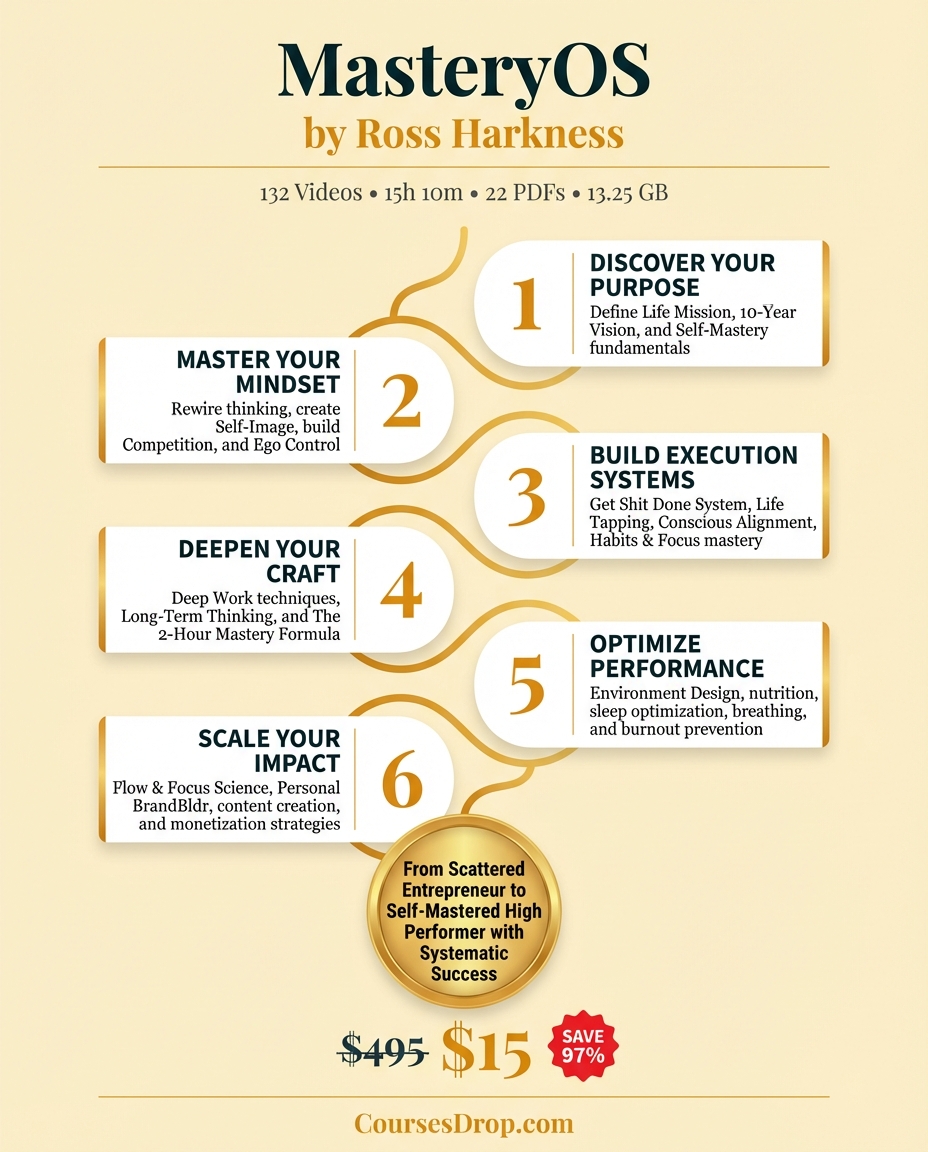
Who It's Actually For
MasteryOS is built for someone specific. You're in the 18–30 age range (or adjacent in mindset). You have a clear sense of what you want to build -- a personal brand, a coaching business, a creator income -- but you're underperforming relative to your own standard. You consume more content about doing the work than you actually do the work. You've started building an online presence and stalled, or you're starting from scratch and want a complete system rather than scattered advice.
In summary, if that's you, this course delivers a coherent end-to-end operating system: from rewiring limiting beliefs to building productivity rituals to growing a Twitter and Instagram audience to monetizing through coaching and digital products.
The course is also legitimate for content creators at 0–10K followers who need platform-specific growth tactics beyond generic "post consistently" advice. The engagement and distribution methods alone -- commenting on 30+ posts per day at the 0–1K stage, trading retweets and story shares as you grow -- are more actionable than most social media courses at twice the price.
Who Should Skip It
Pass on MasteryOS if you're already generating serious revenue and need advanced business systems. The course doesn't cover team building, delegation, hiring, or operational scaling.
Pass on it if you're building on YouTube, TikTok, or LinkedIn as your primary platforms -- the playbook here is Twitter and Instagram, and the tactical specificity that makes the course valuable is platform-specific.
Pass on it if you've already built strong self-mastery foundations. If you've internalized Cal Newport, James Clear, and a solid morning routine, the first five modules will feel like review rather than revelation.
And pass on it if the direct, masculine-coded communication style will make it difficult to engage with the material seriously.
Verdict
The key takeaway is this: MasteryOS 2.0 does something genuinely uncommon — it makes a coherent case that self-improvement and personal brand building are the same project, then delivers a curriculum that treats them that way. The Conscious Alignment Hub is a real operating system. The deep work protocols are specific and neuroscience-grounded. The distribution methods lesson alone is worth the price of admission for anyone building a creator business on Twitter or Instagram.
The limitations are real. The self-mastery half repackages well-known material. The monetization depth is introductory. The platform scope is narrow. The 132-lesson count overstates the information density.
But for the specific person this course is built for -- someone who wants to build a personal brand and needs to build the internal operating system that makes consistent execution possible -- MasteryOS delivers a more complete system than most alternatives at its price point.
The course costs $495. The full breakdown — plus 110+ other premium courses — is $49 for 30 days. Before you spend $495, read what the course actually teaches AND what it doesn't. Read the Full Breakdown — Free — free account, no credit card. Every summary includes audio, so you can listen while you commute.
Frequently Asked Questions
Is MasteryOS 2.0 worth $495? MasteryOS 2.0 is worth $495 if you are an aspiring personal brand builder at 0–10K followers who needs both the internal operating system (mindset, habits, deep work) and the external growth tactics (content strategy, distribution, monetization) in a single integrated course. The personal brand half — particularly the distribution methods and content strategy modules — contains tactical intelligence that justifies the price on its own for the right audience. Skip it if you already have strong productivity foundations or need advanced business scaling systems. What does MasteryOS 2.0 actually teach? MasteryOS 2.0 teaches 7 named frameworks across 8 modules and 132 lessons. The first half covers self-mastery: the Three Pillars model, the 3-Step Mindset Rewiring Process, the Conscious Alignment Hub, and the Build, Sweat, Learn daily structure. The second half covers personal brand building: the Content Pyramid, the Five-Part Thread Structure, the Five Marketing Awareness Levels, and specific distribution and monetization methods for Twitter and Instagram. What does MasteryOS 2.0 NOT cover? MasteryOS does not cover YouTube, TikTok, or podcasting. LinkedIn receives one lesson. The monetization section is introductory and defers to external books for depth on offer-building and sales funnels. Team building, delegation, hiring, and operational scaling are not addressed. The self-mastery half draws heavily from Cal Newport, James Clear, and Stoic philosophy rather than presenting original research. Who is MasteryOS 2.0 best for? MasteryOS is best suited for aspiring personal brand builders aged 18–30, content creators at 0–10K followers who need specific growth tactics, and entrepreneurs who consume more content than they produce and need a structured system to break the cycle. It is not built for experienced entrepreneurs generating $500K+ or creators focused on platforms other than Twitter and Instagram. How does MasteryOS 2.0 compare to other personal brand courses? Most personal brand courses are purely tactical — post this format, use this hook structure, engage at these times. MasteryOS is unusual in teaching the internal operating system (mindset, habits, deep work) as a prerequisite to sustainable brand building. The combination makes it more complete than tactical-only alternatives, though less deep on the business and monetization side than dedicated business courses. Where can I read a full summary of MasteryOS 2.0? The complete independent breakdown — every framework, every limitation, and what the course does not cover — is available free at Course To Action. The platform also has an AI tool that applies frameworks to YOUR specific goals — 3 credits included free.Read the Complete MasteryOS 2.0 Summary
The course costs $$495. The full breakdown is $49/year — for every course on the platform.
Every framework deconstructed, every action step extracted, AI that applies it to your specific business. Read or listen — every summary has audio.
Start free — 10 full summaries, no credit card required