Relationship Vault 2.0 + Self Love Course Review (2026): Is Teal Swan's $896 Course Worth It?
Is this course worth $896? That depends almost entirely on whether you are in the specific situation it was built to address — and whether you are willing to engage with the kind of work it demands.
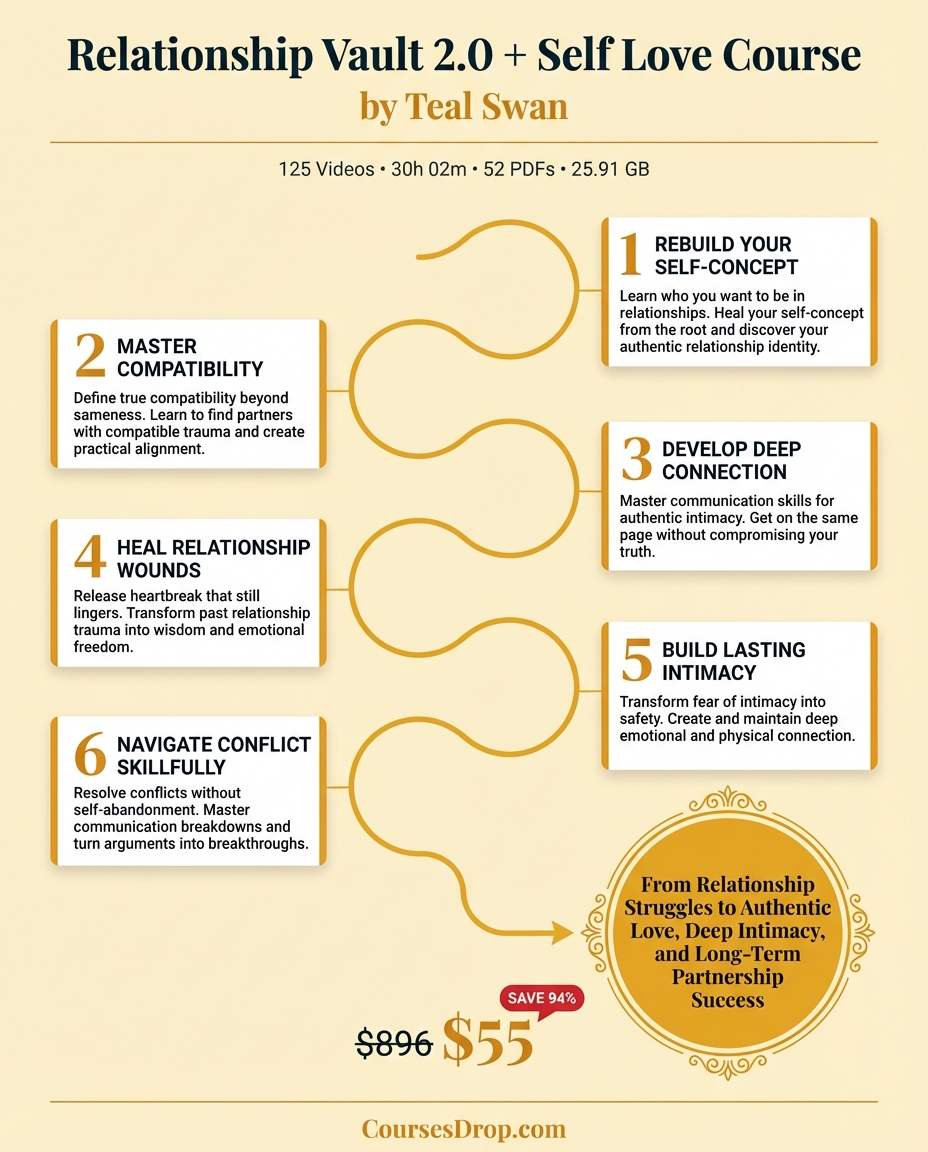
Relationship Vault 2.0 + Self Love Course is a comprehensive psychological toolkit from Teal Swan — spiritual teacher, author, and one of the more polarizing figures in the self-help space. The course spans 125 lessons across 30 hours and covers relationship dynamics, self-hatred as a coping mechanism, internal parts work, and shadow integration. It is not a communication skills course. It is not a dating guide. It is an extended, psychologically demanding investigation into why intimate relationships tend to follow the same destructive patterns — and what it actually takes to change them at the root.
Before committing $896, there are things you should know about this course that the sales page will not tell you.
Course at a Glance
| Field | Detail |
|---|---|
| Course | Relationship Vault 2.0 + Self Love Course |
| Creator | Teal Swan |
| Price | $896 |
| Format | 4 modules, 125 lessons, 30 hours |
| Category | Relationships / Self-Development / Psychological Inner Work |
| Best For | People in repetitive relationship patterns, breakup recovery, childhood trauma affecting adult relationships, couples willing to do deep psychological work |
| Core Topic | Internal fragmentation, self-hate as a coping mechanism, parts work, compatible trauma theory, shadow integration |
| Difficulty | Advanced — requires emotional openness and readiness for confrontation with self |
| Skip If | You want dating tactics, communication scripts, or quick resolution to an active crisis; you are uncomfortable with spiritual and metaphysical framing |
| Verdict | ★★★★☆ — One of the most psychologically substantive relationship courses available, with a genuinely original framework at its center. The scattered vault structure and heavy spiritual overlay are real limitations. The Compatible Trauma Model and parts work integration alone justify the investment for the right buyer. |
The Core Insight
The central argument of Relationship Vault 2.0 is this: the relationships you choose are not accidents. They are precise reflections of your internal psychological state — specifically, of the unintegrated fragments, suppressed shadow material, and self-hate you carry from earlier experiences.
Most relationship advice operates at the surface: improve your communication, set better boundaries, choose partners with better qualities. Teal Swan argues that this approach fails because it misidentifies the problem. The pattern does not persist because you have not yet found the right communication technique. It persists because you keep selecting — unconsciously and with precision — partners whose wounds interact with yours in specific, predictable ways.
This reframe has significant implications. It means the relationship problem is not fundamentally about the relationship. It is about what is unresolved inside you. And self-love — the actual remedy Teal Swan teaches — is not affirmations, journaling gratitude lists, or self-care routines. It is the willingness to turn toward the parts of yourself you have spent years refusing to look at, to feel the self-hate rather than bypass it, and to integrate what has been fragmented.
This is serious psychological territory, and the course treats it as such.
The Frameworks: Where the Thinking Lives
1. Compatible Trauma Model
This is the most original and intellectually rigorous framework in the course. The Compatible Trauma Model redefines compatibility entirely — and the redefinition is not comforting.
Swan's argument: compatibility between two people is not primarily about shared values, interests, or communication styles. It is about whether your respective trauma patterns mutually heal or mutually retraumatize each other. Two people who are "compatible" in the conventional sense — similar backgrounds, similar goals, magnetic attraction — may be profoundly incompatible in the Compatible Trauma Model sense if their unresolved wounds trigger each other's defenses in escalating cycles.
The inverse is equally important: two people who look mismatched on paper may be highly compatible if their unresolved material creates conditions where each person is pushed toward their own healing.
The clinical implication is significant. It reframes the question you ask when evaluating a relationship from "do we get along?" to "does this relationship push me toward integration or away from it?" That is a harder question to answer, and it demands a level of self-awareness that most people lack at the start — which is why the course spends considerable time building the internal inventory skills first.
2. Compromise vs. Workability (18-Question Checklist)
This framework addresses one of the most common relationship dynamics that masquerades as health: compromise.
Swan's position is direct — compromise in relationships consistently produces resentment. When each person suppresses what they genuinely need in service of a middle ground, both people accumulate unexpressed grievance. Over time, the accumulation corrodes the connection the compromise was meant to protect.
Workability is the alternative. A workable arrangement is one where both people get their actual needs met — not equally distributed versions of each person's second choice. The distinction requires rigorous honesty about what is genuinely acceptable versus what is being accepted out of fear, obligation, or conflict avoidance.
The course provides an 18-question checklist for evaluating whether a given arrangement is truly workable or is compromise in workability's clothing. This is one of the most practically applicable tools in the course and one that couples can work through together.
3. Three-Entity Relationship Model
- Three-Entity Relationship Model — treating yourself, your partner, and the relationship itself as three distinct entities, each requiring deliberate attention
4. Self-Hate as Coping Mechanism Model
- Self-Hate as Coping Mechanism — reframing self-criticism as a survival strategy and identifying what is actually needed to change it at the root
5. Parts Work / Internal Fragmentation Model
- Parts Work / Internal Fragmentation — understanding how different internal parts operate with conflicting agendas and how to move toward integration
6. Additional Frameworks
- 9-Step Conflict Resolution Protocol — a structured process for navigating conflict that goes deeper than surface communication technique
- Containment Framework and The Connection Process — emotional regulation and a structured relational practice for building genuine intimacy, taught through live coaching demonstrations
What It Teaches Exceptionally Well
The live coaching demonstrations are the most effective teaching modality in the course. Watching Teal Swan work with actual participants on the Compatible Trauma Model, parts work integration, and conflict resolution gives you access to what these processes look like in practice — the hesitations, the resistance, the breakthrough moments. This is categorically different from being told about a framework, and it is one of the features that justifies the course price for serious buyers. The Compatible Trauma Model is a genuinely original contribution to the relationship framework space. It does not appear in this specific form in mainstream psychology or standard relationship courses, and it reframes the compatibility question in a way that has real practical and diagnostic value. Even people who engage critically with Swan's broader worldview tend to find this framework useful. The parts work integration is taught with unusual depth. Many courses mention Internal Family Systems-adjacent concepts superficially. The Self Love and Vault modules spend significant time building actual facility with parts work — identifying parts, understanding their function, learning to communicate with them. The ten-week daily exercise structure in the Self Love module builds this capacity progressively rather than presenting it as a single concept.What It Doesn't Cover
This is the section no other review will give you honestly.
There are no dating tactics, communication scripts, or practical relationship logistics. If you are looking for guidance on how to start conversations, how to respond when a partner pulls away, how to navigate specific situations like long-distance or conflict over finances — that content is not here. The course operates at the level of internal architecture, not interpersonal technique. There is no crisis support infrastructure. The course is designed for people doing deep developmental work, not people in active relationship crisis, separation with children involved, or acute mental health distress. If you are in the middle of a crisis, the material may be valuable eventually, but the course has no mechanism for supporting you through acute instability. The Vault structure is genuinely scattered. The Relationship Vault section covers 70+ topics — and the breadth comes at the cost of navigational clarity. There is no clearly signposted learning progression. Buyers who are self-directed will find value in moving through it nonlinearly. Buyers who need structure will find it overwhelming. The heteronormative framing appears throughout. The masculinity/femininity bonus module and certain frameworks in the Vault use a traditional gendered lens. This does not mean the content is inaccessible to LGBTQ+ buyers — many of the core frameworks are orientation-neutral — but the framing is present and worth knowing in advance. The spiritual and metaphysical content is substantial and not clearly separated. Swan's work consistently blends clinical psychology with Law of Attraction frameworks, channeling references, and metaphysical claims. Buyers who want psychological tools without spiritual overlay will need to do their own filtering work throughout the course. This is not incidental; it is a design feature of Swan's approach.Get Every Framework from Relationship Vault 2.0 + Self Love Course
The course costs $896. The complete breakdown is $49/year.
Start free — 10 full summaries, no credit card
Who This Course Is Actually For
You are the right buyer for Relationship Vault 2.0 if you fall into one of these situations.
You are in a repetitive relationship pattern you cannot exit through effort or intention alone. You have been in the same dynamic — with different people, in different contexts — and you have reached the point where you recognize the common variable is you. You want to understand what is driving the pattern at the level where it originates.
You are recovering from a significant breakup and want more than grief processing. You want to understand what the relationship revealed about your internal state, what the attraction was really responding to, and what would need to change before you enter another serious relationship.
Your childhood relational environment was significantly difficult — neglect, emotional unavailability, enmeshment, abuse — and you can trace the direct line between those experiences and your current relationship behavior. You are ready to do the excavation work.
You are in a relationship that is not working and you and your partner are both willing to do serious psychological work — not just couples therapy techniques, but the kind of internal inventory the Compatible Trauma Model and parts work require.
Who Should Skip This Course
Anyone looking for dating tactics or communication scripts should not buy this course. The entire curriculum operates at the level of internal psychological architecture. If you want to know what to text, how to play it cool, or how to be more attractive to potential partners, you will find nothing useful here. People in active crisis should find appropriate clinical support first. The course is not designed to be a stabilizing resource during acute distress. Doing deep parts work and shadow integration while in the middle of a crisis is not a sequence that serves most people well. Anyone who is not prepared to engage with spiritual and metaphysical framing will find the course significantly harder to use. The psychological content is real and often valuable, but it arrives wrapped in a worldview that includes Law of Attraction, channeling, and metaphysical claims about consciousness. If that framing is a hard block for you, the experience of constantly filtering it out will make the course exhausting rather than productive. Quick-fix seekers will be disappointed. The ten-week Self Love module exists for a reason. The kind of change this course is after does not happen from watching a series of videos once. The course asks for sustained, repeated engagement with uncomfortable material over an extended period.Teal Swan: What You Need to Know About the Creator
Teal Swan is a genuinely polarizing figure, and buyers deserve to know that before spending $896.
She has millions of YouTube followers, has written multiple books on shadow work and spiritual development, and has built a significant teaching practice around exactly the kind of deep self-inquiry this course addresses. The frameworks she teaches — particularly the Compatible Trauma Model and parts work approach — reflect real psychological substance, and many practitioners in the trauma-informed therapy space engage seriously with her concepts.
She is also a controversial figure. There have been documented criticisms about her approach to suicide and depression in some of her public teachings, and about the intensity of some community dynamics around her work. These criticisms are specific and documented; they exist independently of whether her frameworks are useful. Buyers should research them separately and make their own assessments.
The course itself does not contain the most concerning elements that critics point to. It is psychologically grounded, the frameworks are genuinely substantive, and the coaching demonstrations reflect real clinical skill. But transparency about who you are buying from matters at the $896 price point.
Frequently Asked Questions
Do I need prior experience with shadow work or therapy to benefit from this course?Prior experience helps but is not required. The course builds foundational concepts before applying them. What is required is emotional readiness — a willingness to engage with material about yourself that is uncomfortable. The course is demanding regardless of your starting point.
Is this course suitable for couples to take together?Parts of it, yes. The Workability Checklist and Three-Entity Relationship Model are particularly suited to couples working together. The Self Love module is designed as individual work. The most effective approach for couples is probably to each do the individual work independently and then apply specific frameworks together.
How does this compare to other relationship courses?Most relationship courses teach skills — communication, conflict resolution, emotional expression. Relationship Vault 2.0 teaches architecture — the internal structure that generates relationship behavior. If you have done skills training and found it insufficient, this course is working at a different layer. If you have never done skills training, a combination approach may serve you better.
Is the spiritual framing avoidable?Not entirely. Swan's worldview is embedded throughout. You can extract the psychological content from a significant portion of the course, but the framing is present in enough places that constant active filtering will be necessary. This is a feature for buyers aligned with her worldview and a real cost for those who are not.
What happens after you complete the Self Love module?The ten-week daily exercise structure ends. The Vault continues as a library of 70+ topics you can revisit. There is no formal integration or community support structure built into the course at the end of the daily module — ongoing work is self-directed.
The Verdict
Relationship Vault 2.0 + Self Love Course is one of the most psychologically substantive courses available on the subject of intimate relationships. The Compatible Trauma Model is a genuinely original and diagnostically useful framework. The parts work integration is taught with unusual depth and practical specificity. The live coaching demonstrations provide access to what these processes actually look like applied to real human situations — which is rare.
The limitations are equally real. The scattered Vault structure will frustrate buyers who need a clear learning progression. The spiritual framing is substantial and not easily separated from the psychological content. The volume — 125 lessons, 30 hours — is genuinely overwhelming without a guided sequence. And the course demands that Teal Swan be someone you can learn from, which means engaging honestly with the controversy surrounding her.
Buy it if: You are in a repetitive relationship pattern you cannot think your way out of, you are prepared to do genuine psychological excavation rather than skill-building, and you can engage with a spiritual framing without it being a dealbreaker. Skip it if: You want dating tactics or communication scripts, you are in active crisis, or you find the combination of clinical psychology and metaphysical framing genuinely incompatible with how you think.Before you spend $896 on the full course, you can explore a summary of the frameworks — with audio — at Course To Action for $49/month (or $399/year, no auto-renewal). The free tier includes 10 summaries and AI credits with no credit card required. The "Apply to My Business" AI tool (3 free credits) lets you connect the frameworks directly to your situation. Course To Action covers 110+ premium courses, so one month of access covers far more than this single course.
Read the Full Relationship Vault 2.0 Breakdown at Course To ActionThe Compatible Trauma Model and the Workability Checklist are worth understanding before you commit $896. Start free — no credit card needed.
Relationship Vault 2.0 + Self Love Course — Full Breakdown on Course To ActionRead the Complete Relationship Vault 2.0 + Self Love Course Summary
The course costs $896. The full breakdown is $49/year — for every course on the platform.
Every framework deconstructed, every action step extracted, AI that applies it to your specific business. Read or listen — every summary has audio.
Start free — 10 full summaries, no credit card required