
The 5-Hour YouTuber Review (2026): Gabe Bult's System for Working Less and Growing More
The 5-Hour YouTuber is a 45-lesson course by Gabe Bult, priced at $997, that teaches creators how to build a YouTube channel generating real income while working five hours a week. It is one of 110+ courses available on coursetoaction.com, where you can read the full breakdown before spending a dollar.
Most YouTube advice sounds like this: post consistently, find your niche, make great content, and eventually the algorithm will reward you. Gabe Bult spent years doing exactly that — and then figured out that almost none of it is the lever that actually moves the needle.
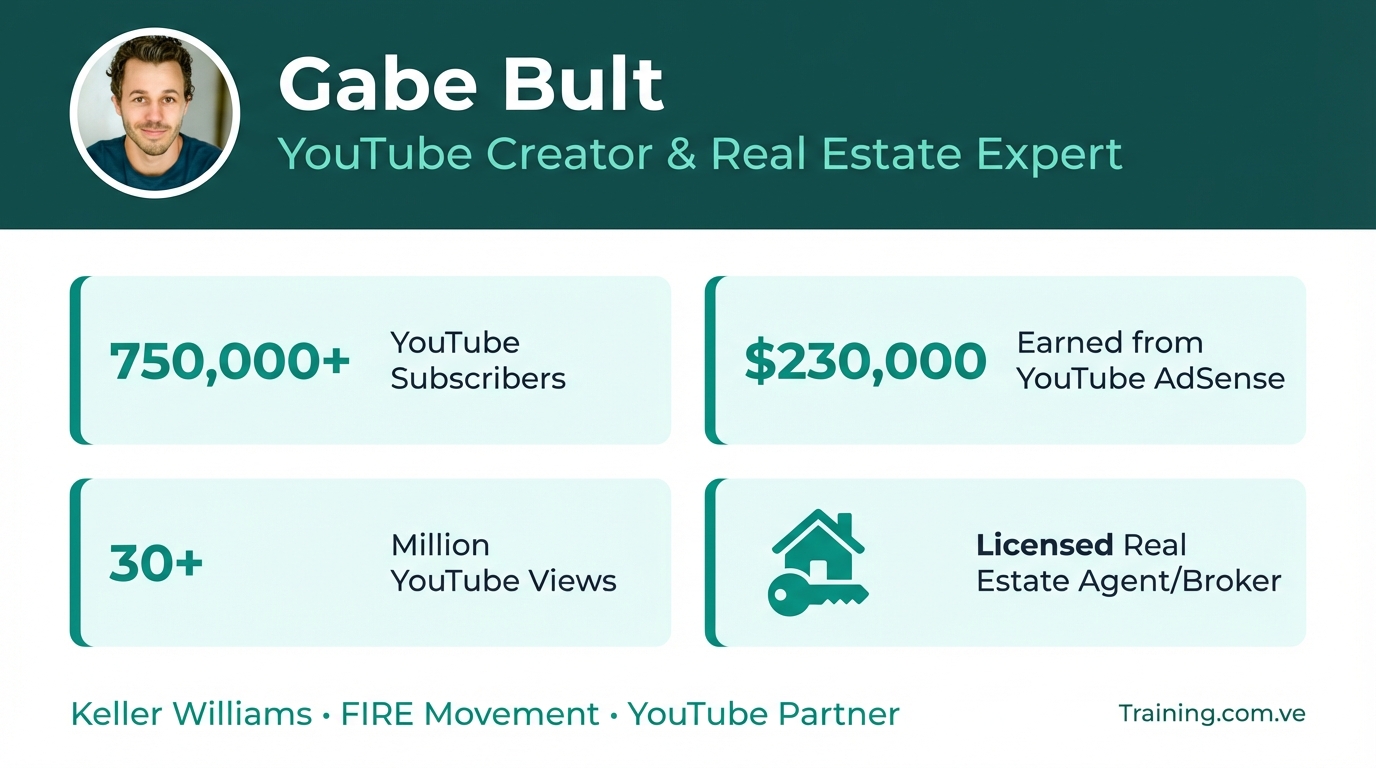
The 5-Hour YouTuber is his attempt to teach what he learned the hard way: that YouTube success is an engineering problem, not a creativity problem. After generating $360K in lifetime AdSense, hitting $20–40K/month working roughly five hours per week, and pulling $225K from a single video, Bult has enough receipts to back up the premise.
But does the course deliver on that promise, or is it another info-product dressed up in compelling personal results? This review gives you the full picture.
At a Glance
| Creator | Gabe Bult |
| Price | $997 |
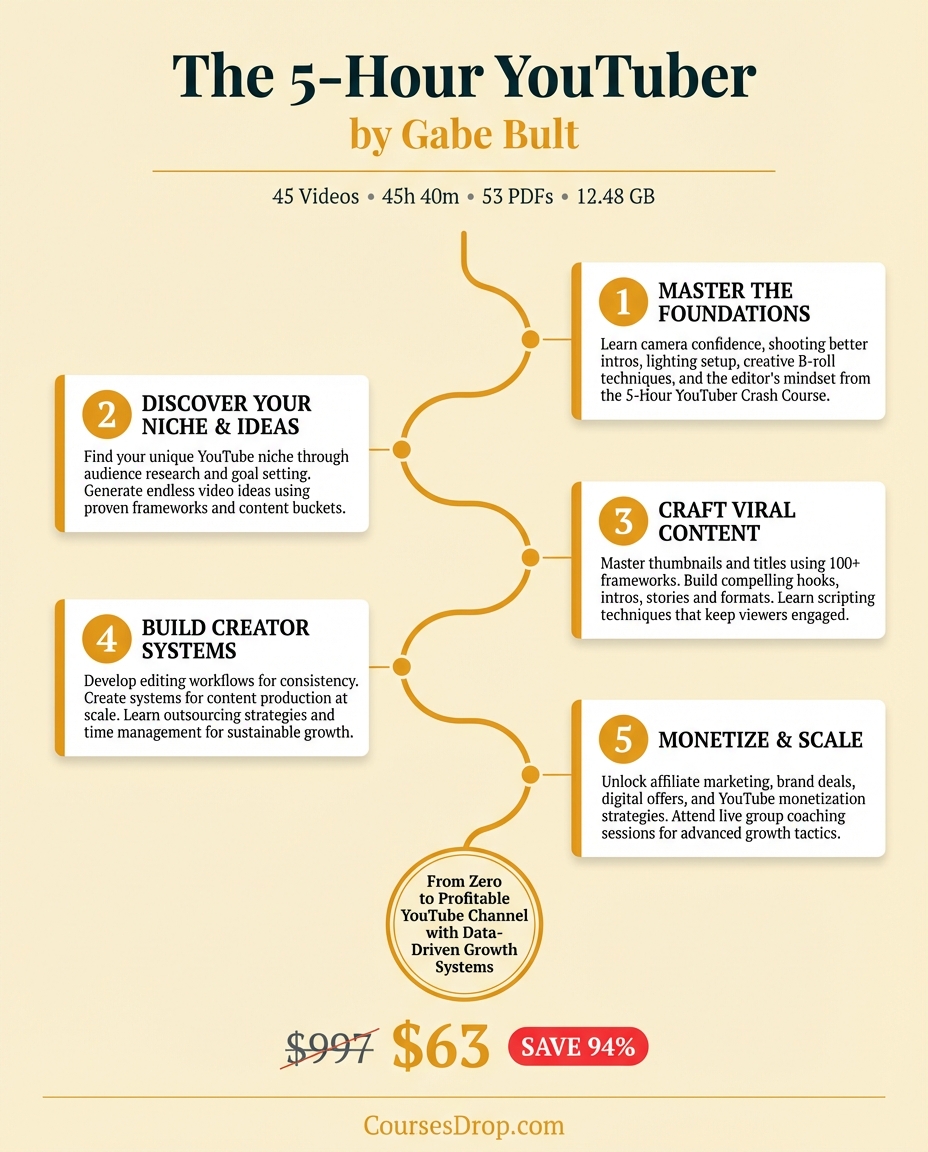
| Format | 12 pre-recorded crash course lessons + 33 live cohort sessions |
| Total video | 45.4 hours across 45 lessons |
| Difficulty | Beginner |
| Best for | Aspiring YouTubers, small creators under 10K subs, entrepreneurs using YouTube as lead gen |
| Skip if | Already earning $10K+/month, operating in highly technical niches, or looking for a quick fix |
The Core Insight That Reframes Everything
Before you dig into frameworks and workflows, Bult introduces a mental model shift that underpins the entire course: YouTube is a TV network, not an art gallery.
An art gallery rewards craft. A TV network rewards systems, scheduling, audience retention, and repeatable production. Most struggling YouTubers treat their channels like art galleries — pouring energy into polished videos that nobody clicks on — when what YouTube's algorithm actually rewards is consistency, packaging, and viewer psychology.
From that foundation, Bult makes one specific, high-leverage claim: the only two things that determine whether anyone ever sees your video are the thumbnail and the first 30 seconds. Everything else — editing quality, B-roll, transitions, color grading — is largely irrelevant to growth at the early stage.
This is not a novel idea in isolation, but Bult is one of the few educators who builds an entire operating system around it rather than just mentioning it in passing.
Frameworks Covered in the Course
The 5-Hour YouTuber is dense with named systems. Here is the core framework in depth, with the rest named for reference.
The 5-Hour System (The Deep Framework)
This is the operational backbone of the entire course. Bult maps out exactly how to allocate five hours per week across ideation, scripting, filming, and delegation so that YouTube does not consume your life.
The system rests on a single insight: most creators spend their time on the wrong things. They pour hours into editing, color grading, and B-roll while spending almost nothing on the thumbnail and the first 30 seconds — the two variables that determine whether anyone watches the video at all. The 5-Hour System restructures the entire week around this reality.
The practical allocation looks like this: the majority of creator time goes to ideation, thumbnail design, and scripting the hook. Everything downstream from that — the edit, the upload workflow, the posting schedule — gets systematized, delegated, or compressed to the minimum viable standard. An editor handles the 80% of production that does not move the needle. The creator stays in the 20% that does.
This is what makes the five-hour-per-week claim plausible. Not by posting less, but by eliminating low-leverage work from the creator's plate entirely. Bult is explicit that the five-hour state is a target, not a starting point — early-stage creators will spend more time building the system before it runs efficiently. But the system itself is designed to get there: documented SOPs, briefed editors, and a weekly workflow that does not depend on the creator's mood or motivation.
The Three-Year Rule connects to this framework. Bult teaches that creators who build repeatable systems and stay for three years disproportionately succeed — not because three years is magic, but because that is the window in which systems compound. The 5-Hour System is what makes three years survivable.
The Other Frameworks
The course also covers these named frameworks. Each is applied within the broader 5-Hour System.
Four-Bucket Content Strategy — Divides content across four categories (viral, searchable, community, money-maker) to keep the channel balanced without letting any single goal dominate output. YouTube Ikigai + Three Pillar System — Finds the intersection of what you know, what audiences want, and what the market rewards, then builds a sustainable content universe around it. Make Noise, Listen for Signal — Publish broadly first, then let audience response tell you what to double down on. Contradicts the standard "niche down before you start" advice. Authority Hacking — Creating content that borrows credibility from established creators in your space, producing 77–200x performance increases on specific videos. Three-Step Psychological Hook Formula — The structure for the first 30 seconds: pattern interruption, problem framing, and promise delivery. 80/20 Production Rule — 80% of production effort on the first 30 seconds. The remaining 80% of the video gets 20% of your energy. Avatar Research Channel System — Systematic, iterative viewer research treated like product management rather than guesswork. Progressive Validation Ladder — Monetization sequencing: free content to low-ticket to mid-ticket to full course, validating demand at each step before investing heavily. Thumbnail-First Workflow — Design the thumbnail before you film. The thumbnail defines the promise; the video fulfills it.What the Course Teaches Particularly Well
Outsourcing earlier than feels comfortable. Bult is direct: hire a video editor before you think you can afford one, before you feel ready, and almost certainly before you want to. He walks through the economics of why editing is the highest-ROI task to delegate and gives practical guidance on finding and managing editors on a tight budget. The operational side of running a channel. Most YouTube courses teach content strategy. This one teaches channel operations — how to build a workflow that does not depend on your motivation or mood on a given week. That distinction matters enormously for long-term output. Proven ideas over original ideas. Bult makes a persuasive case that originality is overrated and often actively harmful at the early stage. Studying what already works, building on proven formats, and iterating from a stable foundation is how small channels actually grow. The Three-Year Rule. Bult introduces a mindset framework that reframes the timelines most new creators expect. Understanding why creators who stay for three years disproportionately succeed — and what separates them from those who quit — is genuinely useful context for anyone who has stalled or is tempted to give up.Get Every Framework from The 5-Hour YouTuber
The course costs $997. The complete breakdown is $49/year.
Start free — 10 full summaries, no credit card
What the Course Does Not Cover
No course covers everything, and being honest about gaps is more useful than pretending they do not exist.
The course is not designed for short-form content. If your primary platform is YouTube Shorts, Instagram Reels, or TikTok, the system here will not map cleanly to your workflow.
Highly technical niches — scientific, medical, legal, engineering — face distribution and monetization constraints that the course does not specifically address. The frameworks are applicable in principle, but you will do more translation work than a lifestyle or business creator would.
Advanced SEO and search optimization beyond YouTube's native tools is light. If you are building a channel primarily on search volume rather than algorithmic distribution, you may want to supplement this course with dedicated SEO resources.
Finally, if you are already earning $10K+/month from your channel, the foundational work here will feel redundant. This course is explicitly built for the creator who is still figuring out the system, not optimizing an existing one.
Who This Course Is For
- Aspiring YouTubers who have not yet started or are in their first year
- Creators under 10,000 subscribers who are posting but not growing
- Entrepreneurs and business owners who want YouTube as a lead generation channel
- Anyone who has tried YouTube, burned out, and wants a more sustainable approach
- People who have strong domain expertise but no framework for turning it into a channel
Who Should Skip It
- Creators already generating $10K/month or more from their channel
- Anyone looking for a shortcut or expecting results within 30 days
- Creators in highly technical or regulated niches without some budget for adaptation
- Short-form-only creators with no interest in long-form YouTube
Verdict
The 5-Hour YouTuber is one of the more coherent YouTube education products on the market because it is built around a single, defensible thesis: the creators who win are the ones who engineer repeatable systems, not the ones who make the best individual videos. Gabe Bult does not just teach that thesis — he demonstrates it with his own channel economics.
At $997, this is not an impulse purchase. But for a beginner who is serious about building a YouTube channel as a business asset, the cost compares favorably to the months of wasted effort and misdirected energy that the right framework would have prevented. The 45+ hours of content, the live cohort access, and the operational specificity make this a substantive course, not a bloated workshop.
The qualifier is honesty about timelines. This is a three-year investment, not a three-month one. If you are willing to accept that framing and execute the system, the course gives you everything you need to build a channel that runs on five hours per week and actually grows.
The course costs $997. The full breakdown — plus 110+ other courses — is available on Course To Action. A free account gives you 10 summaries with no credit card required. Every summary and every lesson has audio. You can also use the AI tools to apply Bult's frameworks to your own channel or generate a full action plan.
View The 5-Hour YouTuber on Course To Action — Free to StartFrequently Asked Questions
Is The 5-Hour YouTuber worth $997? For a creator who is serious about YouTube as a long-term business and has not yet found a repeatable system, yes. The course is operationally specific enough to save you months of trial and error. If you are dabbling or expect fast results, it is not the right fit. What experience level do you need? None. The course is rated beginner and assumes you are starting from scratch or have a small channel without a working system. You do not need any prior experience with video production, editing, or YouTube strategy. How long does the course take to complete? The recorded crash course is 12 lessons. The full cohort experience adds 33 live sessions for 45 lessons and 45.4 total video hours. How much you consume and how quickly depends on your schedule. Is it just a video course or is there live access? Both. The course includes a pre-recorded crash course and 33 live cohort sessions. The live component is a meaningful differentiator for people who want accountability and the ability to ask questions directly. Does the 5-hour-per-week claim hold up? Bult's results are real — $20–40K/month on roughly five hours per week — but those results came after years of building systems, developing audience, and delegating production. The five-hour workflow is the target state, not the starting point. Early on, you will likely spend more time learning the system before it runs efficiently. What happens if the course does not work for me? Check the current refund policy directly on the course page. Terms can change and it is always worth confirming before purchasing. Can I use these frameworks for channels that are not about money or lifestyle? Yes, with some adaptation. The core frameworks — thumbnail-first workflow, four-bucket strategy, hook formula — are platform mechanics that apply broadly. The monetization sequences are more tailored to business or educational channels, so you may need to remap those to your specific goals.Read the Complete The 5-Hour YouTuber Summary
The course costs $997. The full breakdown is $49/year — for every course on the platform.
Every framework deconstructed, every action step extracted, AI that applies it to your specific business. Read or listen — every summary has audio.
Start free — 10 full summaries, no credit card required