The Client Studio 2025 Review (2026): Is Ross O'Lochlainn's $500 Business Model Worth It?
Most business models ask you to choose between money and freedom. Ross O'Lochlainn decided not to choose. The Client Studio 2025 is his attempt to teach you how.
At $500 for 53 lessons across 12 hours of video, this is not a cheap impulse buy. But it is also not a vague motivational program. It is a documented operating system for a specific kind of business — one that generates $35,000 to $40,000 per month with two people, 82 to 85 percent profit margins, and a hard cap of 43 members.
The question is whether the model fits your situation, and whether the course teaches it clearly enough to be worth the price. This review covers both. The full curriculum is free to explore at coursetoaction.com — 10 summaries free, no credit card required.
At a Glance
| Detail | Info |
|---|---|
| Course | The Client Studio 2025 |
| Creator | Ross O'Lochlainn |
| Price | $500 |
| Lessons | 53 across 4 modules |
| Video Hours | 12 |
| Difficulty | Intermediate |
| Category | Business Model Design |
| Best For | Coaches and consultants earning $10–30k/month who want high-margin group delivery |
The Core Insight: Your Clients Are Your Innovation Team
The premise of The Client Studio 2025 is unusual and, if you have spent any time building courses in isolation, it will feel uncomfortable at first.
Ross argues that most creators solve the wrong problem first. They spend months building a curriculum, record videos in a studio, then launch to an audience and discover they built something people do not actually want — or that they cannot sell. The research, the delivery, and the marketing are three separate and expensive phases.
His reframe: when you co-create solutions hand-to-hand with real clients, all three problems collapse into one. You discover what to build by building it live. You prove it works because it works on real people in real time. You generate testimonials and case studies as a byproduct of delivery. The clients are not the end consumers of your expertise — they are the research and development team.
This is the philosophical core that everything else in the program is built on. Whether the rest of the frameworks land depends almost entirely on whether you accept this premise.
The Key Frameworks
The Optimal Build OrderA sequenced roadmap for how to build the Client Studio model from zero. This addresses a practical question the earlier sections leave open: if you accept the co-creation philosophy and understand the flywheel, what do you actually do first? The Optimal Build Order is Ross's answer, and it is one of the more actionable pieces of the program for people who are still in the early stages of building.
The framework makes explicit that sequencing matters as much as the components themselves. Building the Conversion Engine before the Studio is operational, for example, produces leads with nowhere to go. Building the Studio before the proof exists means nothing compelling to feed the Lead Refinery. The Optimal Build Order walks through each phase in sequence — with the rationale for the order — so students are not assembling pieces in the wrong direction.
For people arriving at The Client Studio 2025 with existing client relationships but no systematized model, this framework often serves as the clearest on-ramp to implementation.
The course also covers: Client Studio Model, Studio Flywheel, Conversion Engine (5 Components), Games Master/Quest-Based Delivery, Creative MOFO Model, 1-2-3 Co-Creation Process, and Dan Sullivan's Value Creation System. Full framework breakdowns are at coursetoaction.com/.
What The Client Studio 2025 Teaches Well
Operational architecture. If you want to understand how a two-person business can generate $500,000 per year at high margins without scaling headcount, the course does this better than almost anything else in the market. The numbers are not hypothetical — Ross runs this model and the metrics he shares are from his own operation. The co-creation philosophy. The conceptual shift from "build then sell" to "sell then build with clients" is genuinely useful, and Ross makes it accessible without oversimplifying. By the end of the program you understand not just what he does but why the design decisions are made the way they are. Quest-based delivery. The Games Master framing is a practical model for running group programs that feel engaging rather than transactional. It is applicable beyond the specific Client Studio model. Real metrics. A $72.50 CPA and 60 percent opt-in rate are specific enough to be useful as benchmarks. Most courses in this space deal in vague promises. Ross deals in documented numbers from his own business.Ready to go deeper before you decide? Course To Action covers 110+ premium courses — every one with structured summaries, audio for every lesson, and AI tools including "Apply to My Business" and "Generate Action Plan." Start free with 10 summaries, no credit card required ($49/30 days or $399/year for full access). The full course page is at coursetoaction.com/.
Get Every Framework from The Client Studio 2025
The course costs $$500. The complete breakdown is $49/year.
Start free — 10 full summaries, no credit card
What The Client Studio 2025 Doesn't Cover
Technical implementation. The course is entirely model and philosophy. There is no instruction on which tools to use, how to set up a community platform, how to handle payments, or how to manage the operational back end. If you are looking for a plug-and-play setup guide, this is not it. Standalone completeness. Ross references other trainings he has built elsewhere, and some of the deeper implementation details point outward to those resources. The Client Studio 2025 is the flagship model course, but it is not a closed loop — there are threads that lead outside it. Case study depth. There are only two client case studies in the program. For a model that stakes its credibility on co-creation producing results, two examples is a thin base. You are asked to extend a significant amount of trust based on Ross's own numbers plus two external data points. Writing-light alternatives. The model has a heavy dependency on writing. Ross writes daily as a core creative practice and the program reflects that orientation. If you are a coach whose strengths are verbal and relational rather than written, the model is not impossible to adapt, but the course does not help you make that adaptation. Repetition across workshops. The core model is taught across three separate workshop sessions inside the program. Ross frames this as intentional reinforcement, and there is an argument for it, but for students who grasp the model quickly, the repeated passes can feel slow.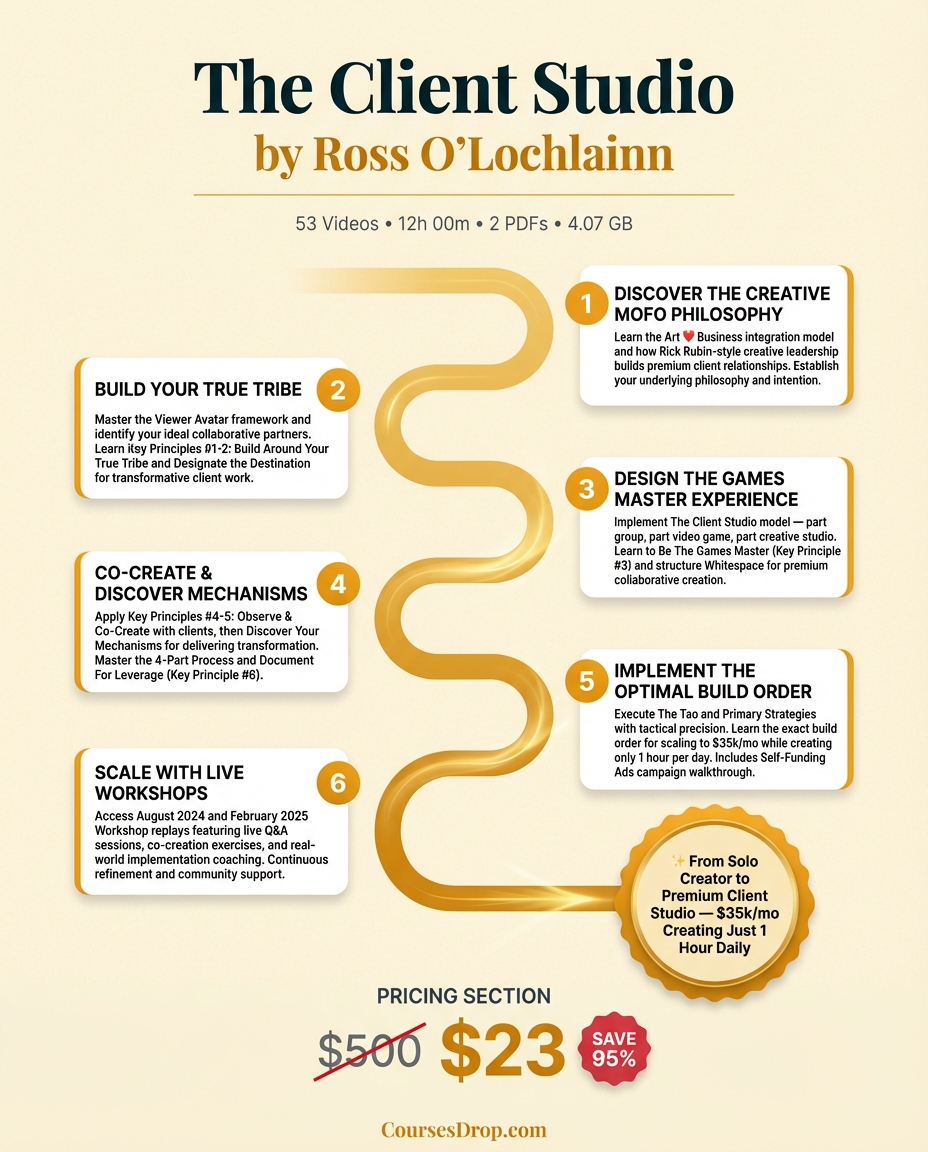
Who This Is For
The Client Studio 2025 is built for a specific operator at a specific stage.
You are likely a fit if you are a coach, consultant, or creative professional already earning $10,000 to $30,000 per month and feeling the friction of that model — the launch cycles, the client acquisition grind, the tension between doing the work and selling the work. You want a high-margin group container that does not require building a team or running complicated funnels. You are comfortable with writing as a primary channel. You want $500,000 per year or more without the organizational complexity that usually comes with it.
You are also a fit if you are earlier stage but unusually clear on the model you want to build, and you are willing to work with the Optimal Build Order as a staged roadmap rather than expecting immediate results.
Who Should Skip It
If you are looking for templates, copy-paste systems, or technical setup guides, this is not the right course. The program teaches principles and architecture, not execution steps.
If you are building toward an acquisition or planning significant team growth, the capacity-limited model is structurally opposed to those goals — the constraints are features of the model, not bugs to be engineered away.
Complete beginners will find the course assumes a baseline of business experience. There is not much scaffolding for someone who has not yet worked with paying clients.
And if writing is not a practice you already have or plan to build, the model as taught will require meaningful adaptation that the course does not provide.
Verdict
The Client Studio 2025 is a genuinely well-designed course for a genuinely specific model. Ross O'Lochlainn is not teaching theory — he is documenting an operating system he actually runs, with real margins and real constraints, for people who want to replicate the architecture rather than just borrow the vibes.
At $500, the price is appropriate for the depth of the model content. It is not cheap, but it is not inflated either.
The limitations are real: limited case studies, no technical implementation, some repetition in the workshop structure. But none of them undermine the core value of the program if you are the right buyer.
The right buyer is an intermediate-stage creator who is done with the launch hamster wheel, comfortable with writing, and ready to build a business that is designed around constraints rather than in spite of them.
Before you spend $500, make sure you have read the full course breakdown, checked the curriculum structure, and confirmed the model fits where you are right now. All of that — with audio for every lesson and AI tools to apply it to your business — is available free to start at coursetoaction.com/. No credit card required.
FAQ
Is The Client Studio 2025 worth $500? For the right buyer — an intermediate-stage coach or consultant wanting a high-margin group model — yes. For beginners or people wanting technical templates, no. Who is Ross O'Lochlainn? Ross runs a $35,000 to $40,000 per month coaching business as a two-person operation with 82 to 85 percent profit margins. He caps at 43 members and delivers only on Tuesdays and Thursdays, protecting the rest of his schedule for personal creative work. How many lessons does The Client Studio 2025 have? 53 lessons across 4 modules, totaling approximately 12 hours of video. What is the Client Studio Model? A capacity-limited business model with a hard cap of 43 members. It runs on a co-creation philosophy where clients participate in product development, making delivery, marketing, and content creation a unified process rather than three separate workflows. Does the course cover technical setup? No. The Client Studio 2025 focuses entirely on model design, philosophy, and operational architecture. Tool selection and technical implementation are not covered. What results does Ross claim? Ross documents his own business results: $35,000 to $40,000 per month in revenue, 82 to 85 percent profit margins, a $72.50 cost per acquisition, and a 60 percent opt-in rate. These are presented as benchmarks from his specific operation, not guarantees.Read the Complete The Client Studio 2025 Summary
The course costs $$500. The full breakdown is $49/year — for every course on the platform.
Every framework deconstructed, every action step extracted, AI that applies it to your specific business. Read or listen — every summary has audio.
Start free — 10 full summaries, no credit card required