The Dream Life Method Review (2026): Is Emily Williams' $997 Life Design Course Worth It?
You've read the books. You've bought the strategy course. You know what you're supposed to do — and you're still not doing it. That gap between knowing and doing is exactly what Emily Williams built The Dream Life Method to close. But is a $997 mindset course the answer, or just another thing you'll start and abandon?
This review covers every framework, every module, and every limitation so you can decide before you spend the money. At coursetoaction.com — a library of 110+ premium courses available from $49 for 30 days — you can also read the full lesson-by-lesson summary with audio before committing to the full $997. No credit card required to start.
At a Glance
| Detail | Info |
|---|---|
| Course | The Dream Life Method |
| Creator | Emily Williams |
| Price | $997 |
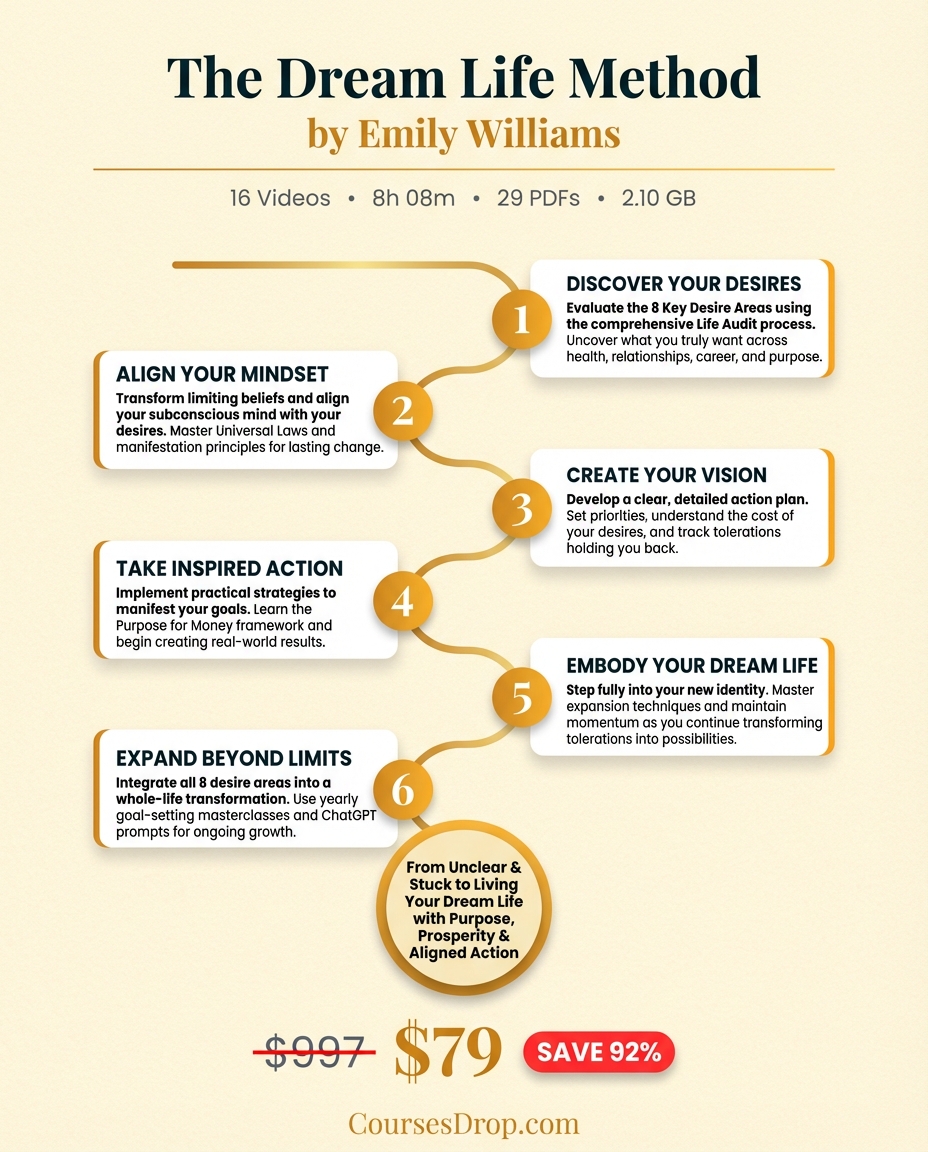
| Lessons | 16 (6 modules + live coaching calls) |
| Video Hours | 8.1 |
| Difficulty | Beginner |
| Category | Mindset & Personal Development |
| Best For | Women entrepreneurs stuck by internal resistance |
| Skip If | You need business strategy, marketing, or sales training |
| Read First | Full summary + audio at coursetoaction.com (free tier available) |
The Core Insight That Drives This Course
Emily Williams opens The Dream Life Method with a premise that cuts through a lot of noise: most people who feel stuck don't lack knowledge or strategy. They lack clean energy around their desires and self-trust built from kept promises.
That second part is the sharper of the two ideas. Self-trust isn't something you think your way into — it's built through a track record of following through on commitments you make to yourself. Every time you set a goal and abandon it, you erode your own credibility with yourself. The course argues that the real work isn't finding the right productivity system or the right mentor. It's becoming someone who does what they say they'll do, starting with the smallest possible promises.
The other framing that runs throughout the program is what Emily calls stopping strategies: the subconscious patterns your brain deploys to keep you safely inside your comfort zone, disguised as wisdom, preparation, or responsibility. Perfectionism is a stopping strategy. Researching instead of launching is a stopping strategy. Saying you'll start when the kids are older, when revenue is higher, when you feel ready — all stopping strategies. The course is largely an exercise in identifying yours.
The Frameworks
1. The 8 Key Desire Areas Life Audit
The course begins here, and it's a useful place to start. Emily maps your life across eight domains — things like relationships, health, finances, environment, personal growth, and contribution — and asks you to score yourself honestly in each area. The goal isn't to find where you're failing. It's to surface the areas where you've gone numb, where you've stopped wanting things because wanting felt too risky or too distant.
The audit forces you to confront tolerations: the things you've been putting up with so long they've become invisible. Emily did this exercise and identified 62 tolerations in her own life. That number tends to land with people. Most of us have been tolerating far more than we've consciously registered.
2. The Three-Part Desire Uncovering Framework
Once the audit surfaces where you're numb or stuck, the course moves into desire clarification through three lenses:
Brain Dump. An uncensored written exercise designed to bypass your internal editor. You write down everything you want without filtering for feasibility, practicality, or what other people would think. The point is to access desire before the logical mind shuts it down. Tolerations. These are the low-grade drains you've normalized — the cluttered office, the friendship that leaves you feeling worse, the financial situation you've stopped trying to improve. Emily's argument is that tolerations suppress desire. When you clear them, you create space for clarity. Jealousy as Data. This is the most counterintuitive and often most effective of the three. Emily teaches that jealousy is a diagnostic tool, not a character flaw. When you feel a sharp pang of envy at someone's life, relationship, business, or freedom, that feeling is pointing directly at something you want but haven't admitted to yourself. The exercise is to audit your jealousy rather than suppress it.3. The Stopping Strategies Framework
This is arguably the most practically useful framework in the program. Emily identifies the specific mental patterns that masquerade as reasonable behavior while quietly preventing any real progress. Common examples she works through:
- Needing more information before acting (perpetual research mode)
- Perfectionism that delays shipping, launching, or starting
- Busyness with low-priority tasks while the important work waits
- Framing self-sabotage as protecting others ("I can't focus on this right now, my family needs me")
4. The Desires + Mindset + Actions = Success Formula
This is the structural backbone of the course and reflects how Emily sequences the work: you can't take clean action from a place of unclear desire or unexamined belief. Most people skip straight to action because action feels productive. Emily's argument is that action taken from murky desire or limiting belief tends to produce murky, inconsistent results — which is why high-achieving people can know exactly what to do and still not do it.
The formula is simple enough to remember and use as a diagnostic. If results aren't coming: is the desire unclear? Is there a limiting belief blocking execution? Or is the action plan genuinely missing?
5. The Upper Limit Problem (Gay Hendricks)
Emily incorporates Gay Hendricks' concept from "The Big Leap": the idea that most people have an internal thermostat for success, happiness, and love — and when things go too well, the subconscious finds ways to pull them back down to a familiar level. This shows up as self-sabotage at moments of breakthrough, relationship conflict right after a big win, illness before a major opportunity, or sudden drama that derails momentum.
The course uses this framework to explain why intelligent, capable people keep hitting the same ceiling. It's not lack of skill. It's the upper limit kicking in. Emily includes exercises for identifying your personal upper limit patterns and beginning to expand your tolerance for good things.
What the Course Teaches Exceptionally Well
The tolerations exercise. The combination of having a name for this concept, a structured way to surface tolerations, and Emily's own example (62 of them) makes this genuinely illuminating. Most people finish this exercise surprised by how much low-grade friction they'd stopped noticing. Jealousy reframing. Using envy as a pointer rather than a source of shame is one of those simple reframes that tends to stick. Students consistently cite this as one of the more immediately applicable tools in the program. Stopping strategies identification. Naming the specific patterns that look like productivity or responsibility but function as avoidance is high-value work. The framework gives language to something most people feel but can't articulate. The coaching call breakthroughs. The live coaching call components of the program are where the most individualized insight tends to happen. Emily is a strong coach, and watching her work through someone else's stopping strategies in real time is often more instructive than the direct teaching. Action planning that connects to desire. Rather than giving you a generic productivity system, the course ties your action planning directly back to what you said you actually want. This makes the planning feel less like obligation and more like navigation.Thinking about enrolling? Before spending $997, read every lesson summarized with audio at coursetoaction.com/. Use the "Apply to My Business" AI tool (3 credits) to see how the frameworks map to your situation, or generate a personal action plan (10 credits). Free tier available — no credit card required.
Get Every Framework from The Dream Life Method
The course costs $$997. The complete breakdown is $49/year.
Start free — 10 full summaries, no credit card
What the Course Doesn't Cover
Be clear-eyed about this before purchasing. The Dream Life Method is almost entirely a mindset course. It does not teach:
- Business strategy, marketing, or sales
- Content creation, lead generation, or client acquisition
- Any tactical framework for growing revenue
- Community or peer support beyond the program itself
- Financial literacy beyond a basic "Purpose for the Money" spreadsheet
The course also speaks almost entirely to a feminine audience. The language, examples, and framing are specifically oriented toward women entrepreneurs. Men or those who don't identify with that framing will likely find it harder to connect with the material.
Who This Course Is For
The Dream Life Method is well-suited for you if:
- You're a woman entrepreneur who feels stuck despite having enough knowledge and strategy
- You've bought business courses but can't seem to execute what you've learned
- You're drawn to a spiritual-meets-practical approach to personal development
- You want a structured way to audit your life, identify what you actually want, and understand what's been stopping you
- You're in the early-to-mid stages of building your business (roughly pre-$500K)
Who Should Skip It
Pass on this course if:
- You need concrete business strategy: marketing, sales, client acquisition, or revenue systems
- You're skeptical of manifestation principles and energetics — you'll spend a third of the course frustrated
- You're well past the mindset work and need tactical execution frameworks
- You're a man or don't identify with feminine-focused language and framing
- You're at $500K+ and have already done significant mindset work
Verdict
The Dream Life Method delivers on its core promise: it gives you a structured, thorough process for identifying what you actually want, diagnosing what's been stopping you, and building the self-trust to follow through. The frameworks — particularly the tolerations exercise, the jealousy diagnostic, and the stopping strategies identification — are genuinely useful tools that many students report returning to repeatedly.
What it doesn't do is teach you how to build or grow a business. If the gap between you and your goals is a knowledge or strategy gap, this course won't close it. But if you've accumulated plenty of strategy and still can't execute — if you recognize yourself in the description of someone with stopping strategies — then the $997 is targeting the actual problem.
The mindset-heavy framing, including the manifestation content, is a meaningful portion of the curriculum. Whether that adds or subtracts value depends entirely on your openness to it.
For women entrepreneurs who are intellectually honest with themselves about the fact that internal resistance is the real obstacle, this course is well-constructed and likely worth the investment. For everyone else, the limitations are real enough to look elsewhere first.
Before you spend $997, read the full lesson-by-lesson summary with audio at coursetoaction.com/. coursetoaction.com covers 110+ premium courses — access starts at $49 for 30 days, with a free tier that requires no credit card.
FAQ
Is The Dream Life Method worth $997? For women entrepreneurs whose main obstacle is internal resistance rather than missing knowledge, yes. The frameworks are substantive and the coaching call component adds real value. If you need business strategy rather than mindset work, the price is hard to justify. What's actually inside The Dream Life Method? 16 lessons across 6 modules plus live coaching calls, totaling 8.1 hours of video. The content covers life auditing, desire clarification, limiting belief identification, stopping strategies, and action planning connected to your actual desires. Who created The Dream Life Method? Emily Williams, founder of I Heart My Life, a personal development brand for women entrepreneurs. She built the course from her own experience transforming her life and building a successful coaching business. Does The Dream Life Method teach business strategy? No. It is almost entirely mindset-focused. There is no marketing, sales, client acquisition, or revenue strategy content. If that's what you need, this is not the right course. Is there a community included with The Dream Life Method? No dedicated community beyond the program itself. The live coaching calls are the primary interactive component. Is The Dream Life Method good for men? The course language, examples, and framing are heavily oriented toward women entrepreneurs. Men or those who don't identify with that framing will likely find it difficult to connect with the material.Read the Complete The Dream Life Method Summary
The course costs $$997. The full breakdown is $49/year — for every course on the platform.
Every framework deconstructed, every action step extracted, AI that applies it to your specific business. Read or listen — every summary has audio.
Start free — 10 full summaries, no credit card required