
The Science of Storytelling Review (2026): Is Muse Storyfirst's $497 Filmmaking Course Worth It?
There is a famous study that researchers at Wharton use to explain why rational persuasion so often fails. Two groups were shown information about children starving in Africa. One group received statistics — millions affected, severity data, survival rates. The other group received a story about one girl named Rokia. The Rokia group donated 2.4 times more. But here is the part most people miss: when researchers added the statistics to Rokia's story, donations went down.
Patrick and Grant at Muse Storyfirst built an entire filmmaking methodology around that finding. The Science of Storytelling ($497) is their attempt to systematize what separates films that change minds from films that simply fill screens.
This review covers every module, every major framework, the real limitations, and who should — and should not — spend $497 on this course. At coursetoaction.com — a library of 110+ premium courses available from $49 for 30 days — you can read the full lesson-by-lesson summary with audio before committing. Free tier available, no credit card required.
What This Course Actually Is
The Science of Storytelling is a pre-production methodology course. It is not a camera course, a lighting course, or an editing course. Patrick and Grant are explicit about this from the first lesson: their thesis is that 50% of a film's success is determined before anyone picks up a camera.
The course runs 26 lessons across 4 modules and clocks in at approximately 4.2 hours of video. That runtime is deceptive — the material is dense with frameworks, research citations, and scored examples. This is not passive viewing content.
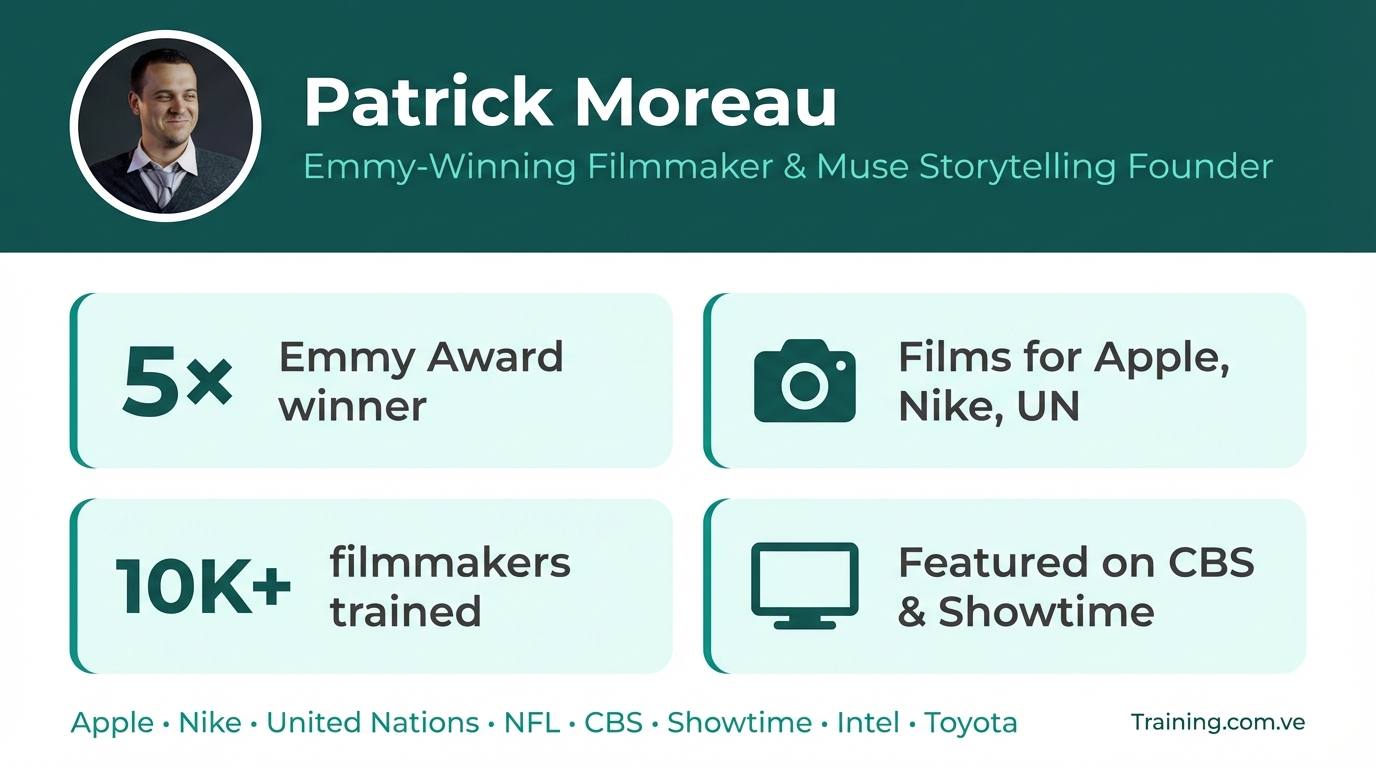
The creators bring credibility most online filmmaking instructors lack. Patrick and Grant have produced Emmy-winning documentary and commercial work under the Muse Storyfirst banner, and they teach their methodology through the lens of academic research — specifically narrative transportation theory, character identification psychology, and decades of persuasion science.
The Core Idea (And Why It Matters)
Before breaking down the modules, it is worth understanding the psychological model the entire course is built on.
Narrative transportation theory, developed by Melanie Green and Timothy Brock, describes what happens when an audience becomes fully absorbed in a story. When someone is transported, their rational defenses lower. They stop evaluating claims and start generating beliefs internally — as if the story's conclusions are their own. This is categorically different from receiving a persuasive argument, no matter how well-constructed.
The Rokia experiment is the course's anchor example, but Patrick and Grant support it with multiple studies throughout the curriculum. The practical implication for filmmakers is significant: a technically average film with a powerfully structured story will outperform a technically brilliant film with weak narrative architecture. That is the entire bet the course is making on your behalf.
Module-by-Module Breakdown
Module 1: Foundations
The opening module establishes the Four Pillars of Story framework — People, Plot, Places, and Purpose. These are not abstract categories. Each pillar maps to specific pre-production decisions, and the course returns to this structure repeatedly as an organizational spine.
Module 1 also introduces the Desire + Conflict + Growth formula, which Muse abbreviates as the Delta Formula. The core argument is simple: a story needs a character who wants something, faces real obstacles to getting it, and is measurably changed by the journey. Remove any leg of that triangle and what you have is content, not story. The Delta Formula becomes the diagnostic tool for everything that follows.
Module 2: Character and Story Architecture
This is the most rigorous section of the course. Module 2 introduces the Storyfinding Process — a systematic approach to identifying story subjects before committing to production — and the Big Three Things character scoring system.
The scoring system is particularly useful for documentary and commercial filmmakers who regularly need to evaluate multiple potential subjects. The Big Three Things gives you a reproducible rubric for assessing whether a character has the narrative potential to carry a film. This prevents the common (and expensive) mistake of falling in love with a subject who photographs beautifully but has nothing that functions as genuine desire or conflict on screen.
Module 2 also covers the Six Essential Plot Points. These are not a Hollywood screenplay formula imported wholesale into documentary work. They are structural checkpoints — moments that must exist in some form for the narrative transportation effect to activate in an audience. The instruction here is grounded and practical, with examples drawn from real commercial and documentary work the Muse team has produced.
The Seven Story Archetypes round out this module. This section is more conceptual than tactical, but it serves a useful function: it gives filmmakers a vocabulary for categorizing the type of story they are telling, which in turn clarifies production decisions well before shoot day.
Module 3: Place and the Three Creative Milestones
The Four Layers of Place framework treats location not as backdrop but as narrative instrument. The four layers — physical environment, sensory detail, symbolic resonance, and emotional memory — guide filmmakers toward locations that amplify character and conflict rather than simply provide visual variety.
The Three Creative Milestones (Keywords, Characters, and Storyboards) form the operational backbone of Muse's pre-production process. Keywords anchor the film's emotional intention. Characters are locked through the scoring process. Storyboards translate story architecture into visual sequences before a single camera rolls.
This sequence is where the course's most cited example lives: the $60,000 commercial that was edited on a plane ride with zero revision cycles. The claim is not magic. It is the direct result of completing all three creative milestones before production. When the story architecture is resolved in pre-production, the shoot becomes execution and post-production becomes assembly.
Module 4: Application and Tools
The final module applies the frameworks to real production scenarios and walks through the Muse workflow in practice. Two lessons in this module are product demonstrations for Muse's own software tools. This is worth flagging: if you are evaluating the course purely on instructional content, the last two lessons function more as promotional material than curriculum. They are not useless — seeing the workflow in a purpose-built tool has illustrative value — but they are not neutral instruction.
Ready to Learn the Full Framework?
Before spending $497, read every lesson summarized with audio at coursetoaction.com/. Use the "Apply to My Business" AI tool (3 credits) to map the methodology to your own film projects, or generate a full action plan (10 credits). Free tier available — no credit card required.
Get Every Framework from The Science of Storytelling
The course costs $$497. The complete breakdown is $49/year.
Start free — 10 full summaries, no credit card
What the Course Does Well
Repeatable creative process. The strongest thing Muse delivers is a system that removes the dependency on inspiration. The Storyfinding Process, the character scoring rubric, and the Three Creative Milestones can be executed on any project, for any client, on any timeline. That repeatability is what allows filmmakers to scale from $4K projects to $40K+ engagements — not because the tools get more expensive, but because the process produces predictable quality. Research grounding. Most filmmaking courses teach taste. Muse teaches mechanism. The difference matters because mechanism is transferable. When you understand why narrative transportation works, you can apply that understanding to formats, genres, and client scenarios that were never covered in the course. Real examples with real metrics. The commercial examples are not abstract. Patrick and Grant show work, cite numbers, and explain what decisions produced what outcomes. This is rarer in creative education than it should be.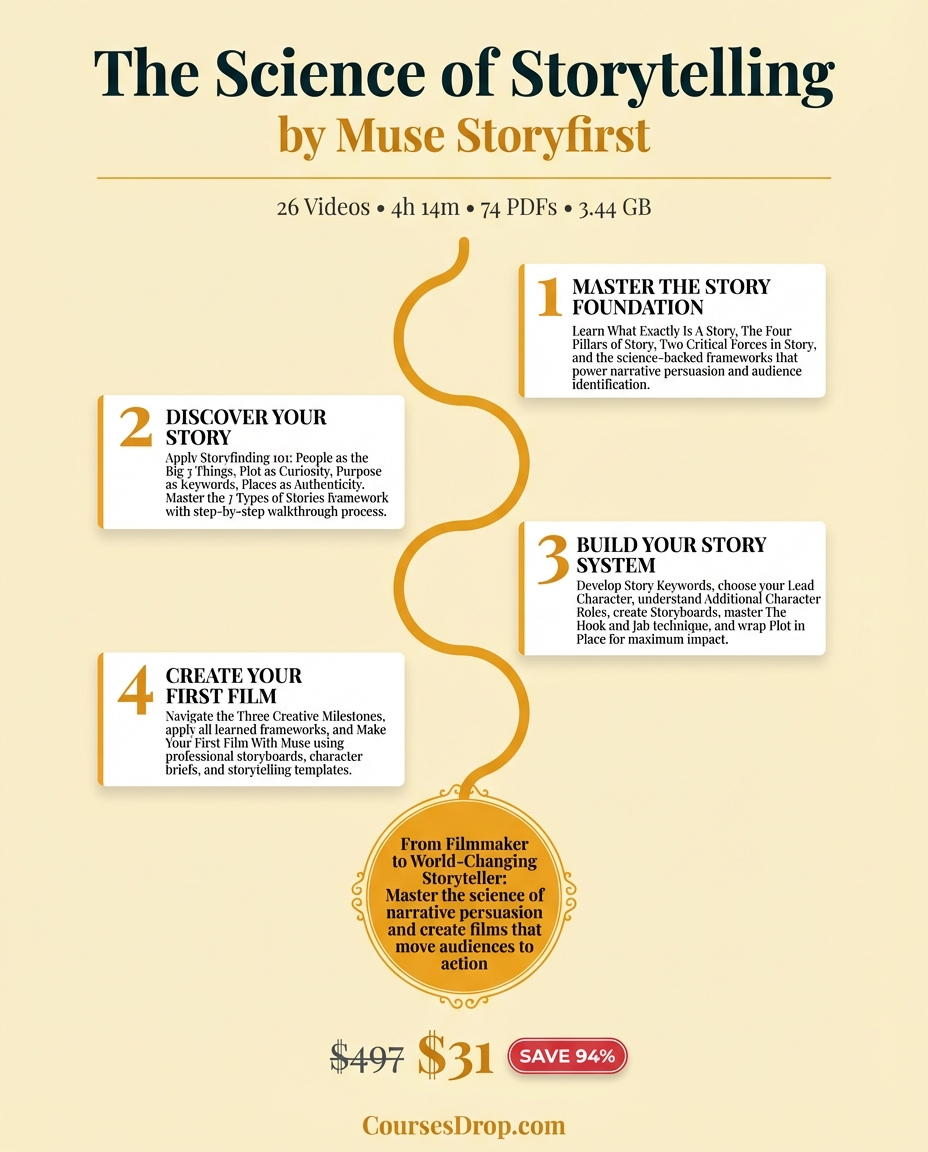
What the Course Does Not Cover
This section is not a criticism. It is a map of the territory the course explicitly does not claim.
No technical filmmaking skills. Camera operation, lighting setups, audio capture, color grading, and editing are not addressed. If you are searching for those skills, this is not the course. Stops at pre-production. The course teaches you to build a story architecture that is production-ready. It does not teach production or post-production workflow beyond the brief tool demonstrations. Documentary and commercial focus. The frameworks are drawn from non-fiction work. Fiction screenwriters and narrative feature filmmakers will find the material intellectually interesting but not directly applicable without significant translation. No business operations. Pricing, client acquisition, contracts, and studio building are not covered. The $4K-to-$40K transformation cited in Muse's marketing is the result of applying the methodology to higher-value projects — but the course does not teach you how to find or close those projects.Who Should Buy This Course
- Filmmakers who have the technical skills but feel their creative process is inconsistent or dependent on luck
- Content creators producing brand films, documentary shorts, or cause-driven video who want a repeatable story architecture
- Entrepreneurs using video storytelling for marketing and want their films to actually change audience beliefs, not just demonstrate production value
- Videographers who are technically proficient and want to transition into higher-value storytelling work
Who Should Not Buy This Course
- Anyone looking for camera, lighting, or editing instruction
- Fiction screenwriters or narrative feature filmmakers
- Beginners with no production experience looking for a starting point
- Marketers looking for quick social media content templates
Verdict
The Science of Storytelling is a focused, research-grounded course that delivers exactly what it promises: a pre-production methodology for building films that create genuine narrative transportation in audiences. The $497 price is appropriate for the level of systematic thinking Muse provides and the production value of the instruction.
The limitations are real but clearly scoped. This is not a complete filmmaking education. It is the creative architecture layer that most filmmaking education skips entirely.
If you have the technical skills and your films are not landing the way you intend — or if you are producing work that looks competent but does not move people — the Muse methodology addresses the correct problem. The course teaches you that the gap between good footage and a great film is almost never solved in post-production. It was solved, or not solved, in pre-production.
That is a lesson most filmmakers learn expensively over a decade. The Science of Storytelling compresses it into 4.2 hours.
Before you spend $497, read the full lesson-by-lesson summary with audio at coursetoaction.com/. coursetoaction.com covers 110+ premium courses — access starts at $49 for 30 days, with a free tier that requires no credit card.Read the Complete The Science of Storytelling Summary
The course costs $$497. The full breakdown is $49/year — for every course on the platform.
Every framework deconstructed, every action step extracted, AI that applies it to your specific business. Read or listen — every summary has audio.
Start free — 10 full summaries, no credit card required