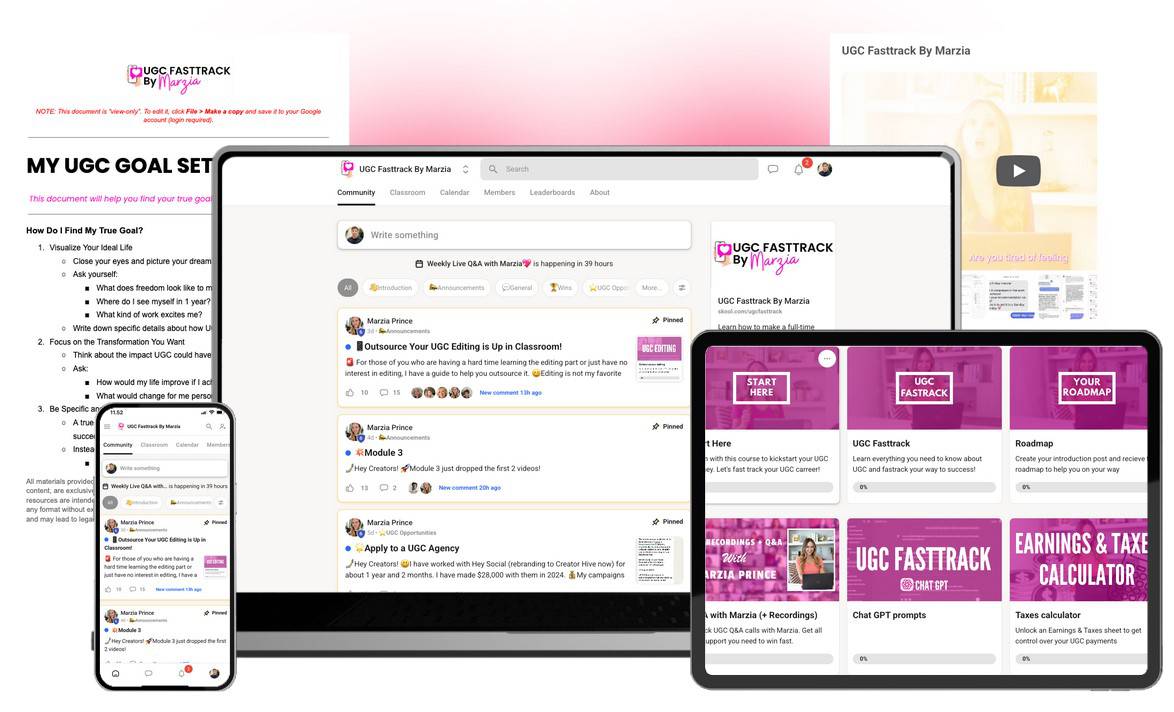
UGC Fasttrack Review (2026): Is Marzia Prince's $1,497 UGC Course Worth It? (Full Breakdown)
Marzia Prince's UGC Fasttrack is one of the more talked-about programs in the creator-economy space, priced at $1,497 for 65 lessons across 8 modules and 16.4 hours of video. User-generated content creation has become one of the most accessible ways to earn money online — no massive audience required, no viral moment needed. But most UGC courses are thin on specifics.
This review breaks down exactly what is inside, what frameworks Prince teaches, where the course is strong, and where it falls short — so you can decide whether this is the right investment before you spend $1,497. If you want to read the full framework breakdowns and lesson summaries before deciding, coursetoaction.com has the complete structured breakdown of UGC Fasttrack — with audio for every summary — free to start, no credit card required.
Who Is Marzia Prince?
Marzia Prince started creating UGC content at age 50. That detail matters, not as a novelty, but because it directly challenges the assumption that UGC is a young person's game. She has earned over $500,000 from UGC work and pulled in $27,600 from a single agency in 2024. She teaches with specific numbers and real examples from her own portfolio, which gives the course a grounded, practical quality that many creator-economy courses lack.
Her position in the market is clear: she is not teaching you how to build a personal brand or go viral. She is teaching you how to get paid by brands to make short video ads — and how to maximize what you earn from each piece of content you create.
What Is UGC (and Why It Pays Without Followers)?
Before getting into the course structure, it helps to understand the model. Traditional creator income depends on audience size — sponsorships, ad revenue, and brand deals scale with followers. UGC flips that completely.
Brands need authentic-looking video content for their paid ads. They are not running it on your channel. They are running it on theirs. Your follower count is irrelevant. What matters is whether you can make a video that performs — one that stops the scroll, communicates value, and moves someone toward a purchase. That is a learnable skill, and it is what UGC Fasttrack is designed to teach.
Course Structure: 8 Modules, 65 Lessons
Module 1: Foundations and Mindset
The course opens with the business model explained clearly. Prince walks through why brands pay for UGC, how the economics work from the brand's side, and why creators over 40 and 50 are in high demand. This module establishes the framework for everything that follows and sets expectations about timelines and income.
Module 2: The Universal UGC Video Formula
This is the core technical framework of the course: Hook + Ad Body + CTA. Every piece of UGC you create is built around this three-part structure. Prince breaks down 30+ real examples from her own work and her students' portfolios, showing what each element looks like in practice across different product categories.
The Hook Formula receives its own dedicated treatment, covering six distinct hook types. Understanding which hook to use for which product and which audience is a central skill the module develops through examples rather than theory alone.
Module 3: The Psychology Checklist for Ad Bodies
Once you can write a hook, you need to hold attention and drive action. Module 3 introduces a seven-element psychology checklist for constructing ad bodies. Each element addresses a specific cognitive trigger — social proof, specificity, transformation language, urgency mechanics, and others — that make the difference between a video brands ignore and one they want to license repeatedly.
This is one of the more distinctive sections of the course. Many UGC programs stop at format. This one addresses the persuasion layer underneath the format.
Module 4: Content Styles and Creator Roles
Prince identifies four content styles and four creator roles, giving students a framework for understanding where their strengths fit within the market. Not everyone will perform the same way on camera or produce the same type of content. This module helps students identify their natural positioning and lean into it rather than trying to imitate a style that does not suit them.
On-camera energy training is covered here with specific techniques for delivering lines naturally, maintaining eye contact with the lens, and avoiding the stiff quality that separates amateur UGC from content brands actually want to pay for.
Module 5: The Revenue Stream Stacking Model
This is arguably the most financially important section of the course. Base UGC fees — typically $150 to $300 for beginners — are just the starting point. The Revenue Stream Stacking Model teaches students to layer additional income on top of every piece of content:
- Usage rights: Charging brands for the right to run your content as paid ads
- Whitelisting: Allowing brands to run ads from your personal account
- Raw footage: Selling unedited clips separately
- Exclusivity fees: Charging brands not to work with their competitors
Module 6: The Seven-Channel Prospecting System
Getting clients is where most UGC courses go quiet. This module covers seven distinct channels for finding brand partnerships: direct outreach via email, Instagram DMs, LinkedIn, TikTok creator marketplaces, UGC-specific platforms, agency relationships, and referral systems. Each channel is treated with enough specificity to be actionable.
Agency relationships receive particular attention. Prince's $27,600 from a single agency in 2024 came from stacking ongoing work rather than chasing one-off deals, and this module explains how to position yourself for that kind of relationship.
Module 7: Portfolio Building
Brands need to see your work before they pay for it. This module walks through building a portfolio from scratch — including creating spec work for products you have not been paid to promote — setting up a portfolio page, and presenting yourself professionally even as a complete beginner. One student in the course landed a $625 deal with just 53 followers by leading with a strong portfolio rather than social proof.
Module 8: The Four-Tool Research Method
The final module covers research: how to identify brands actively spending on UGC content, how to analyze what is working in a given niche, and how to position your pitches based on what a brand's existing ads look like. The four-tool research method gives students a repeatable process rather than a one-time checklist.
What UGC Fasttrack Does Well
Specificity over inspiration. The course is built around real numbers, real examples, and real frameworks. Prince does not trade in vague motivational content. Revenue stacking. Most UGC courses teach base fees and stop. The stacking model is a genuine differentiator and is the framework most likely to change a student's income trajectory. Accessibility for older creators. The course makes a credible case for why creators over 40 and 50 have competitive advantages in certain product categories — authenticity, life experience, relatability to specific demographics. This is not just marketing; it reflects real demand from brands. Prospecting depth. Seven channels with actionable guidance is more than most courses in this category offer.Get Every Framework from UGC Fasttrack
The course costs $$1,497. The complete breakdown is $49/year.
Start free — 10 full summaries, no credit card
What UGC Fasttrack Does Not Cover
No performance marketing perspective. The course teaches creation from the creator's side. It does not address what makes a paid ad perform well from the buyer's side — ROAS, CPM, click-through rates, or how brands evaluate content against campaign metrics. Understanding this would help creators pitch more effectively and retain clients longer. No legal or contract coverage. There is nothing here on contracts, payment terms, intellectual property agreements, or what to do when a brand uses your content beyond the agreed scope. For a course at this price point, that is a meaningful gap. Rates may shift. The $150 to $300 beginner rates and the specific platform economics taught here reflect 2023-2024 conditions. The UGC market is changing. Treat specific rate guidance as a starting point, not a fixed benchmark. TikTok Shop coverage is thin. Given how significant TikTok Shop affiliate has become as a UGC revenue channel, its limited coverage here is a notable omission. US-focused. Brand partnerships, platform availability, and prospecting channels skew heavily toward US creators. International students may find portions of the prospecting module less applicable.Who Should Buy UGC Fasttrack
This course is well-suited for:
- Anyone who wants income without building a following first
- Creators over 40 or 50 looking for a professional skill with genuine market demand
- People with professional backgrounds (healthcare, finance, fitness, parenting) that translate to UGC authenticity in specific niches
- Stay-at-home parents who want flexible, project-based income
- Existing freelancers — writers, photographers, social media managers — looking to add a video-based revenue stream
- Anyone looking for passive income — this is active, client-facing freelance work
- Personal brand builders focused on growing their own following
- Anyone uncomfortable with sustained outreach and the rejection that comes with it
- Those who need income within the next 30 days — building a portfolio and landing first clients takes time
Is $1,497 Worth It?
The price is real money, and the answer depends on your situation. If you land two clients in your first month at beginner rates with even modest stacking, you recover the investment. If you use the prospecting system to build one solid agency relationship, the annual return is multiples of the course fee.
The course earns its price with the revenue stacking framework and the prospecting depth. These are not the sections you can reverse-engineer from free YouTube content. The legal gap and the thin TikTok Shop coverage are real limitations, but neither is a dealbreaker for someone who is genuinely new to UGC and needs a complete system to start.
If you are serious about UGC as a business model rather than a side hustle experiment, UGC Fasttrack is a strong foundation.
coursetoaction.com covers 110+ premium courses including UGC Fasttrack — every lesson summarized, every framework broken down, with audio for every summary. Start reading free with no credit card required. The AI tools ("Apply to My Business" and "Generate Action Plan") let you apply Prince's frameworks directly to your niche and situation.
See the full course breakdown at coursetoaction.com/Final Verdict
UGC Fasttrack is a well-structured, example-heavy beginner course built by someone who has done the work at scale. Its strongest sections — the revenue stacking model, the hook formula, and the prospecting system — justify the price for the right student. Its gaps (legal, performance marketing perspective, TikTok Shop) are worth knowing before you buy, but they do not undermine the core system.
Rating: 4.1 / 5Best for beginners and career-changers who want a concrete system for building UGC income without needing a following. Not for those looking for passive income or a complete freelance business education in one course.
Read the full UGC Fasttrack breakdown on Course To Action — free to start, no credit card required.Read the Complete UGC Fasttrack Summary
The course costs $$1,497. The full breakdown is $49/year — for every course on the platform.
Every framework deconstructed, every action step extracted, AI that applies it to your specific business. Read or listen — every summary has audio.
Start free — 10 full summaries, no credit card required