Your Ghost Biz Faceless Mastermind Review (2026): Ryan Lee's Anonymous Business Playbook, Decoded
Most online business advice starts with the same foundational assumption: you need to build a personal brand. Show your face. Post consistently. Become the face of your niche. Ryan Lee's Ghost Biz Faceless Mastermind opens by rejecting that assumption entirely — and the argument he makes is more credible than the premise might suggest. This is a $299 live workshop recording across 3 lessons that teaches beginners how to build a portfolio of small, anonymous income-generating businesses using AI tools, low-overhead digital products, and traffic methods that require zero personal exposure.
Here is everything that is actually inside it.
The Course at a Glance
| Field | Detail |
|---|---|
| Course | Your Ghost Biz Faceless Mastermind |
| Creator | Ryan Lee |
| Price | $299 |
| Content | 3 lessons |
| Difficulty | Beginner |
| Best For | Burned-out personal brand entrepreneurs, side hustlers, multi-passionate beginners who want anonymous income streams |
| Core Topic | Building a portfolio of faceless, anonymous online businesses using AI products, print-on-demand, and affiliate stacking |
| Skip If | Anyone needing advanced scaling, SEO, paid ads, or legal/tax guidance |
| Verdict | ★★★★☆ — A rare, refreshingly honest beginner system from a 25-year online business veteran who has built and exited multiple businesses |
The Core Insight: The Era of the One Big Personal Brand Is Over
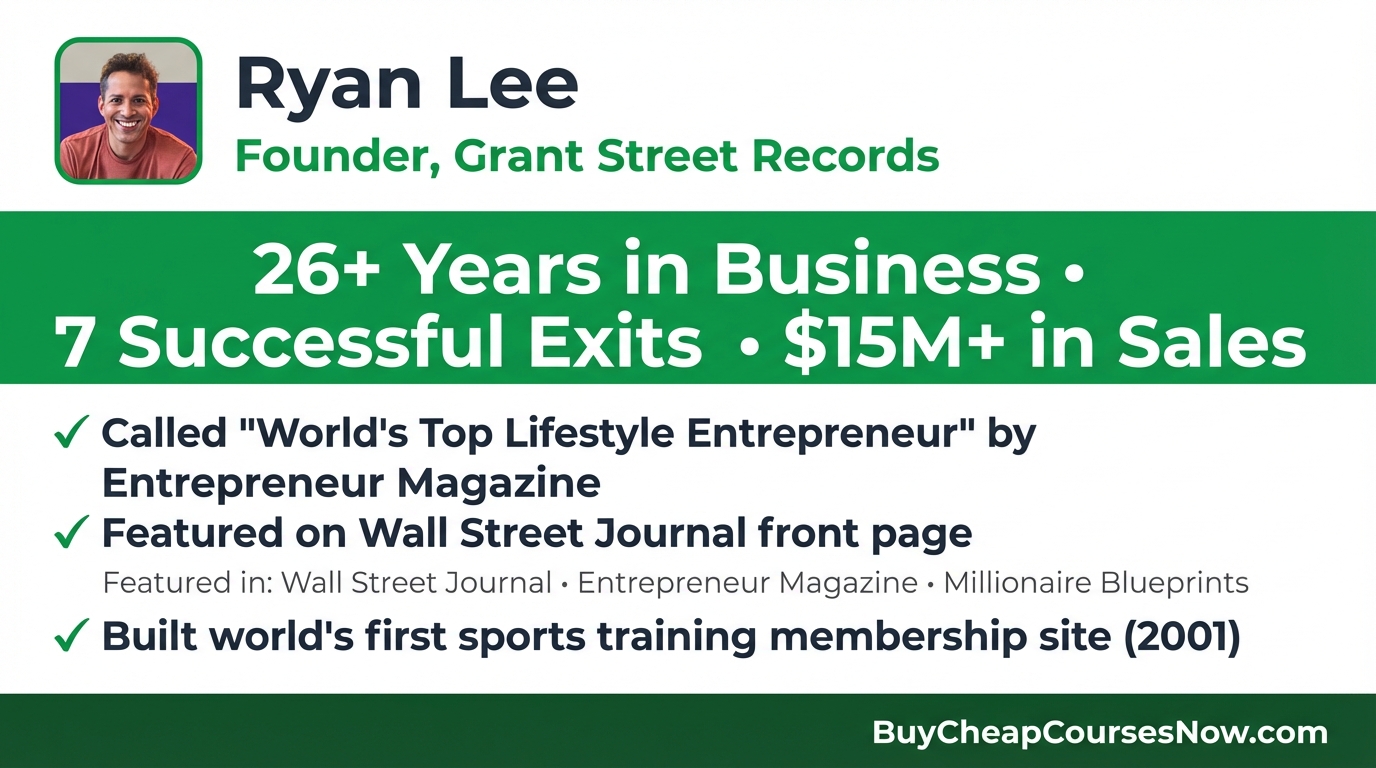
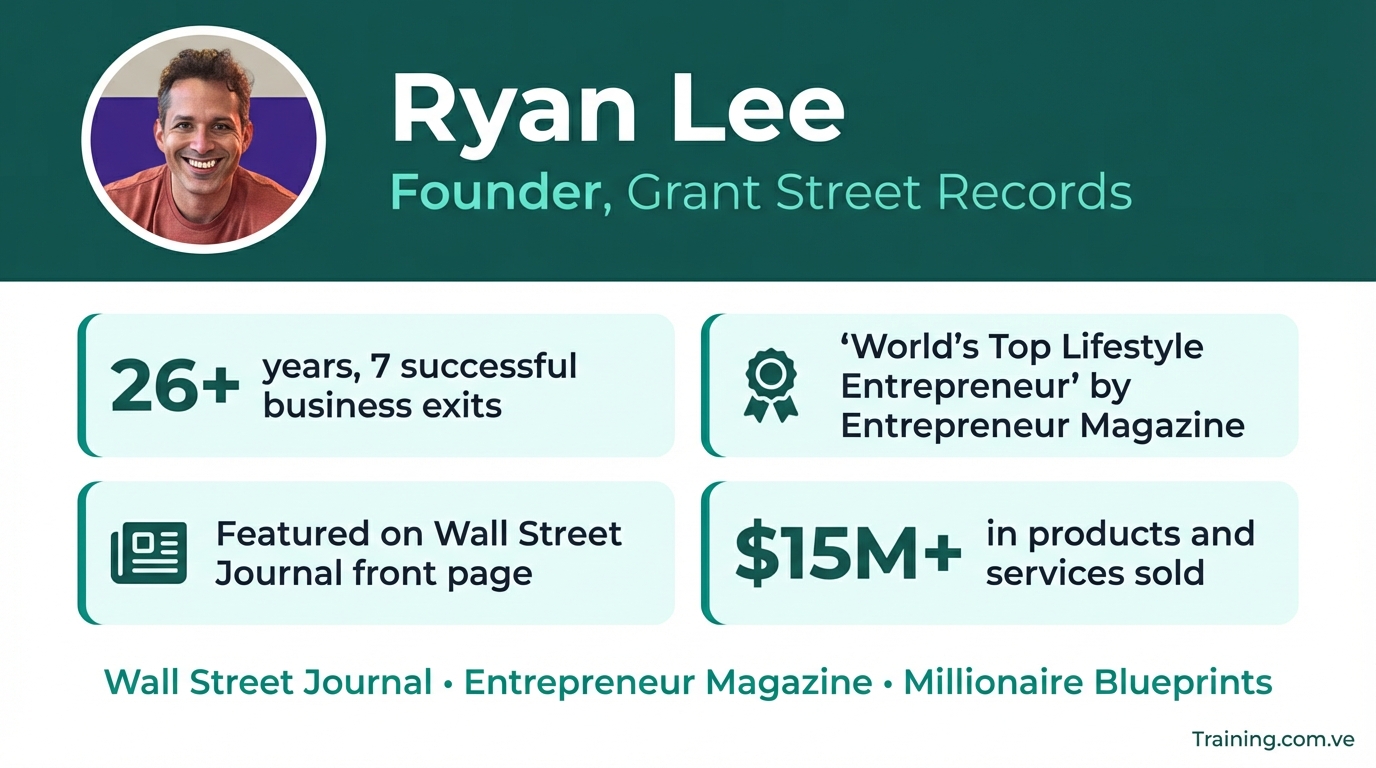
Ryan Lee has been building online businesses since 1999, long before "personal brand" was a marketing category. He built the world's first sports training membership site in 2001 while working as a gym teacher in the South Bronx, turned that into a multi-market business generating seven figures a month, and has since founded Freedym and Grant Street Records alongside multiple other ventures and six successful exits. He is not a beginner theorizing about what might work. He has lived through multiple platform cycles.
His central argument in Ghost Biz is this: AI has made generic information free. The era of the single large personal brand — built on information authority, expertise positioning, and content volume — is functionally over for most people trying to start from scratch. You cannot out-expertise the internet anymore. You cannot out-content the algorithm. And if you tie your income to your face and your name, you are building something that depends on you showing up forever.
The alternative he proposes is what he calls the Ghost Business Model: build many small, anonymous businesses instead of one large personal one. Think like a private equity firm. Each project is a small, independent investment. Most will not scale. Some will. The ones that do, you double down on. The ones that do not, you move past without the psychological weight of a failed personal identity.
The math he centers the course around is deliberately humble: if you have 10 projects each generating $200 per month, that is $2,000 per month in income — all anonymous, all low-overhead, all running without your face attached to any of it. For most beginners, that number is genuinely life-changing, not because it is a dramatic income claim but because it is achievable through a system with known, replicable parts.
The Frameworks: Where the Value Lives
1. The Ghost Business Model
The foundational framework. A ghost business is anonymous by design — no face, no real name attached, no personal reputation at stake. The practical implication is that you can build it alongside anything else in your life, fail at it without public consequence, and run many of them simultaneously. Lee's argument is not that anonymity is inherently virtuous; it is that anonymity removes the largest friction point that stops most people from starting: fear of being seen, judged, or associated with failure.
The model allows for what he calls a "Portfolio Mindset" — treating your projects the way a private equity firm treats its holdings. You are not married to any single project. You launch cheaply, test quickly, and let data tell you which bets to double down on.
2. Three-Level Niche Narrowing
One of the most practically useful frameworks in the course. Lee teaches a three-step niche selection process that moves from broad interest category down to a highly specific, monetizable micro-niche. The narrowing is not just about reducing competition — it is about finding a space where a small, dedicated audience will pay for focused resources that a general audience has no reason to.
The framework prevents the most common beginner mistake: picking a niche that is interesting to the creator but too broad to monetize without massive traffic volume. A three-level narrow niche can generate real income at 200 monthly visitors. A first-level broad niche needs 20,000.
The course also covers: The Ghost Product Ladder (a tiered product architecture from hands-off custom GPT products at $29–$49 up through creator-made printables and an optional personal layer); The 7-11-4 Rule (7 hours of content exposure, 11 touchpoints, 4 platforms before a buyer trusts a brand — and how ghost businesses satisfy that math without a face attached); Ghost Scanner Three-Dimension Scoring (evaluating niches across audience pain, monetization density, and content accessibility before committing); and Affiliate Stacking (layering affiliate relationships into an existing product ecosystem to add $150–$300/month per project at near-zero incremental cost).
The Live Demo: Building a Faceless YouTube Channel in Real Time
The most distinctive element of this course is not a framework — it is a live workshop demonstration. Lee screen-shares the process of creating a faceless YouTube channel, setting up its content structure, publishing an initial piece of content, and reaching 41 views in the first few minutes after going live. The style is casual and fast-paced, closer to a friend walking you through their laptop than a polished instructional video.
What the demo communicates that no framework document can: the activation energy to start is genuinely low. The tools are accessible. The production quality required to attract an initial audience in a narrow niche is far below what most beginners assume. The 41 views are not a viral number — they are a proof-of-concept number. This is not a course about going viral. It is a course about getting to $200 per month per project without your name or face attached to any of it.
What It Teaches Exceptionally Well
The portfolio mindset reframe is the most useful thing in the course. Most beginner business education implicitly treats business as identity — you are building your brand, your platform, your audience. The failure of a single project therefore feels like personal failure. Lee's private equity framing — you are managing a portfolio of small bets, not a single identity — removes that psychological weight. Most projects will not scale. That is fine. You only need a few to work, and each new launch gets faster and cheaper as you internalize the system. The custom GPT product category is genuinely underexplored at this price point. The $29–$49 custom GPT on Gumroad is not a novel product type — people are doing this. What Lee provides is a systematic framework for identifying which niches warrant a custom GPT, how to structure the prompt architecture to create a defensible product (not just a wrapper), and how to write the Gumroad listing without revealing who you are. For a beginner who has never sold a digital product, this framework from someone with 25 years of online business experience is worth a significant portion of the $299 alone. The Three-Level Niche Narrowing framework prevents the most common and costly beginner mistake. Choosing a niche that is too broad is responsible for more beginner business failures than almost any other single error. The niche narrowing framework is practical, step-by-step, and gives students a decision filter they can apply repeatedly as they build new projects. The 7-11-4 Rule contextualizes why multi-platform presence matters without requiring a social media content grind. Most courses that mention multi-platform distribution either make it feel overwhelming (be everywhere all the time) or underspecify what "presence" actually means in a faceless context. Lee's framing — you need the trust math to work, and the trust math requires multiple touchpoints, not celebrity status — is both more honest and more actionable than the typical advice.Get Every Framework from Your Ghost Biz Faceless Mastermind
The course costs $299. The complete breakdown is $49/year.
Start free — 10 full summaries, no credit card
What It Doesn't Cover
This is the section no other review will give you. We tell you what the course does NOT cover.
No advanced Amazon KDP strategy. Lee mentions print-on-demand and some digital product distribution concepts that gesture toward KDP, but anyone looking for a systematic Amazon KDP playbook (keyword research, cover design, category optimization, review strategy) will not find it here. This course is about the broader ghost business system; KDP is one instrument in the portfolio, not the focus. No SEO. The course does not teach search engine optimization in any structured sense. The 7-11-4 Rule and the faceless YouTube demo address organic discovery, but if you need a keyword research methodology, on-page SEO framework, or backlink strategy, this is not the course for it. No paid advertising. Ghost Biz is built around organic and low-overhead traffic methods. There is no framework for running paid ads to a ghost business — not because it is impossible but because the course is explicitly designed for beginners who want to start without ad spend. No scaling past early traction. The program's honest target is $200 per month per project. What happens when a project reaches $2,000 per month and you want to scale to $20,000? The course does not address that transition. The portfolio mindset suggests starting new projects rather than scaling existing ones aggressively, but the mechanics of meaningful scale — team building, ad infrastructure, advanced funnel architecture — are outside the scope of this workshop. No legal or tax considerations. Running anonymous businesses raises real practical questions about business structure, tax treatment of Gumroad income, international platform rules, and IP protection. None of these are addressed. You will need professional guidance elsewhere. Cannot sell courses or coaching faceless. Lee is explicit about this: the ghost business model does not work for course creators or coaches. Those businesses are fundamentally built on personal credibility, and credibility requires identity. If your goal is to build a personal brand and sell knowledge products under your own name, this course is pointing in the wrong direction for you.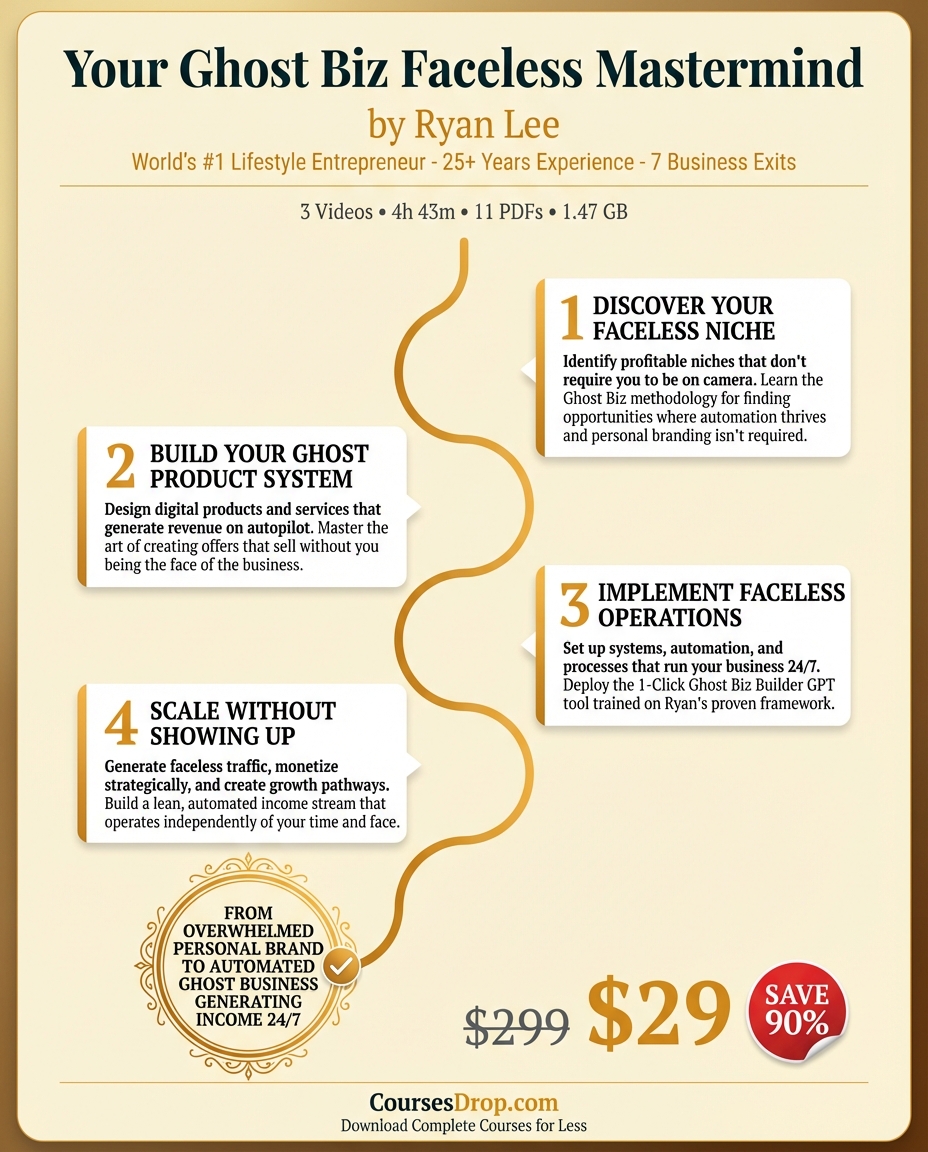
Who This Course Is Actually For
You are the right student for Ghost Biz Faceless Mastermind if you have tried building a personal brand and found it exhausting — the content calendar, the on-camera performance, the vulnerability of tying your income to your public identity — and you want a system that generates real income without any of that.
You are also the right student if you are a beginner who has never built an online business and wants the simplest possible entry point: a systematic framework for launching small, low-risk income projects using tools that already exist, without needing to become a content creator or an expert in a specific domain.
The multi-passionate creative who cannot commit to one niche will find the portfolio mindset liberating. The side hustler with a day job and limited time will find the low-activation-energy project structure practical. The burned-out entrepreneur who has already done the personal brand thing and needs a different model will find the ghost business framing genuinely fresh.
Who Should Skip This Course
If you want to build a personal brand, this course is philosophically misaligned with your goal. Lee's entire framework is built around the premise that personal branding is harder, riskier, and less beginner-appropriate than anonymous portfolio businesses. If you believe your name and face are your competitive advantage, you are in the wrong place.
If you need scaling infrastructure — team management, ad account strategy, advanced funnel architecture, or systems for growing past $5,000 per month per project — this workshop does not address those problems. It is a beginner-to-early-traction system, not a growth-stage playbook.
If you are primarily interested in Amazon KDP, SEO, or paid traffic as your primary growth engine, the gaps noted above are likely to be frustrating rather than acceptable.
If legal and tax guidance is a must-have before you start, you will need to supplement this course with professional advice. The workshop does not treat these as significant topics.
Frequently Asked Questions
Is this a get-rich-quick course?No. The income targets Lee uses as examples are deliberately modest — $200 per month per project, $2,000 per month across ten projects. The argument is that these targets are achievable without the complexity that most business education introduces. There is no promise of passive income from day one or six-figure results from a single product. The pitch is a system, not a shortcut.
Do I need technical skills to implement this?No. The course is built around accessible tools — Gumroad for product listing, custom GPT builder for product creation, and free-to-start platforms for faceless content. If you can use a browser and type a prompt into a chatbot, you have the technical skills required.
Is the Ghost Biz model actually anonymous? Can anyone find out who I am?Lee teaches anonymity as a business design choice, not a legal guarantee. The practical anonymity means no face, no real name in public-facing materials, and no personal reputation at stake. Gumroad and other platforms will have your legal and payment information. This is a marketing and lifestyle choice, not a legal shield.
How does this compare to other faceless business courses?The differentiator is Ryan Lee's background. Twenty-five years of online business experience, six exits, and a track record that predates YouTube and the modern creator economy. The Ghost Business Model is not being taught by someone who figured it out last year. It is being taught by someone who watched the personal brand era rise, recognized its structural limitations, and built a system that removes the dependency.
Does Course To Action have the full breakdown?Yes. The Course To Action breakdown covers every framework across all 3 lessons — the Ghost Business Model, Portfolio Mindset, Three-Level Niche Narrowing, Ghost Product Ladder, 7-11-4 Rule, Ghost Scanner Three-Dimension Scoring, affiliate stacking methodology, and the full live demo analysis. Not a summary. A complete deconstruction. Every summary has an audio version so you can read it or listen. The breakdown is part of a library of 110+ premium courses — access starts free (10 summaries, no credit card required), or $49 for 30 days of full access.
The Verdict
Ryan Lee's Ghost Biz Faceless Mastermind is a beginner business course built by someone with the credentials to back up its central claim: you do not need a personal brand to build real online income. The portfolio approach — many small, anonymous projects instead of one large personal one — is a genuinely different mental model than what most beginner business education teaches, and it is a more honest model for most people's actual risk tolerance and available time.
The frameworks are practical. The niche narrowing system works. The Ghost Product Ladder gives beginners a clear sequence of product types to build in order of complexity. The live demo is the most credible element — not because it shows spectacular results, but because it shows a real process producing real initial results in real time, without polish or hype.
The gaps are real: no SEO, no paid ads, no scaling past early traction, no legal guidance. If you need any of those things, you will need other resources. If you do not — if you want a simple, low-risk, anonymous income system that a beginner can actually implement with a few hours of effort per project — the $299 price point is reasonable for the framework depth Lee delivers.
Buy it if: You are burned out on personal branding or have never wanted to build one, you want a beginner-friendly system for generating portfolio income anonymously, and you are realistic about the target outcomes ($200–$2,000 per month in the near term, not six figures from a single product). Skip it if: You want to build a personal brand, need scaling infrastructure, or require SEO, paid ads, or legal guidance as part of your business education. Before you commit, read the full breakdown on Course To Action. We have the actual course — not the sales page, not a highlight summary. Every framework across all 3 lessons, the live demo analyzed step by step, every gap documented, and an honest map of who the Ghost Biz system serves and where it falls short. Course To Action is the pre-read: the thing you do before you invest, or the thing you do instead.The course costs $299. The full breakdown — plus 110+ other courses — is available on Course To Action. Free account gets you 10 summaries with no credit card required. Full access is $49 for 30 days or $399/year. Every summary includes audio. AI tools let you "Apply to My Business" (3 free credits) or "Generate Action Plan" (10 credits).
Read the Full Ghost Biz Faceless Mastermind Breakdown on Course To ActionSources:
Read the Complete Your Ghost Biz Faceless Mastermind Summary
The course costs $299. The full breakdown is $49/year — for every course on the platform.
Every framework deconstructed, every action step extracted, AI that applies it to your specific business. Read or listen — every summary has audio.
Start free — 10 full summaries, no credit card required