ZenithMind by Rich Schefren Review (2026): Using AI as a Psychological Mirror
Most business courses assume that if you give an entrepreneur the right strategy, revenue follows. ZenithMind opens with a different diagnosis: the strategy is not your problem. You are your problem — specifically, the psychological patterns you cannot see because you are too close to them. And Rich Schefren's argument is that AI, loaded with enough personal context, can surface those patterns with a precision that therapy, journaling, and masterminds rarely achieve.
That is a bold claim. Here is what the program actually delivers.
The Course at a Glance
| Field | Detail |
|---|---|
| Course | ZenithMind |
| Creator | Rich Schefren |
| Price | $1,097 |
| Content | 5 modules / 11 lessons |
| Difficulty | Intermediate |
| Format | Live cohort Zoom calls, slides, demos, group coaching |
| Best For | Entrepreneurs whose primary bottleneck is psychological, business owners wanting AI-powered self-discovery, ChatGPT users seeking deep personalization |
| Requires | ChatGPT Plus ($20/month), 1–6 hours daily in Week 1 |
| Skip If | Looking for marketing, funnels, offers, or traffic strategy |
| Verdict | ★★★★☆ — A genuinely novel framework for using AI as a psychological operating system, with rough edges that Schefren openly acknowledges |
Who Is Rich Schefren?
Before evaluating the curriculum, it is worth understanding why Schefren's opinion on entrepreneur psychology carries weight.
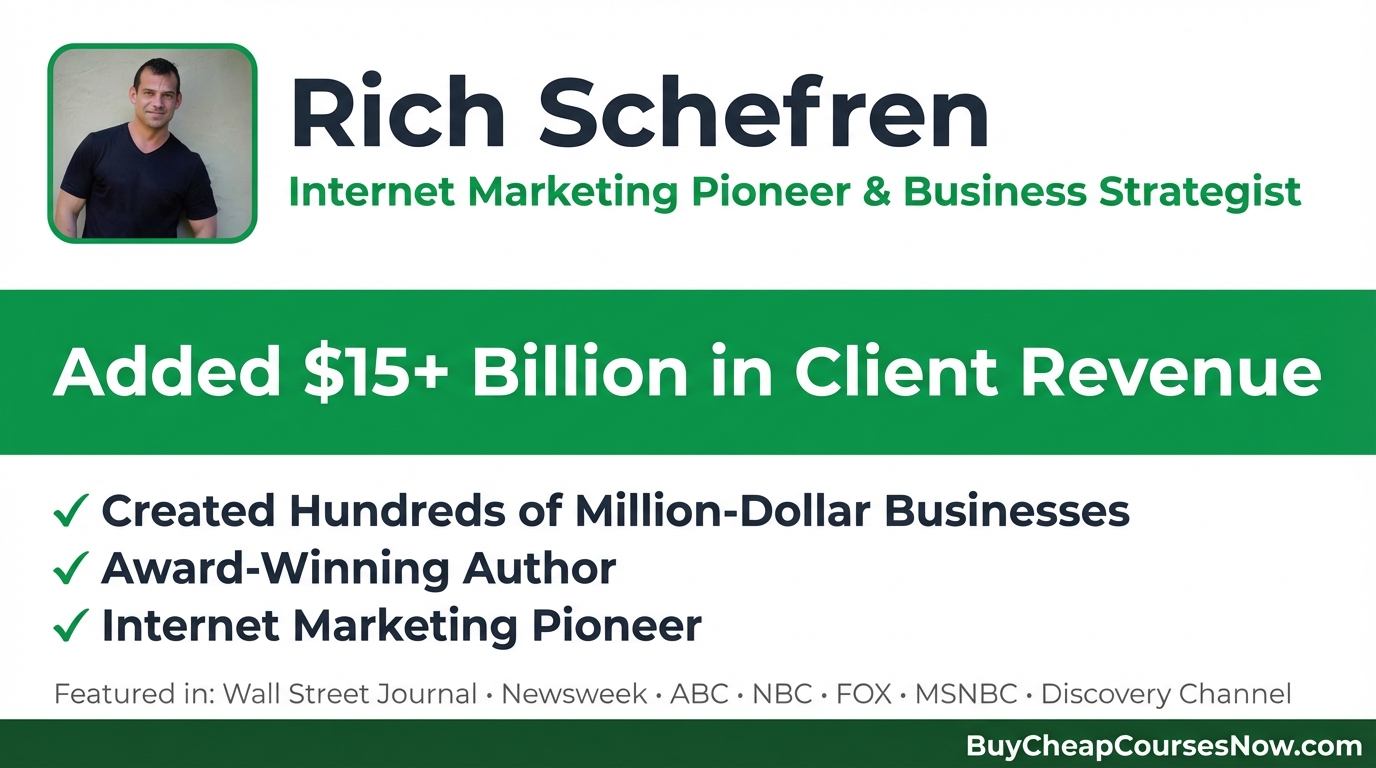
Rich Schefren founded Strategic Profits in 2005 and has since become known in marketing circles as the "guru to the gurus" — the advisor behind the advisors. He personally coached many of the most recognized names in online marketing before they became household names in the space. By his own account and by independent reporting, his clients have collectively added more than $15 billion in revenue across his career.
His reputation is not built on flashy content. It is built on a body of work — most famously the Internet Business Manifesto, which reframed how online entrepreneurs thought about systems and scale — that anticipated trends others were still catching up to. He was among the first to do online coaching at scale. He has been a strategic advisor to some of the top marketers working today.
ZenithMind represents a different direction from his earlier strategy work. It is not about marketing systems. It is about the person running the business — and the invisible psychological architecture that either enables or limits every strategy that person will ever try to implement.
The Core Insight: Your Bottleneck Is Invisible to You
The foundational claim of ZenithMind is borrowed from developmental psychologist Robert Kegan's Subject-Object Theory: the things you are "subject to" — your automatic patterns, assumptions, and emotional reactions — are invisible to you precisely because you are inside them. You cannot examine what you cannot see. The path to growth is making the unconscious conscious: moving your hidden patterns from "subject" to "object," from something that runs you to something you can examine and choose to act on.
This is not a new idea in psychology. What Schefren argues is new is the mechanism: AI.
His claim is that ChatGPT, when loaded with sufficient personal context — your personality assessments, your work history, your stated values, your known self-deceptions, your past decisions and the rationalizations you gave for them — can process all of that self-disclosure simultaneously in a way that no human advisor can. A therapist sees you for 50 minutes a week. A coach sees you for an hour. AI sees everything you have given it, all at once, every time you prompt it.
The result, when the system is configured correctly, is that AI can surface patterns you have been rationalizing past for years. It does not do this with empathy or warmth. It does it with clinical consistency — because it has no investment in protecting your ego, and no fatigue from hearing you explain yourself for the hundredth time.
That precision is the product ZenithMind is selling. The curriculum is the instruction manual for configuring AI to deliver it.
The ZenithMind OS: The 4-Phase Architecture
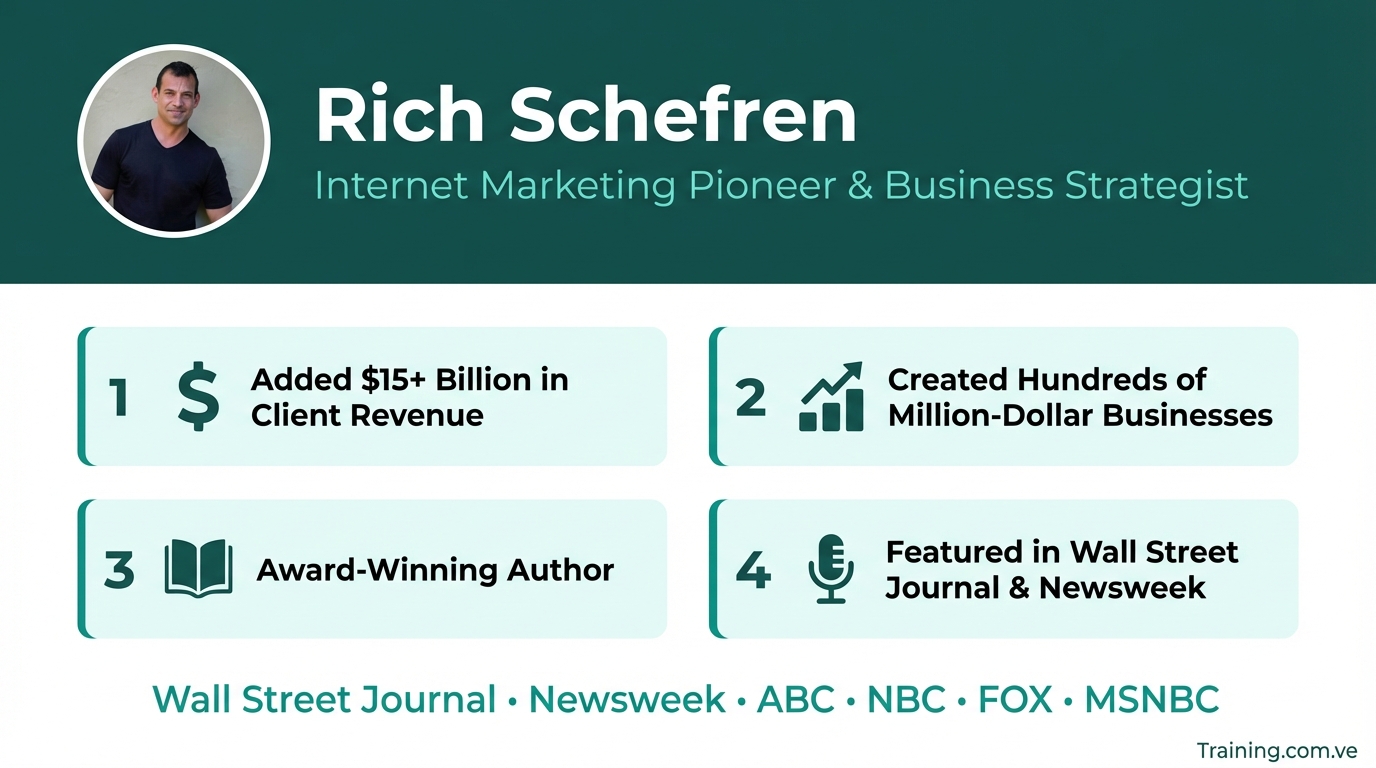
The structural core of the program is what Schefren calls the ZenithMind OS — a four-phase system for progressively deepening the relationship between the entrepreneur and their AI.
Phase 1: AI Knows You (Daily Calibration + God Prompt)
Before AI can challenge your thinking, it needs to understand who you are. Phase 1 is the data-loading phase. The central tool is the God Prompt — a comprehensive prompt architecture that Schefren teaches you to build from your personality assessments, your stated values, your professional history, your known cognitive patterns, and the psychological models that best describe how you operate.
The idea behind the God Prompt is that personality scores — results from assessments like the Enneagram, DISC, Myers-Briggs, or similar instruments — function as compressed memory. Rather than re-explaining yourself to AI in every conversation, the God Prompt pre-loads that context so that AI is already oriented to your specific psychological profile before the first substantive exchange begins.
The Daily Calibration component is the maintenance layer: a ritual for updating the AI's context with what is currently relevant — your current goals, current pressures, current emotional state — so that responses stay grounded in where you actually are rather than a static historical snapshot.
The course also delivers three additional phases: Phase 2 (Omniscient Observer) — a prompt configuration that instructs AI to challenge your rationalizations rather than validate them, applying the Subject-Object Theory to surface patterns you cannot see; Phase 3 (Expander, Mentor Council, Smallest Actions) — tools for pushing thinking beyond existing frames, synthesizing multiple mentor perspectives through AI, and identifying minimum viable behavioral changes; and Phase 4 (AI Executes) — applying self-knowledge to actual business execution via the Business Neural Network Model.
The Coach-the-AI Protocol
Running as a thread through all four phases is what Schefren calls the Coach-the-AI Protocol — a meta-skill about how to interact with AI in a way that produces depth rather than surface responses.
The central principle is that AI trust is not automatic. It needs to be earned through the quality of the context you provide and managed through how you structure the interaction. Schefren teaches AI trust management as a deliberate practice: knowing when to push back on AI responses, how to detect when AI is being agreeable rather than accurate, and how to configure prompts that make comfortable validation structurally harder to produce than honest challenge.
This is arguably one of the most transferable skills in the entire program — and one of the most underappreciated in popular AI discourse, which tends to treat prompt quality as primarily a function of clarity rather than psychological structure.
Get Every Framework from ZenithMind
The course costs $1097. The complete breakdown is $49/year.
Start free — 10 full summaries, no credit card
What It Teaches Exceptionally Well
The God Prompt as an identity architecture exercise is genuinely valuable regardless of AI. The process of assembling a comprehensive self-description — gathering your personality scores, identifying your known patterns, naming your documented self-deceptions — is itself a high-quality introspective exercise. The output happens to be a prompt. The process is something closer to structured self-inventory. The Omniscient Observer reframes what AI is for. Most AI users optimize for AI that helps them do things faster. Schefren optimizes for AI that makes them think better. That reframe — from productivity tool to psychological sparring partner — is not obvious, and the Omniscient Observer gives it operational form. Schefren's transparency about his own discoveries is disarming. The program is taught in a live cohort format where Schefren openly shares patterns he has uncovered about himself through the system he is teaching. This is a meaningful pedagogical choice: it makes the vulnerability the work requires feel like a shared practice rather than something the student is asked to perform alone. The Subject-Object framework gives psychological pattern-surfacing a repeatable structure. Rather than hoping that introspection produces useful insight, the ZenithMind OS gives you a specific mechanism: move the thing from subject to object. That structure makes the process reproducible rather than mood-dependent.What It Doesn't Cover
This is the section no other review will give you. We tell you what the course does NOT cover.
No marketing content whatsoever. ZenithMind does not teach funnels, offers, traffic, copywriting, or any component of business strategy. If your bottleneck is operational or strategic rather than psychological, this program will not address it. Schefren is explicit about this. Some lessons are chat logs only. Not every lesson is a structured video with slides and frameworks. Some consist of annotated AI conversation transcripts. This is a pedagogically interesting choice — it shows the system in practice — but learners expecting fully produced lesson content should know that the format is inconsistent. The program is still being iterated, and prompt bugs exist. Schefren is transparent that ZenithMind is a live product being refined. Known issues with specific prompts have been acknowledged. If you prefer a finished, polished program, this is an early-cohort experience, not a completed course. Week 1 requires 1–6 hours daily. The initial setup phase — building the God Prompt, running the Daily Calibration, configuring the Omniscient Observer — is time-intensive. This is not a passive learning program. The work is the deliverable, and the work takes real time. ChatGPT Plus is a required ongoing cost. The program is built on ChatGPT and requires a paid subscription ($20/month). This is not a dealbreaker but should be factored into the total cost of the program.
Who This Course Is Actually For
You are the right student for ZenithMind if:
You are an entrepreneur who has the strategy but is not executing it — and you suspect (or have been told) that the gap is psychological rather than informational. You know what to do and still don't do it consistently. You have patterns you can name but cannot seem to change. You keep arriving at the same ceilings regardless of which strategy you try next.
You are already a ChatGPT user and want to move significantly beyond productivity use cases. You are interested in AI as a tool for depth rather than speed.
You have enough business context — enough history, enough self-awareness, enough documented experience — to load into a God Prompt. The system gets its leverage from the quality of context you provide. If you are early in your entrepreneurial journey without much self-knowledge to draw from, the inputs will be thin.
You are comfortable with a program that is iterative and somewhat rough-edged, delivered live by a creator who is figuring it out alongside you.
Who Should Skip This Course
If you need marketing, offer design, traffic strategy, or funnel architecture — this program does not address those needs. Come back after you have worked through whatever is constraining your execution, or find a program specifically designed for the operational challenge you are facing.
If you want a polished, finished course with consistent production quality across all lessons, ZenithMind as a live cohort is not that product. Expect variation.
If you are a complete beginner without an existing business context, the program has limited surface area to work with. The psychological pattern-surfacing requires patterns to surface — which requires a track record of decisions, behaviors, and outcomes to examine.
If you are skeptical that your psychological patterns are the primary bottleneck in your business, this program will not convince you. The framework's value is visible only to those who already have reason to believe the diagnosis.
Frequently Asked Questions
Is this a therapy program or a business program?Neither, exactly. It is a structured system for using AI to surface and examine the psychological patterns that show up in your business decisions. It is not clinical therapy. It is also not conventional business strategy. It occupies a specific space between the two.
Do I need any prior AI knowledge?No prior AI expertise is required, but comfort with ChatGPT is helpful. The program teaches the prompt structures you need. Basic familiarity with how chatbots work will reduce the learning curve.
What personality assessments does the program use?The program uses results from assessments you likely already have — Enneagram, DISC, Myers-Briggs, and similar instruments — as inputs for the God Prompt. You are not required to take new assessments, though Schefren recommends having at least one or two on hand before the intensive Week 1 setup.
Is the live cohort format required?The program is delivered through live Zoom calls with group coaching and Q&A. The cohort format is part of the design — shared discovery among participants is a deliberate element. Recordings are typically available, but the live component is where much of the value is generated.
Does Course To Action have the full breakdown?Yes. The Course To Action breakdown covers every framework across all 11 lessons — the full 4-Phase ZenithMind OS Architecture, the God Prompt construction methodology, the Omniscient Observer configuration, the Mentor Council and Expander frameworks, the Smallest Actions system, the Coach-the-AI Protocol, and the Business Neural Network Model. Every component is decoded, not summarized. Every summary has an audio version — read it or listen. The breakdown is part of a library of 110+ premium courses. Free account gives you 10 summaries, no credit card required. Full access is $49 for 30 days. AI tools let you "Apply to My Business" (3 free credits) or "Generate Action Plan" (10 credits).
The Verdict
ZenithMind is a genuinely novel program. It is not the first program to argue that entrepreneur psychology matters more than strategy. But it is likely the first program to build a systematic operational framework for using AI to surface and work with that psychology — and to deliver that framework from someone with Schefren's credibility and track record.
The gaps are real and Schefren is honest about them. Prompt bugs. Chat-log-only lessons. Live-cohort delivery that is iterative by design. Week 1 time demands that will filter out casual learners before they get to the interesting parts. These are not disqualifying, but they are real.
The price — $1,097 — is justified by the framework's novelty and the creator's reputation, not by production polish. If you are paying for a sleek learning experience, look elsewhere. If you are paying for a genuinely new mental model for how to use AI to accelerate personal development and business clarity, ZenithMind delivers that.
Buy it if: You are an entrepreneur whose real bottleneck is psychological, you have enough self-knowledge to load into an AI, and you want a structured system for using ChatGPT to surface the patterns that are costing you the most. Skip it if: You need marketing strategy, prefer finished products over live-cohort iteration, or are early enough in your journey that your primary constraint is knowledge rather than psychology. Before you commit, read the full breakdown on Course To Action. We have the actual course — not the sales page, not the promotional clips. Every framework across all 11 lessons, every prompt architecture decoded, an honest map of what works and where the rough edges are. Course To Action is the pre-read: the thing you do before you invest in a program at this price, or the thing you do instead.The course costs $1,097. The full breakdown — plus 110+ other courses — is available on Course To Action. Free account gets you 10 summaries with no credit card required. Full access is $49 for 30 days or $399/year. Every summary includes audio. AI tools let you "Apply to My Business" (3 free credits) or "Generate Action Plan" (10 credits).
Read the Full ZenithMind Breakdown on Course To ActionSources:
Read the Complete ZenithMind Summary
The course costs $1097. The full breakdown is $49/year — for every course on the platform.
Every framework deconstructed, every action step extracted, AI that applies it to your specific business. Read or listen — every summary has audio.
Start free — 10 full summaries, no credit card required